

Nerdology 101: Querying Update for Harem of the Heavens
Nerdology 101: Querying Update for Harem of the Heavens
Wondering how The Harem of the Heavens is doing? This is the post for you. Full query stats & my own analysis.
Heyyy! So, this weeks topic requires some explanation for those who may not be familiar. Let’s get right into this Nerdology!
What is Harem of the Heavens?
The Harem of the Heavens (a.k.a HOTH) is the first book in a new series I want to write. It’s complete and edited already. Here’s a bit about it.
Vitals:
Word count: 87k
Genre: Romantasy - Mythological Romance
Comps: The Games Gods Play (Abigail Owen), Broken Bonds (J. Bree), The Serpent and the Wings of Night (Carrissa Broadbent), Dark Olympus (Katee Robert). (My personal favorite and the actual inspiration for the book: Record of Ragnarok (anime)).
Tropes: Why Choose/Reverse Harem (using both because it’s a Reverse Harem by premise, but the ultimate result of it turns into a Why Choose since the characters involved end up agreeing on polyfidelity), Trials, Black Cat x Golden Retriever.
More:
HOTH is a mythological romance where 5 warring pantheons have driven themselves to the brink of extinction. The lone survivor of the Mesopotamian pantheon steps in to mediate a treaty and save them from the fate that befell her pantheon. To bind her to her neutrality, the treaty dictates that she must select one god (gender neutral usage) from each pantheon to wed. To select these gods, she will hold a series of trials for each pantheon. In book 1, the Greek pantheon competes.
I’m not telling you which gods or what the other pantheons will be, but my whole goal for this series is to spotlight gods and pantheons who usually aren’t popularized in romantasy and other pop culture media. Thus, even for a pantheon as popular as the Greeks, the gods I chose are probably not the one’s you see featured in other books (HINT: Not Hades!!!!).
Okay, so what’s querying?
I don’t blame you for not knowing if you aren’t an author or industry professional—most people I’ve met who aren’t actively involved with industry don’t know. Querying is the process by which authors present their works to literary agents to seek representation. It’s also the first step to becoming traditionally published.
While I have been a self-published author for a few years now, this series feel different. To some extent, I’ve always wanted to go trad eventually (I love and support indie til the day die. It’s a perfectly valid choice even if you choose to stay indie your whole career. It just stresses my bandwidth more than I can manage effectively and that takes a toll when you’re doing it long term. Even just a few years have taken a toll on me.), but because of how commerical-friendly the premise for this one is, it also rings as something that can be merchandised beautifully by an entity with the funds to back it. My other works weren’t as commercial. So, to produce at that level and fulfill my vision for it, I would need A LOT more money than I can afford to fork out on my own. You know how has a lot more money than I do? Publishing companies. Thus, decision made.
Anyway, here’s what you need to know about querying in order to understand the stats and analysis:
When an author queries a lit agent, they must send -
A query letter containing basic metadata (most of the stuff I listed under “vitals”), a pitch paragraph (something similar to the “more” section, but usually shorter than that. The one I use in query letters is a lot more condensed), and a bio paragraph.
A synopsis (in most cases. Occassionally there’s an agent who won’t request one) containing a full description of the plot, including twists and the ending. Yup, they want ALL the spoilers.
Sample pages (again, in most cases. There’s always a rare agent who literally just wants they query letter). Usually, this is the first 1-3 chapters of a manuscript, it can be more or less though, they’ll let you know what they want on their website and wishlist.
When querying, this is the process -
Send requested materials in batches to several agents (10-15 at a time, typically)
Wait for a reply (varies a lot, but standard is 6-8 weeks)
If rejection, query more agents. If a lot of rejections (less than 10% of queries turning into requests), re-work query letter, synopsis, and opening pages)
If request, send additional pages (they give you an amount. If they want the whole manuscript, that’s a highly coveted full request, if they want some more pages but not the whole thing, that’s a still pretty freakin’ great partial request)
Wait again (varies a lot, but standard is 3 more months)
If rejection, keep querying. If the rejections pile up on full requests, you probably need to edit the manuscript more before you keep querying.
If the agent asks for a call, congrats! They’re considering offering you representation. Have the call. Then, ask for 2 weeks to make a decision. Nudge all other agents you have queries out to and talk to any who want to make offers.
Consider your choices and choose your agent.
Got it. Now, gimmie the details on where you’re at!
Total queries sent: 68
Total replies: 48
Of the replies, total requests: 4
Of the replies, total rejections: 44 (NOTE: I mark queries I make via email (since they aren’t autotracked by QueryTracker) as “closed/no response” FAST because of it keeps my anxiety from fixating on them. So, this number might be distorted by agents who are actually still considering the 23 I did that to.).
Of the requests, total replies: 2
Of the replies to requests, total requests for more material or calls: 0
Of the replies to requests, total rejections: 2
Of the rejections on requests, rejections that came with feedback: 1
Of the rejections on requests, the rejections that came with an offer of referals: 1
Of the rejections on requests, the rejections that came with nothing (otherwise known as a form rejection): 0
Queries still pending: 20
Requests still pending: 2
Numbers. Lot of em’. What do they actually tell you?
Actually, they’re tell me some good stuff. From this, I can determine the following with relative certainty:
My query letter, synopsis, and opening pages are working. No need to revise them.
1 of the 2 people who rejected me after requesting thought other people they knew would like my manuscript enough to make me an offer after reading it. While it wasn’t for that person, this reaffirms that it is commercially viable.
The 1 rejection with feedback tells me that it was a taste mismatch. To start, that agent only requested a partial (50 pages) and her feedback was that she wanted more backstory in the opening chapters. People who requested the full obviously read the same chapters and felt differently. That has nothing to do with my writing and isn’t a manuscript issue. Unless multiple people give similar feedback, it’s best not to take stuff like this to heart. The industry is subjective.
The 2 pending requests are both fulls. I probably still have a good shot with those agents because they haven’t said no yet.
I have referrals coming. I don’t know to who or when. It might be a minute before she actually sends them, but that’s good.
That’s all great. Do you think you’ll get an offer?
The reality: I don’t know. Maybe. Hopefully. Perhaps even probably, in time, since these stats are so good.
My hunch: Yes, absolutely. It could be tomorrow. It could be in a year. There’s no way of knowing when, but I do think this manuscript will be the one to get me an offer.
That’s about all for this week though! Hopefully you learned a bit about querying and got a little excited for my future works. Check back next week for more Nerdology 101. In the meantime, have a nerdy week!
Nerdology 101: Mythology
Nerdology 101 Topic Reveal
Post Date: 9/11/2026
Topic: Mythology 101
Annddd, we're back on track with next week's topic reveal coming the Saturday before (instead of the day before) like it should.
Have you ever wanted to learn more about mythology, but didn't know where to start? Let's talk about it! For my next post, I'm going to be giving the curious-minded a few great resources to start learning about mythology. Come by and check it out!
Hey everyone! Welcome back to Nerdology 101, the bookish blog fulfilling all your nerdiest desires. Have you ever wanted to learn more about mythology, but felt clueless on where to start? If so, you’re in exactly the right place. Mythology is such a vast subject that covers many different cultures and time periods—modern and ancient alike. It can feel like you’re being pulled in every direction if you don’t have a clear starting point. Even if you do have one, understanding the structures and archetypes that we see appear in multiple cultures over and over is a critical part of being able to not just understand an isolated pantheon, but understand the relationships pantheons have with each other and the relevant historical context that allowed the archetypes to appear in so many different places across time. So, let’s talk about the starting point that comes before the actual mythology first.
The Writer's Journey: Mythic Structure for Writers
This is likely the absolute best place to start understand the archetypes of mythology. Whether you’re a writer or not, mythology and religion as a whole is ultimately always going to be a story one generation passes to the next by teaching them that same story. Mythic structure is the foundation for so much of our understanding of character development, mythology, and more. Since the dawn of time, we’ve seen the story of the gods told in so many ways across so many cultures, languages, periods, and contexts. But, many of them have these reoccuring themes and strikingly similar gods. This book will help you understand a bit about why these stories rely so heavily on those roles being filled.
The Ancient Egyptian Book of Thoth & The Hermetica
I say to do these two books next because they are going to help you understand how one god can evolve when real people from different cultures meet. What one has intrigues the other and next thing you know, they’re carrying their new knowledge back home. The story catches on, they adopt it to their tongue, and next thing you know, a new god exists. Also, these books are foundational to understanding three major pantheons: The Egyptian, Greek, and Roman mythologies are all connected strongly to what you’ll learn here. Why? Because history. Greco-Roman, Hellonism, etc. The Greeks went to Egypt, brought stories back when them, the Greeks interacted with Rome, etc. Think of it like the way a cold spreads from person to person until next thing you know, everyone has it. Except, in this case they were spreading gods. Therefore, these three cultures, and every culture they touched, and so on, are bound to have this connection.
Chinese Mythology (Library of the World's Myths and Legends) & Buddhist Myths: Cosmology, Tales and Legends
Just like the last two, these two are going to help you with a foundational understanding of another chunk of the world’s mythology. China, historically, was a very massive, very powerful empire that did a lot of invasions on it’s neighbors. So, if you want to understand other Asian mythology’s like Japanese mythology an Shintoism, Korean, Vietnamese, etc., understanding China helps give you context you wouldn’t otherwise have.
Keep applying that concept
That’s right. When you’re done, read up on Mesopotamian mythology because it’s going to affect a lot of what happens in Southwest Asian mythologies. Read on Aztec, Inca, and so on. Learn about different indiginous tribal beliefs.
Be Respectful
Most of these cultures, aren’t extinct. Many of the mythologies here aren’t even extinct. There is absolutely no reason you should be studying their beliefs while ignoring their existence. Make sure you pay attention. A lot of the more accessible books are whitewashed in some way, shape, or form. There’s no avoiding that because colonialism requires pretty much any mass-produced text petaining to non-white cultures and beliefs to be whitewashed in some way. Cross-reference them with information coming directly from the people when you can.
Don’t be afraid to challenge the modern mythologies
All religions are mythology. I make no distinction between the two because I am not religious. I STRONGLY encourage you to treat it as such and learn more about it’s evolution through texts like Christian Mythology: Revelations of Pagan Origins and The Christian Myth: Origins, Logic, and Legacy. You’ll never truly understand mythology if you aren’t willing to learn things that may or may not make you uncomfortable as fuck. Around here, though, we don’t ignore information just because it doesn’t suit our beliefs. That’s not my nerdy way (the Naruto reference was there, I couldn’t help it, leave me aloneee).
Anyway, that’s about it for this segment of Nerdology 101. Stop back next Friday for another. Until then, have yourself a nerdy week!
Nerdology 101: Patience
Nerdology 101 topic reveal!
Post date: 9/4/2026
Topic: Patience
Heyy, loves. Sorry this is so late. I have an insanely slow recovery time and just now got up the energy necessary to assess the blog post for tomorrow after my trip to FL. So, here's our topic: Patience. You know? That thing authors of any kind need desperately but are always on the verge of running out of. More specifically, I want to talk about all the different circumstances in which patience is necessary as an author. There's some pretty interesting ways that it comes up and I think it'll be a fun topic, so drop by tomorrow to read all about it.
Hey loves, welcome back to Nerdology 101. This week I wanted to chat a little about how patience comes into play for authors of all kinds.
Misconceptions
I frequently see people talk about self-publishing like a short cut, but that is far from the case. Self-publishing is a career decision, but the truth is, it requires just as much patience as trad. It’s not a way to circumvent the query queue or avoid the pain of rejections. It’s just taking a different road. Self-publishers, like myself, have to wait on editing, wait on social media to discover us to make any money, send out applications and wait on answers from bookstores and conventions in order to get spaces that default to trad authors. All of these things take an insane amount of time—and I say that as an author who does hope to go trad one day soon. My reason for switching up doesn’t have to do with thinking either option requires more or less patience, or is anymore valid than the other. It has to do with the fact that I think trying to produce the new series I’m starting without more support would negatively impact my mental health and right now, I can’t afford to hire the level of support I would need without running the risk of hurting the quality of production. Whereas with the series I’ve already established, self-publishing didn’t have any negative impacts because it was just different. Different series come with different needs and visions. Deciding to self-publish something should mean you’ve decided it’s something you’re capable of producing to the quality standards and vision you have for it—not that you’re just too patient to wait on the trad industry to go through it’s process.
Secondly, I’d like to say that contrary to popular belief, self or trad published, agents WANT you to succeed as an author. Of course, there are exception, but I’ve had interaction with enough agents to know that most of them care deeply about authors and that there are even times where they reject a manuscript because they love it and think it deserves someone who can better represent it (more time, more clear vision, etc.). Yup, turns out most of them are just people doing something they love while trying to make sure they do right by all parties involved—including the author and themselves. The process is slow, but that’s because it’s human. For as much as the bookish community loathes AI, one would think we’d appreciate seeing signs of life a little more. I, for one, am glad when a reply takes a bit of time because no matter what the answer is, I feel substantially more confident that a human looked at my work and gave it thorough consideration than if a reply came in a few seconds.
Patience in Trad
Many people seem to forget that publishing is a waiting game. Waiting for a market to swing your way, waiting for an agent to reply to a query, then waiting for them to reply for a full, waiting for editiorial notes, waiting for publishers to answer once you’re on sub, waiting for cover design and blah, blah, blah. You’ll always be waiting for something. It’s highly unlikely that you sign a trad deal and instantly become that publishers first priority. If you do, that’s probably a huge red flag because I have no doubt every other author signed to them had things going on before you got there. If they drop all those people for you, won’t they eventually drop you for the next shiny, new author who comes along? Now, naturally, publishers will always put more into the people they think will bring in the most money, but the simple fact of the matter is that if they think you’ll rake in that much, that’s even more reason for them to slow down. Slow down so you don’t conflict with other big releases, slow down so they can put more time and money into design and marketing, slow down because mishandling the next bestseller could very well stop it from becoming the next bestseller.
Patience in Indie
Here’s the kicker, you can absolutely rush to print as an indie author. No one can tell you no. In fact, the first time around most authors make this mistake. I know I did. In all likelihood, though, the book will flop if you do that. The editing will be poor, the design will be poor, the marketing will be totally skipped over because you wouldn’t have had time to do it. You will almost certainly be doing yourself a disservice.
A self-published book should be going through every single step a trad published one does. You need developmental editing, line editing, copyediting, proofreading, typography, cover design, art design for any character art or map you want inside, file prep, marketing, and so on. If you skip any step, it’s likely to cost you. So, yeah, be patient and do the work. Then, keep being patient because most of the time, you’ll do that 3-5 times with 3-5 books as an indie author before you start gaining traction. The truth is, though, most indie authors will give up long before that happens. They’ll give up in the first year most likely. They’ll realize they’re hermeraging money, cut their losses, and move on. I hate to say it, but self-publishers do kind of have to suffer for their art. I’m sure trad authors do too in ways I’ve yet to discover because I’m not trad yet. There is no easy road in this industry. No fast road either. No matter what you do, you should expect it to take an excrutiating amount of time and energy, quite possibly money too because not every trad deal comes with a marketing budget the size of Saturn. Most people don’t even get Pluto and if you want to make it, you might have to take the difference out of your own pocket.
Post Publishing
Nikki St. Crowe was publishing for 20 years before Never King caught on. She didn’t stop. She kept going. If she hadn’t, she wouldn’t have written the book/series that made her a USA Today Bestselling Author. Tolkien was dead before LOTR caught on. A ton of authors have experienced this. I’ve seen people say that BookTok put an end to stuff like that and it won’t happen anymore, but I assure you it will. There are so many authors on BookTok. Readers are seeing so many book recs all the time and I’m sure it becomes easy for them to tune out the vast majority of them. So, it’s not even just possible, it’s probable that BookTok has scrolled past something that someone some day will stumble upon and next thing you know it’ll be huge. The accessibility of the internet is a double edge sword. Because so many people can reach readers, readers are seeing more things. They’re people and only have so many hours in a day. The more they see, the more selective they have to be about where they spend time and money. So, yes, you do probably have to wait post-publishing. You have to be willing to wait for your success even as you pursue it relentlessly because usually, it takes time.
That’s about it for this weeks segment of Nerdology 101. Hopefully you learned something. See you back next Friday for whatever I’ll be posting then (I’ll make sure I write it Saturday and get the topic reveals back on schedule.). Until then, have yourself a nerdy week!
Nerdology 101: First 150 Days
Nerdology 101 Topic Reveal
Post Date: 8/28/2026 at 3 PM EST
Topic: First 150 Days
Next week will mark 150 days since my newest book, The Fate of Angels and Demons, came out. Friday will actually be 149, but close enough, especially since I'll be at a book signing in Orlando on day 150.
Anyway, I wanted to do a little celebratory post to discuss the landmarks I've hit since release (as well as those I'm still aiming for).
For those who are seeing me for the first time, The Fate of Angels and Demons is a dark romantasy book about a priestess who falls in love with the demon him fated to kill her family. It runs about 388 pages, is super spicy, and explores the complexities of trauma, resentment, and family ties.
The book is available widely. You can find the ebook (.99¢) and paperback ($20) at most retail websites including Bookshop, Amazon, Barnes and Noble, and more. Some libraries might also have it available on Libby and Hoopla. The special edition ($30), however, is a lot more limited as to where it can be bought. To find it, please see my website. Additionally, the paperback is discounted on my website, something I offer for those buying direct because it's a bit cheaper for me since I'm not splitting profits with other places.
You can find all these links and more on my page! I hope you'll check it out and that you'll stop by Nerdology 101 next week to see the post.
Oh my Goddesses! It’s already been 150 days since The Fate of Angels and Demons came out. This is awesome! I’m excited. Honestly, I didn’t even realize how long it had been until I started thinking about this week’s topic. It’s awesome that it falls where it does too since I’ll technically be in Orlando, FL doing a book signing at The New Romantics on the 150th day (I write these posts about a week before they actually release because it helps me make sure I can get them out on schedule. Seems to be working because I haven’t missed a post since this blog started in October of last year.). Anyway, sidebar aside, let’s get into some Nerdology!
What’s so special about 150 days?
A lot! It’s a huge post-release landmark in a lot of ways. 150 days is enough time to accurately measure how a book is doing. Early indicators usually are the most accurate when it comes to indie/self-published works, unlike with trad published books where early sales are some of the highest indicators. This is because of simple math. Most of the big name trad authors that come to your mind when you think of trad publishing are reaching the majority of their audience off the bat, meaning that early indicators are probably gather metrics from most of their established audience. The same doesn’t apply to indies. Even if a book isn’t doing wonderfully out of the gate, for indies, that probably doesn’t cover very much of their target audience because they usually haven’t already found said audience. So, every time they post or run ads, they’re likely being introduced to an entirely new group of people. Thus, long term indicators are probably a much better way to ensure accurate measurement, especially since indie books have a habit of doing a 180 when least expected.
What do the long term indicators say about your book?
Well, I’d say the heartbeat is steady but that it doesn’t necessarily mean we’re out of the woods yet. I see the growth, the slow upticks in engagement (specifically on TT this week), the interest from more and more events and bookstores, and even the slow addition of reviews. The efforts of me and my PA are producing some results, however slowly that might be happening. Here’s a more in-depth summary:
Social Media:
Since April 1st (the release date of The Fate of Angels and Demons) my TikTok metrics have been 14.8k views (375.4% increase), 104 profile views (205.9% increase), 360 likes (291.3% increase), 49 comments (1125% increase), and 89 shares (368.4% increase). Those are pretty huge leaps and bounds, but lets put them in perspective by also going over just the metrics of the last 7 days. 1.5k views (109% increase), 11 profile views (450% increase, also like 1/10th of the total profile views since April), 32 likes (45.5% increase), 3 comments (100% increase, had not the week prior), 7 shares (100% increase, had none the week prior). From this, you can see pretty clearly that the majority of this growth is coming more recently. All in all, I’m up 54 followers on TikTok since April 1st 86.2% increase).
On Instagram, the growth is even slower. It only shows the insights from up to 90 days ago, meaning this is doesn’t go all the way back to April 1st, but in my net followers I see that I’m up by 9 and 71.2% of my views are coming from non-followers, as is 43% of my engagement. The totals are 9419 views, 279 interactions, 452 followers. It’s by no means a boom, but it is a slow, hard earned growth.
Sales:
This is going great. Just this week, I heard from another bookstore in my local area wanting to set up a meeting with me to talk about stocking my book. This one came from a referral. My best friend’s cousin stopped by their store and saw that they work with indies, so she told my best friend and my best friend told me. I reached out; they responded. Yay!
I also had to turn down an event for the first time. It was one I had been waitlisted for. They reached out to me due to some cancellations and asked if I could come, but I had already filled the space with another event on the same date in a different state, so I had to turn it down. This is growth because this year is the first year, and the first book, where I’ve had a pretty full schedule and am able to start working on events for the next year ahead of time. It does also mean more sales.
Of course, most of those haven’t happened yet (next week, Sept, Oct), so I can’t give results quite yet. What I can do, though, is tell you what I have sold—and that, my loves, is more than DOUBLE what I had sold this time last year. The Fate of Angels and Demons has MORE. THAN. DOUBLED. the sales I saw from Journey to Rallem.
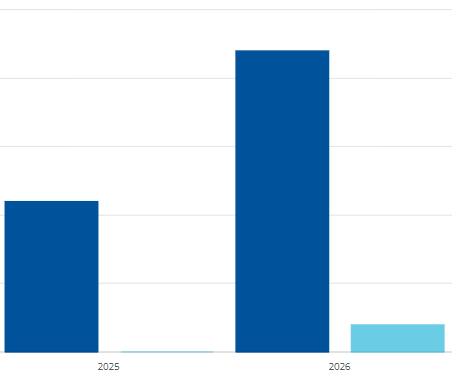
Year-to-Date Sales (2026) vs. Last Year-to-Date Sales (2025). Paperback sales are depicted in dark blue while ebook sales are depicted in light blue. Screenshot from my IngramSpark Dashboard. Special edition sales are not included, nor are in person sales, direct sales, or website sales. This dashboard only counts sales reported from retailers to IngramSpark. Including sales counts from other sources adds an additional 12-ish? copies.
Needless to say, that is awesome. I don’t think there is a better example of why long term indicators are better for gearing the growth of an indie author. For all the struggling and feeling like I’m getting nowhere, this number makes it abundantly clear that I am. I couldn’t be happier. So, thank you, dear readers, as well as my team and the wonderful people who helped me do this. You nerdy weirdos are the best.
That is all I have for this week, though. Check back with me again next week for the next segment of Nerdology 101. Until then, have a nerdy week!
Nerdology 101: Identity & Writing
Nerdology 101 Topic Reveal
Post Fate: 8/21/2026 at 3PM (Next Friday)
Topic: Identity and Writing
This week's Nerdology 101 will be exploring identity and writing. As a mixed person, I can tell you that being mixed is a weird and complex experience in the best of circumstances (but ultimately one I wouldn't trade for the world). This week, though, I want to talk a bit about how that manifests FOR ME as it applies to my authorhood, as well as some other aspects of my identity that I've seen come up in complicated ways throughout my journey as a writer.
The nerds have returned! Welcome back to Nerdology 101. I’m super excited for this weeks topic as it is, of course, one that is very personal to me. This week, I’ll be sharing with you my own experiences regarding identity and writing. Strap in because this is going to be a long post.
Why this topic?
Writing forces you to sit with the truth of who you are in some of the most unexpected ways. Even in the most fictioniest of fiction, it holds up a mirror that you can’t shy away from if you want to write something good. So, I chose this topic because right now, I feel like looking into that reflection and sharing it with my audience is a necessary thing to do. This blog is the best way to do that because it’s definitely NOT a topic designed for short-form content.
Why now?
Because when I sat down at my computer to write a blog post, this is the topic I felt drawn to. On the surface, there probably isn’t a profound reason I’m choosing to do it now. Though, on a more profound level, I think the context of my life, position as a writer, and the world in general is likely why the topic was drawing me in.
What are you mixed with?
In this instance, I am CHOOSING to share specifics because I feel that it’s relevant. Please remember, though, that in general, you aren’t owed answers to this questions or questions like it—and that “what are you?” is NOT an appropriate way to ask the question. If asked in that format, I will almost always say “your worst nightmare” (shout out to Mushu for that one).
Anyway, the simplified answer is Italian and Black. Anything else would be distant and unsubstantial to my identity and experience. I do say it in that order because it’s roughly a 75/25 split.
Being Mixed in General
So, a common issue for mixed people is that you exist outside of societal context. There’s never a clear space for you. In a lot of cases, this triggers a series of back-to-back identity crises that really isn’t healthy on any level. I experienced identity crises like this all throughout my childhood and teenage years. For the most part now, I have sorted that out internally (despite the worlds best efforts to make that impossible), but that doesn’t mean it doesn’t still come up on occassion. It just means I know how to work through the internal chaos it triggers in a way that allows my identity to remain in tact, rather than being called into question by someone else’s lack of education.
Okay, so how does that carry over to your writing?
Well, for starters, the entire angel vs. demon plotline experiments with race. The demons are an obviously oppressed group with dark skin. The angels are group of people with light skin being used as weapons to uphold the oppression of demons. The gods are the ones who misinformed the angels in such a way that made the demons seem bad, thereby turning them into weapons of oppression, because it maintained the power of the gods. There’s a lot of specific context where I ask the reader to question how wrong the demons can really be for reacting to their oppression in ways that are frowned upon by other characters, as well as context where I highlight the fact that the angels being misinformed doesn’t automatically absolve them of harm they perpetuated once they know better, yet I still make it clear that these systems where created and designed by the gods who should ultimately be blamed for it. Now, there’s a lot of obvious real-world metaphor for race in that, but that’s not the only context in which race comes up for me as a writer.
There’s also the community aspect. Most readers at this point have heard the terms Booktok, Bookstagram, and even Booksky for Bluesky users. But, did you know there’s also online Black communities that focus on Black authors and readers—like Black Booktok, Black Bookstagram, and Black Booksky. Let me be abundantly clear about something before I continue: BLACK PEOPLE HAVE EVERY RIGHT TO WANT A SPACE WITHIN THE BOOKISH COMMUNITY SPECIFIC TO THEM. It’s actually out of respect for that space that I don’t use the language, tags, or keywords specific to these communities. My experience will never be equivalent to that of someone with darker skin. I am a light-skinned Mixed woman who could be white passing if she tried and is frequently mistaken for various kinds of Hispanic (I’ve heard Columbian, Mexican, Puerto Rican, everything under the sun.).
Here’s the point, though: There isn’t really a space specific to Mixed people in the book community. Just now, I pulled up IG on my phone and went like I was going to post. When I put in #MixedBooktok and #MixedBookstagram, nothing came up. When I put in #MixedAuthor, there were 272 uses of the hashtag. In contrast, #Booksta has 4,142,080 uses and #BlackBookstagram has 359,954. Now, I do use Booksta and BookTok tags and keywords, but that comes with it’s own challenges. It means that most frequently my books are being introduced to people that don’t specifically connect with the themes I’m writing. The odds of finding my audience are reduced dramatically in that context. What is already a highly saturated space where it’s difficult for an indie author to find their footing becomes an even steeper hill when you’re unable to direct content in a way that connects with the group who would be most invested in seeing a voice like yours thrive.
This isn’t anyone’s fault. My books can certainly be read by anyone of any race and I’m happy to have those readers too. It’s just the way these platforms work. Algorithms run by AI are probably not able to pick up on these nuances and therefore probably can’t send your books to the audience looking for them. Also, because these are short-form content platforms that only push popular content, anything made with the goal of connecting with a sub-audience that isn’t already established ends up being deemed irrelevant.
This sort of erasure is something I often see people hesitant to act on too. It doesn’t come off as malicious to me (most of the time). Rather, it comes from the question “who is this book for?” most of the time. We already have such a hard line in place. There’s been issues where white people who read about mythical creatures and can relate to them have said they can’t relate to Black characters. There’s also Black people who exclusively seek out books by Black authors because they know their community is that authors best chance at thriving—which is fair because Black authors are being pushed out of spaces dominated by white readers regularly. The clear division, though, leaves a limbo where Mixed people exist. Neither group is specifically seeking books by Mixed people. Mixed people usually aren’t even seeking out books by Mixed people because so many of us have been conditioned to feel like we have to “choose a side” often either go one way or the other.
For example, I say, “I’m Italian and Black” and a white person argues with me about how my Black family isn’t even fully Black because my several times great grandmother was Cherokee (we can’t even confirm that in any real way) and someone else generations ago was Irish and blah, blah, blah. Or, I say “I’m Italian and Black” and a Black person starts talking about the 1 percent rule and whether a kid is their mother or fathers race legally and so on—which are valid conversations about the history of race as a construct, how little it’s connected to one’s genetics, and how it’s been legal definition has been so erratic based on what is most convenient for racists at a particular moment—but ultimately does cause some pressure to identify in a certain way when these topics that come up every time a Mixed person mentions that they’re Mixed.
Thus, a lot Mixed people identify more strongly with one aspect of their racial identity than the other and are more likely to seek out books related to the aspect of their identity they identify with because of it. For me, that has always been the Black side because of the fact that I was almost entirely raised with and by my Black family and lived in primarily Black communities where I spent most of my time with Black people. This doesn’t have any impact on my ethnicity, but does greatly impact my racial identity because, as we should all know, race is a social construct that’s comprised of many factors including but not limited to ethnicity, culture, socialization, etc.
All of this is to say, these are things I’ve experienced and topics that have come up for me related to my race as a Mixed author. I’m sharing it based on what I’ve observed and how I percieve the overall bookish space. By sharing these experiences, I hope to create a space where other Mixed people (or literally any other POC) who wants to can share their own. Ultimately, these are all manifestations of a systemically racist society, which infects all spaces within said society, creating issues like this for all people of color. The book space did not create these issues, but they exist nonetheless and I think it’s important that all people of color are able to share the ways racism manifests for them in spaces they occupy.
Other Aspects of my Identity
I make no secret of the fact that intersectionality is a core value to me. For me, that value stems from a place of experience. In my life, I have experienced the crap end of a lot of issues including homophobia, bi+phobia, sexism, issues around mental illness, etc. While race was the primary topic I wanted to talk about today, I did want to add here that these are important issues to discuss as well. I’d like to address them more deeply in the future, but for now I’ll leave you with this:
Through it all, I love being an author more than anything. I adore the bookish community, but I believe there are many ways the community and industry need to grow in order for more diverse voices to thrive within it. Have the uncomfortable conversation. Read books by people who’s voices you don’t often listen to. Engage with content made by people who are different than you are. Support the people who need it. Even if it’s not me, find someone who might not see a clear space where they fit into this community and do something that amplifies their voice.
That’s all for this week’s segment of Nerdology 101. I hope you learned something. Check back again next week for another post. Until then, have a nerdy week!
Nerdology 101: Bookish Gods
Nerdology 101 Topic Reveal
Post Date: 8/14/2026 at 3PM EST
Topic: Bookish Gods
Yup, that's right! Mythology is full of gods who love to read and write. Next week on Nerdology 101, I'll be going over some of my favorite bookish gods.
Nerdsssss! Tehe, you totally just clicked on a post to find out which gods were also nerds. Welcome back to Nerdology 101, and if you’re new here, simply welcome. I’m Maria Levato, indie author & host of this here blog. If you’re wondering what my qualifications are: I’m a book nerd, writing nerd, anime nerd, mythology nerd, kink nerd, and nerd nerd, so listen up!
What qualifies as a “Bookish God”?
I’m qualifying this as gods who created writing in their respective culture, gods of knowledge or wisdom, or gods known to be patrons of the arts or literature specifically.
Thoth
Helloooo. This one is so obvious. Not only is Thoth credited with the creation of writing (yes, heiroglyphs were a form of writing) in Egyptian Mythology, he’s also a god of knowledge known to be a patron of art and literature. He checks every box. He’s also an insanely important god when it comes to this subject because like us, our stories evolve with time and context. Thoth also evolved. I’d describe him as the spark that lit the flame that led to gods like Hermes, Mercury, and more.
Hermes and the Hermetic line
No, Hermes wasn’t just a trickster or speedster. Hermes is credited with the creation of writing in Greek mythology and is strongly associated with Hermes Trismegistus (we believe this person to be a mythical fusion of Thoth and Hermes, you really can’t learn about one of these mythologies without learning about both. They’re too intertwined.), who didn’t actually exist and is still the credited author of numerous works. That’s a bookish god.
Mercury
Mercury is said to have created writing in Roman Mythology (yup, it’s a running theme. Every mythology sees it as their gods who did it. In truth, they’re probably all right and all wrong since these gods are essentially the same god being reiterated across cultures and languages, but are also obviously mythological. We have no actual idea where or when writing was created, though our best lead is either somewhere on the continent of Africa or South Asia where the oldest civilizations we can date actually were). Anyway, I don’t know as much about roman mythology as I do Greek and Egyptian, so while Mercury is strong associated with writing, I can’t delve much further into that without the risk of spreading misinformation. The other 2 mythologies I’ve been reading on for years and I can speak on those more confidently.
Seshat
Seshat is another Egyptian God. Her and Thoth had a strong relation, though the nature of that relation is debated. Either way, she is known to be associated with writing, record keeping, knowledge, and more. She’s proof that we’ve always known librarians were badass (Love you, librarians). The Egyptians cared deeply about storytelling and records.
Nisaba
Nisaba was a Sumerian goddess (Mesopotamia, cuneiform was how they wrote, think of it like an older version of heiroglyphs.). She’s a goddess of writing. Funny thing, she actually started out as a Grain Goddess and evolved to become associated with writing. When cuneiform grew in popularity, she seems to have boomed alongside it. She had libraries and scribal houses she was associated. You can learn more about her here. I do think if you’re going to study more on any of the gods here, this is probably the one you should look into first. Out of all the ones I’ve listed, she is obviously the oldest and learning more about her will lead any nerd down a brilliant rabbit hole. When you’re up at 3am nerding out, remember to thank me by engaging with my content here or on social media.
That’s about all I have for this segment of Nerdology 101. I got The Depths of Bloodshed and Purgatory (one of my WIPs) back from line editing the day before I wrote this and I’m eager to get started on it! I’ll see you back next week for the next segment of Nerdology 101. Until then, have a nerdy week.
Nerdology 101: Upcoming Changes
Nerdology 101 Topic Reveal
Post date 8/7/2026 3PM (I got the date right this time!)
Topic: Upcoming Changes
We are coming up on my yearly site & social update. Join me on my blog, Nerdology 101, to find out what this indie author has in store for you.
Hey, hey! Welcome back to Nerdology 101. It’s August and, if you’ve been following me for a while, you probably know I do a yearly revamp of my website and socials each year. This post will be all about my planned changes so you, my beloved nerds, know exactly what to expect from me in the year to come.
When will changes start?
On September 1st. It’s about 3 weeks ahead of my first fall book con for the year, Love Among the Pages, and should give me the time I need to get them done before that. I’ll focus on the website changes first and the social media changes will be implemented after my site updates are complete. Beginning on Sept. 1st, I’ll do the renovations at night between 9-11PM EST, so you may have trouble accessing the site during those hours.
What changes are the site undergoing?
Well, let me start off by saying Nerdology 101 will be staying exactly where it is. These won’t be major changes. Instead, they’ll mostly focus on SEO and appearance. These changes may not seem substantial from the front end, but on the back end they’re vital to begin shifting focus away from my most recent book release, The Fate of Angels and Demons, and toward the next one, which will be release in 2026 (when in 2026 is still hush hush for now. Sorry, not sorry).
Readers can expect these types of changes to manifest in the form of bio updates, featured title updates, reorganization of vital material (the author, books, reviews and store pages), and some branding updates.
What changes will social media be undergoing?
Nothing all that deep. There will be some template updates for the base graphic I use for carosel style posts and some new pins, as well as a ton of archived posts that are no longer serving my advancement be being up there.
What book is being released in 2026 that you want to shift focus to?
The Depths of Bloodshed and Purgatory is the release—I can tell you that much, at least. The Harem of the Heavens is still a long way off from it’s release because it is starting a new series and I need to make the major decisions about how I want to proceed with that one first. Readers shouldn’t expect to see anything major around that for quite some time still.
As for The Depths of Bloodshed and Purgatory, it’s in the same Islands of Rune universe I’ve been writing in since my first book. The series is one of interconnected standalones following different characters in that primary group. This one will focus on Callian, the half-angel younger brother of the FMC from the previous book, Lilly, but that’s all I can really tell you about it for the moment. But, as you may have guessed, more information will start rolling out after these site and social updates.
What can the general public do to support you throughout these changes?
If readers want to throw some support my way, there’s a few ways you can do that. Starting with the most obvious one: Order my books. The Fate of Angels and Demons is on this website. All of them are on major retail sites. You can find all the different purchase options on my linktree. They’re also on BookVault Shop, Beventi Wholesale, Ingram, some independent bookstores, Hoopla, Libby, and more. I encourage readers to choose whatever works best for them.
Beyond just ordering, reviewing the book on Goodreads, posting about it on social media, and engaging with my content are all super helpful steps to take. Even just commenting on this blog post or liking some of my social media posts can go a long way in helping me reach more people. Engagement is everything on the internet.
Other helpful steps:
Asking your local bookstore or library if they have my book. Even if they don’t, you asking for it could put it on their radar.
Saving my site content to your Pintrest board.
Using the appropriate forms to tell me what kind of content you’d like to see next here on Nerdology 101 or on my social media.
No matter what you do or don’t do to help me out though, please know that your support in any form means the world to me. Thank you so much. That’s about all for this week’s Nerdology 101 post. I hope to see you back next Friday for yet another segment, but until then, have a nerdy week!
Nerdology 101: High Stakes and Immortality
Nerdology 101 Topic Reveal
Post date: 8/8/2026 at 3PM EST
Topic: High stakes and Immortality
How do you balance creating high stakes with having immortal characters (such as gods)? If they can't die, how will it ever feel like they're truly in danger? These are questions many fantasy writers have had to reckon with and next week, Nerdology 101 is going to be posting about it. Join me for a glimpse into how it can be made to work.
NERDSSSSS! Welcome back to Nerdology 101. As most of you probably know by now, I’m Maria Levato, indie author, blog writer, anime nerd, and all around weirdo. Recently, I’ve been working on a manuscript titled Harem of the Heavens (HOTH). HOTH deals with gods, naturally, and so I have had to deal a lot with this weeks topic. When writing a fantasy or romantasy, how do you balance immortal characters with high stakes? Are the stakes ever really high if the characters can’t die? The short answer: The stakes are absolutely high. Follow along and find out how it’s done (no, this will not contain spoilers for my unreleased book.). Let’s get into some nerdology!
Research the Pantheons
First and foremost, you’re going to want to research the pantheon your writing about. Immortality doesn’t always mean the same thing to every pantheon. The Greeks were pretty freakin’ immortal, the Norse just had long lifespans, the Egyptians were immortal but in a reincarnation sort of way, and the list goes on. Depending on what you’re writing about, your characters may very well be killable. If they aren’t, you might find established means of disempowerment that you can use.
Add Other Factors
Pose the question of if an eternity of misery or torment is truly any less high stakes then death? For example: A Greek could be immortal all day long, but after they saw what happened to the Titans, they could very well have a fear that certain actions will lead them into a similar situation. If eternal torment in Tartaros is the consequence that replaces death, most readers will probably view that as a worse outcome if you play the card well.
Beyond that specific example, other high stakes factors can be unfavorable marriages and disinfranchisement from the pantheon or family members.
An Uneven Playing Field
Maybe you just don’t? Maybe one character truly doesn’t have as much at stake as another. That’s realistic AND it intensifies things for the character with more at stake. An uneven playing field can lead to passionate arguements where the party with less skin in the game is made to realize how privileged they are when the party with more skin it opens up to them about what’s truly on the line. It’s a moment that can lead to intense character development for both party, the fearful one becoming more vulnerable with this other character and the powerful one becoming more attuned to the needs of others—or at least one other. It’s a nice contrast, when you think about it, to have one character doing this inconcievably terrifying stuff out of boredom and another who’s life is on the line. Use it.
The Life of a Loved One
Is your god in love with a mortal, or a god from another pantheon with a more flexible immortality? Then, there’s another option. If that lover is at risk of dying, the immortal one has enough reason to act. The fear and potential grief they could face would do well at keeping the story high stakes.
No lover? An immortal god who wants to protect their mortal worshipers serves the same purpose. If, for example, your issue is a war, a single god might not be able to protect their entire mortal following alone. That’s another type of love, but it’s equally effective at providing a high stakes motivation for the character.
These are, of course, just a few examples of outs you can use to circumvent immortality. The point is, this is CREATIVE writing. Be creative and your story will be better for it. I hope this post helps you get your juices flowing if this is something that has hemmed you up. Whatever happens, keep writing, keep reading, and keep being the nerd you are. That’s all for this segment of Nerdology 101. Check back again next Friday for another. Until then, have a nerdy week!
Nerdology 101: Growth and Progress
Nerdology 101 Topic Reveal
Post Date: 7/24/2026 at 3pm EST
Topic: Growth and Progress
This week on Nerdology 101, I'll be providing the curious with a transparent update on my sales figures and growth as an indie author, specifically regarding my most recent release, The Fate of Angels and Demons, a dark romantasy book about a priestess who falls in love with the demon king fated to kill her family.
Hi, how are you today, my beloved nerds? Welcome back to Nerdology 101, the official blog on the official website of indie author Maria Levato. Yup, that’s right, I’m kinds of official and stuff. Lol.
This week, I wanted to provide my readers (and any other inquiring minds) with a transparent update regarding my growth and progress as an indie author with specific regards to my newest release, The Fate of Angels and Demons, a dark romantasy book about a priestess who falls in love with the demon king fated to kill her family. So, let’s get into some Nerdology!
In this post, you’ll find the following sections:
Influencer Request Program and Reviews
Social Media
Events & Bookstores
Sales
Influencer Request Program and Reviews
For those who follow me on Instagram (@malevato6), TikTok (@authormarialevato), or Bluesky (@marialevato.com), you’ve probably seen me talk about my influencer request program. If not, though, here’s a brief recap: Back in April 2026 when The Fate of Angels and Demons came out, I decided to throw an open-ended line out for physical promotional/review copies. As an indie author, doing an ARC program with physical copies was too expensive because I couldn’t afford to print and ship physicals in bulk. So, I ran an e-ARC program. This did give me some yield, but not nearly enough to get the sort of momentum I needed. Knowing this, I decided to play the long game. Each month since, I’ve sent out 2-3 physical copies (usually 1 or 2 paperbacks and 1 special edition) to influencers who expressed their interest via the form I set up for responses.
So far, this program has been an overwhelming success. To date, I’ve sent 10 copies total. Of those 10, 4 have posted on their social media accounts, 1 has posted a review on Goodreads, and 2 have both posted on socials and reviewed on Goodreads (these 2 aren’t included in the count for those who did one or the other). This makes for a 7 out of 10 outright yield. Of the 3 leftover copies that haven’t yielded a response, 1 just got delivered yesterday, one is still shipping, and one has been with the person long enough that I’ve marked it no yield.
Ultimately, even if the 2 people who just got their copies or are still waiting on them don’t post, a 70% yield is above and beyond my goals for this program. It will be continuing for The Fate of Angels and Demons, as well as for future releases, if these numbers remain the way they are. Naturally, I’m also considering a mini-ARC program for physical copies, specifically for those who both posted and reviewed the book they got into the influencer request program (in addition to my normal e-ARC program, not in place of) because the upfront investment is likely to have a high return. It’s something I can afford since it won’t be a massive number of physical books and it’ll keep momentum building long-term if these influencers recieve, post about, read, and review more than one of my books.
Social Media
As for my personal social media accounts, I’ve seen some growth there lately. As expected, my recent announcement posts for my solo in-store signing at The New Romantics, as well as my attending author posts for multi-author book conventions like Love Among the Pages and Smoke & Embers, have a lot to do with that. On top of those, I’ve been trying to post more reels (anxious introvert, it’s hard for me), which gets me more reach. Finally, there’s the boost I get from the influencers participating in the request program tagging me in posts. All in all, I’m around 975 followers on Bluesky, 449 on Instagram, and 61 on TikTok—which makes sense since I created that account in April when my career goals finally started to outweigh my fear of the clock app. Point being, this is an increase in following. Views and engagement are also way up. My IG is at 5300 views in the last 30 days and 122 engagements, which is a massive increase from the 30 days prior. 80.3% of those views are coming from non-followers, most likely due to the collaboration posts I did for the event announcements I mentioned.
Events and Bookstores
Now, onto the part that actually covers my events and space in physical bookstores. This year, 4 events total have or will happened. In April, I have a local author fair called Bound & Bottled. In August, I have the in-store signing at The New Romantics in Orlando, FL. For September, I have Love Among the Pages in London, ON, CA. In October, I have Smoke & Embers in Thunder Bay, ON, CA. Prior to this year, I’ve only ever done one convention (it was one of the ones that turned out to be a disaster on the part of the event coordinators). I have done several other signings, author fairs, and other solo or small events though. Needless to say, getting some more substantial events like this is a big thing. The New Romantics, while still a solo signing, is a popular bookstore with a massive following that really helps my visibility. Love Among the Pages has some major names attending it, like the SmashCast and a ton of popular voice actors who played some of the most beloved characters in wide world of audiobooks. These are great associations for me to have on the visibility front.
Further, The Fate of Angels and Demons is in a number of online and physical bookstores. Libreria Books in North Carolina, The Tipsy Bookmark (online and physical pop-up), Bethany Beach Books in Delaware, and obviously, The New Romantics in Flordia have all picked it up. This gives me a pretty good range of locations and a lot of traction. Then, of course, to add to it, I distribute wide through Ingram so most major online retailers like Amazon, Barnes and Noble, Bookshop, etc. also have it on their websites. It’s also on Hoopla and Libby for the library readers. More recently, it’s also become available on BookVault Shop and Beventi Wholesale.
Sales
So far, I have sold $205 USD (retail price accumulated) worth of books with $126 being profit that goes to me (the royalties) (Note: Proportions this high are unusual. I would NOT have made over half of the total in “royalties” if the majority of my sales weren’t directly purchased from me. I make about $2 on retailer sales. Event and direct sales have a much higher profit margin). These are just my most up-to-date numbers. Sales reports are SLOW to update (anywhere from 7 to 30 days depending on the sales avenue) and of course bookstores that are getting copies from me directly don’t let me know every time they sell a book, they just tell me when the stock is low, it’s time to pay me (quarterly, usually), or when asked for the occassional status report. Even so, I’d consider this pretty good for this book. It came out April 1st, so it’s only been about 3.5 months, which averages me at roughly $58 per month for in retail price and $36 per month in profit. In terms of number of copies sold, that’s a little over 10 copies per month (total 36 copies sold). This puts me on track to beat the infamous “most self-published books don’t sell more than 100 copies” stat in 10 months and get into the “above average for an indie author” zone by month 11, which should be followed by another new release shortly thereafter (that’s not an official release announcement. Let’s call it foreshadowing).
The hope is that between the events, influencer posts and reviews, continued reinvestment in growth, and new projects, I’ll be able to continue growing and that $36 per month will one day have a zero or two on the end of it. I have other streams of income to sustain me until then, though.
In summary, I think this book is doing pretty well. I have several more projects in the work too. In fact, I’m about to go work on one of them now. So, check back next Friday for another segement of Nerdology 101. Until then, have a nerdy week!
Nerdology 101: Prep for Events
Nerdology 101 Topic Reveal
Post Fate: 7/17/2026 at 3PM EST
Topic: Prep for Events
With 3 events coming up, I wanted to spend this week sharing a bit with you about how I'm prepping for them all!
I'm scheduled to appear at @thenewromanticsbooks in August for an in store signing, at @loveamongthepages for a romance bookcon, and @smokeandemberstbay for a dark romance & romantasy bookcon. Check out the event and store pages for information about attending these events, and drop by Nerdology 101 on my website Friday the 17th to see how I'm prepping to make sure these events are great for you!
Hiiii! Welcome back to Nerdology 101. Our topic for this week is prep for events. The end of summer/beginning of fall has always been busier for me in terms of events. In August, I have an in-store signing at The New Romantics Bookstore in Orlando, Flordia. Then, in September, I have a romance bookcon called Love Among the Pages in London, Ontario, Canada. Finally, there’s a dark romance and romantasy bookcon called Smoke & Embers in Thunder Bay, Ontario, Canada in October that I’ll be doing. So, this year before the event season comes into full swing, I wanted to take some time out to tell you what my process looks like and how I make sure these events are great for my readers and all the wonderful readers I’ve yet to find. Let’s get into some Nerdology!
Booth Prep
The first and most obvious way I have to prepare is by planning my booth. For the in-store signing, they ordered from Ingram. That’s not much of an option for conventions, though. Thus, I have to provide the copies. For both events, I have a Beventi page setup, you can find them here to either learn more about the process or to pre-order copies if you’re going to be attending one of these events. Beventi is a service that allows authors to collect pre-orders before an event. This is a huge help because it gives us an idea of how many copies we need to bring. Other factors we use in making that decision involve ticket sales. If there’s going to be 1000 people at an event, for example, bringing 500 books doesn’t make much sense because it’s unlikely that 50% of the total attendees are going to buy your book. These events involve quite a few authors and vendors. A better target would be to bring 75-100 books with the goal of selling to between 7.5 and 10 percent of the attendees. Of course, the pre-orders could totally change that. If I have 100 pre-orders coming from an event with 1000 attendees, I’m bringing at least 200 books because at that point, I know there’s an unusually high amount of interest coming from that events audience.
Beyond ordering books, there’s the matter of decorating my booth! The cool looking ones pull in much more attention. There’s table cloths, runners, candles, and a ton of other options we can use to draw the attention of people at an event. Last year, I attended my first convention and over the course of a few days, I got to see so many other authors booths and got some ideas about how to set mine up in the future. This year, hopefully I’ll be able to implement some of those ideas. Doing so is a bit of an investment, but it’s one well worth it from what I’ve gathered. Naturally, as I continue to grow, I’ll probably work on my display more over time. This will be a great starting point, though!
Financial Prep
Since I just touched on this in one aspect, I’ll go ahead and do this section next. There are a lot of expenses that go into an event, particularly ones that are further away from the author’s home base, like these ones are for me. For the signing at The New Romantics and for Love Among the Pages, I’m flying in, so plane tickets are a factor. For Smoke and Embers, I’ll be driving because I’ll have someone with me to switch out with, so there’s gas and tolls. I’m also renting a hotel room for all three events, and getting a rental car for one. When you factor in book ordering, booth decorations, and eating while I’m there, it adds up. I consider myself extremely lucky that I’m able to invest in myself this way, especially since there’s never a guaruntee that you’ll sell enough to get it back. Usually, though, the value of these events lies in the long term pay off more than the immediate selling enough to make your money back. The event I had in April is the best example of that I can fathom.
At the event, I sold 4 books. After the event, I sold a ton more. First to a bookstore who’s owner I met at the event, she ended up making a wholesale order. Then, I was able to sell several more copies using the paperbacks with the pink sprayed edges another author had done for me at the event at another bookstore. All in all, I came to that event with 20 or 30 books (I don’t remember exactly) and within a week after it, I only had 7 left, meaning I sold most of the stock because of the event, but not at it. It was more than enough to cover the cost of attendance, the book order, and leave me some money leftover though. Further, I know half of the stock the second bookstore had has already been sold and that at least one copy has gone from the first one (she texted me to let me know she sold one the first day it was listed, but I don’t know how many she’s sold since. It’s not time to check on that yet).
So, as you can see, the post-event effect is (in my experience) where you get the money back. Thus, it’s perfectly fine with me if I don’t always sell enough at an event to make every penny I spent back plus some profit. What matters to me is the connection with readers and industry professionals that contribute more to my overall progress as an author than the immediate regaining of that money would anyway.
Mental Prep
Full disclosure: I’m an introvert (that’s so totally obvious, I know). I also have anxiety and PTSD. Events like these are probably taxing on extroverts with no mental health struggles, that goes doubly for someone like me. Thus, in order to ensure I’m not a total wreck at events, I do a lot of pre-event prep in mind, making sure I’m in the right headspace to actually participate in the event. Ones that only last a few hours, like the in-store signing, are much easier. The conventions, however, are an entirely different beast. They’re usually several consecutive days long and are both morning and afternoon. They draw much larger crowds because of the sheer volume of authors and vendors, plus the on-site entertainment like panels and balls. Doing conventions is a major commitment on the mental bandwidth front.
To counteract the chaos, I usually allot myself multiple days both before and after the convention to hibernate in peace. These hibernation periods typically involve alternating book and anime binges, lots of junk food, and plenty of rest. Ultimately, they help me relax before I hop either in the car or on a plane and let the chaos begin.
During the event, I make sure I have my beads. I use them like a fidget when my anxiety starts to bug me and they double as a cool conversation piece when people notice them, so they help me break the ice too.
Promotional Prep
Now that we’ve talked a ton about what I do personally, I’d like to talk about how promotion usually goes. Usually, I post about an event shortly after my attendance is offically confirmed. Then, I leave it be until pre-orders go live, if the event has pre-orders. I share those as early as possible too. Otherwise, I wait until the event is coming up. For conventions, I wait until about 2-3 months beforehand to start posting about them more (trying to lock in more pre-orders before I place my orders). Then, for signings, I usually start pushing about a month beforehand since I typically don’t do the ordering for those and my priority is to generate interest without burning people out. As you might have guessed, this very post is part of a promotional push that began yesterday when me and The New Romantics posted a collaboration post with the official event graphics for my signing there. Since these events are pretty close together, a lot of the promotion will be happening back-to-back. No worries, though! It won’t be getting boring. There’s a lot of different stuff I can discuss this close to a series of events. Announcements are only part of the deal. Instead, you should imagine insight posts like this one, little tidbits about my plans for the events, little features about the people I’m most excited about meeting at each, and more!
You do have to wait a but longer for all that. That’s all I have for this segment of Nerdology 101 (don’t wanna tell you everything right now, lol). Check back next week for a new blog post, make sure you’re following my social (@malevato6 on IG, @authormarialevato on TT, and @marialevato.com on Bluesky). And, as always, make sure you have yourself a nerdy week!
Nerdology 101: The Defeated Warrior Princess and the Barbaric King
Nerdology 101 Topic Reveal
Post Date: 7/10/2026 at 3PM EST
Topic: The Defeated Warrior Princess and the Barbaric King
I finally started the anime! I'm binging! This week on Nerdology 101, I'll be sharing my thoughts on it in more detail. Drop by for my thoughts on it.
Hey, humans! Welcome back to Nerdology 101. This week, I’ll be sharing my thoughts on an anime titled The Defeated Warrior Princess and the Barbaric King. Let me tell you, I was expecting to like this one, but it turns out that I don’t. In the words of Timone and Pumba, “Not like, LOVE.” So, let’s get into some nerdologyy!
The Premise
This is by far where most of my praise is going to stem from. As the title implies, a powerful lady knight is defeated in battle by the next Great Chief of the Barbarians. He takes her captive. Despite all her suspicions that he plans to torture her for information, use her as a sex toy, and so on, he informs her that his intent is to court her. You see, the Barbarians have a long, established tradition of kidnapping lady knights and courting them, then eventually marrying them. Here’s where things get interesting, though: The Barbarians are actually great people. No, not in the expected ways of romance anime, but more in the real world sense. Serafina, the lady knight FMC, is from a society built on what is essentially the anime-world equivalent of a eurocentric society. It’s a patriarchal society based in obviously false religious ideology where sex and the human body are demonized.
The Barbarians have very different views and beliefs. The main reason they choose these lady knights is because they love strong women. Further, it’s completely normalized for men and women to be nude in front of each other in non-sexual ways. They bathe together and whatnot without anyone making a big deal of it. They also don’t see sex as a taboo. There’s no “women need to protect their virtue” purity culture nonsense in the Barbarian world view. What they do have, however, is a deep respect for wildlife. When they hunt and kill, they honor the loss of life, using every part of the being killed possible—which I believe the author intended to be representative of pre-colonial Indiginous practices. There's a culmination of other features in the tribe that represent other marginalized groups. Beyond the culmination of traits that reflect these groups, other aspects are that they main a true account of history, rather than one framed through a religious or patriarchal lens, have several tribes of fae, elves, etc. as allies, and don’t hold grudges or resentment in the way that was normal in Serafina’s homeland. Ultimately, she’s falling in love with him throughout the anime because he’s introducing her to a decolonized world-view and treating her as an equal partner—both things she had longed for before leaving her homeland.
This premise reminds me a lot of books like Heart of the Shadow King by Sylvia Mercedes, where what the FMC thought would be a horrific arrangement based on the things she was conditioned to believe in her homeland turn out to be life-changing experiences that allow her to claim a more true sense of freedom. All in all, this anime went a lot deeper than I’d originally expected. Starting out, I was expecting your average goofy, fun, adorable romance anime, and though it does have those elements the overall premise was a lot more meaningful than I originally expected. I found that I appreciated the thought the writers and studios put into this. I also find it amusing that they chose to do this now as the U.S. is facing such great attacks on diversity and Japan is announcing that it’s buffing up it’s DEI protections. The social commentary in here could not have come at a better moment.
The Romance
Oh, you thought you were getting out of here with out a mushy rant? Na. It’s a romance anime. While the premise added an intriguing layer to the anime, it’s definitely not the only thing I enjoyed about it. Veor, the Barbarian King, is EVERYTHING! First, let’s talk about the fact that even though they make a huge deal of him being hot as hell when he shaves his beard, I’d devour the fuck outta that man with it too. While we’re on the subject, though: Serafina—smash, Kodansha—smash, the list goes on and on.
Now that that’s out of my system…
Veor and Serafina are so cute together. They have this awesome balance of cutesy and chaos. He’s protective, but never overbearing. Thoughtful, respectful, considerate, honest, and fun. She’s curious, open-minded, willing to learn and understand his culture better, earnest, hard-working, powerful, and more. The dynamic is by far one of the healthiest relationships in anime. Even with the cultural learning, he never frames it as him thinking of things the “right way” and her thinking of them the “wrong way”. He respects choices she makes out of the beliefs she was raised in just as he does any other, but also explains the ways his culture thinks differently. Ultimately, her choice to adopt more of his beliefs is Serafina’s to make and she’s choosing to every step of the way. Ultimately, though, he gives the distinct impression that he’ll want her whether she chooses to believe what he does or not.
Overall
After all is said and done, I’d say that The Defeated Warrior Princess and the Barbaric King is a yes for me—if you couldn’t tell. I’ve enjoyed it a ton. It’s definitely going to be up there in my personal favs for the season (I know, the season is long over. I’m so behind. Between the move, the NY trip, and the editing I was toast for a while there. I’m still playing catch up.). Anyway, yeah, definitely check out the anime if you have a chance. That’s about all for this segment. Come by against next Friday at 3PM EST for another segment of Nerdology 101. Until then, have a nerdy week!
Nerdology 101: From Chaos to Completion
Join me this week on Nerdology 101 as I share my thoughts on The Depths of Bloodshed and Purgatory as I move out of developmental editing. I’ll talk a bit about the kinds of issues I addressed, my next rounds of editing and what they’ll do for me, and more!
Hey, nerdy people! Welcome back to Nerdology 101. This week, I wanted to offer my thoughts on developmental editing for The Depths of Bloodshed and Purgatory, the 4th book in my interconnected series of standalones based in The Islands of Rune universe. It’s a kinky romantasy, just like the other books in its series, and follows Callian (son of Josie who was the FMC in books 1 and 2, brother Lilly who was the FMC of book 3).
What’s new in this book?
Callian is new, in and of himself! This is the first time I’m writing a book with a male as the main character rather than as a love interest.
This book is also a tad longer than others in the series, which I see as an established trend in this series. The first book, The Islands of Rune, was short. It only totaled at around 50k words. With the second, Journey to Rallem, the word count went up to 72k. Then, with the third, The Fate of Angels and Demons, it was around 95k. The Depths of Bloodshed and Purgatory is at 101k after developmental editing (AKA, this isn’t a final word count. It may shrink or grow still). The increasing lengths aren’t just for show though! They’re a side effect of my improved skill level. As I’ve grown, I’ve come to consider things I didn’t previously due to a mixture of feedback from my audience, editors, mentors, and more. Even with the parts that end up on the chopping room floor, the improvements in character development, world building, and more tend to take up a little more space. Writing is a craft one is never done learning. One of the things I love most about this series is that from book to book, each one displays a tangible growth. For reference, though, it’s not uncommon at all for a fantasy or romantasy to be over 100k, especially not on the 4th book in the series. I’m far from surpassing the reasonable word count in my genre zone.
Different spice. This book is MM. All of my books have had LGBTQIA+ characters in them, but the central romance has always centered on a woman because I am a woman, but also because a large part of why I write is that I want to write sexually empowered women. I love my femdom/FLR/switch dynamics. Now, with Callian, I break that trend a little. Since I’m writing a main character with a different gender and experiences of my own for the first time, I worked overtime to make sure I was representing gay and even bi+ men well, maintaining the series spice level without leaning into hypersexualization, and writing with the amount of awareness and respect I should be.
What’s developmental editing?
Developmental editing focuses on macro issues. It’s the big, gaping plotholes, glaring world building questions, inconsistencies in character development, stucture, pacing, and other issues that are large and super noticable. Developmental is the first round of editing an editor does with an author. After the writer gets it “as good as I can on my own”, this is the first thing that happens. After all, as good as I can on my own typically leaves some pretty big stuff still because we’ve probably read the manuscript 20 times already. We need fresh eyes that don’t know what we do and are reading the book for the first time!
Okay, so I know what the book is and I know what developmental editing is, what kinds of things did you do in developmental editing for this book?
A LOT! I feel pretty confident that The Depths of Bloodshed and Purgatory recieved the most profound rounds of developmental I’ve ever done. My editor gave me a ton of great feedback. As is standard with developmental edits, I got a manuscript full of comments and highlights. I also got an edit letter, which summarizes some of the major/reoccuring issues for me, and I got a chapter by chapter breakdown of the manuscript. Ultimately, I think there’s 2 major elements we worked on that were particularly exciting for me.
Romance - As a romantasy, the romance is an important element of this book. Callian and Max were a lot different from my other characters. Josie and her multiple love interests were bonded through grief, trauma, pain, and a lack of impulse control. Lilly and Michael were bonded through darkness, resentment, and a longing for freedom so deep that they were willing to destroy the world for it. Callian and Max, however, are both sweeter, lighter (emotionally, they’re still very kinky, lol) natured characters. Even in Lilly’s book, Callian is kind of just a sweet guy that wants to be in love but can’t seem to find his person/people. He’s not weak by any means, but he’s not shrouded in darkness and suffering like his mother and sister. At times, this led to a lack of tension in the romance or a lack of definition in the partnership between him and Max since they were just so unique compared to others I’ve written. To me, this is a good thing because I want every relationship in this series to be distinctive and unique to the characters in it. The work I put in here during developmental contributes to that a lot.
Bloodlines - For those familiar with my writing, I use a magic system based on Nordic runes. Using their meanings, I source magic types. Some character, though, also have bloodlines that grant them additional abilities. Priest/Priestess - Lilly, Josie, Rath, Linola. Demons - Michael, Malachi, Myrkr, Alexandria, Julius, Max. Angels - Callian, Jameson, Rettferd, Mary, Anne. The roles of priests, priestesses, and demons had been well defined in previous books (though enough recap is provided about their roles to follow along in this book), but this is the first time angels are taking center-stage. I didn’t need readers to know more than a few basics about their role in this universe until now. That aspect became more important in Callian’s story because of his own angelic heritage, but also because of the events that unfold over the course of the story. So, we (my editor and I) worked a lot on conveying more about angels, their relationship to other bloodlines, their history, and their present day role in the world now that it’s become such an important aspect of the story. I think it’s something readers will really enjoy, particularly ones that have read previous books in the universe, because it adds another layer to the world they already know.
Naturally, we worked on a ton of other stuff too. These are just the two parts of it I ended up being most excited about.
Cool, cool. So, what happens now?
Line editing, the next phase in the editing process, happens now. It’s the phase where we move our attention to sentence level factors like readability, word choice, etc.. While I wait for my editor to piece together her line editing feedback for me to implement, I’ll work on Harem of the Heavens (HOTH, for short), another WIP that is NOT part of The Islands of Rune universe, but rather the start of a new series and universe all its own. I finished developmental editing for it just before I started it for The Depths of Bloodshed and Purgatory since the draft of it was finished first. My editor has been line editing HOTH while I implemented her developmental feedback for this. It creates a nice back and forth that keeps us from getting bored with either story and ensures reasonable timelines for the readers waiting on either book. As with any manuscript, after line editing for The Depths of Bloodshed and Purgatory, I’ll have copyediting, proofing, and then we can start talking about covers, art, design, and releases. Since I’m self-publishing this series, you can expect that I’ll follow the pattern I have with all my others and aim for an April release. I’m still deciding what to do with HOTH, though. The general conscensus I’ve recieved from my editor, people I’ve talked to about it, and others, is that it’s going to be HUGE. I think that sentiment is rooted in the sense that I think the premise the series is going to be built on has a damn near perfect balance of repeatable formula from the structure and unpredictability from the characters (I will not be elaborating on this statement).
How can I support you in the meantime?
If you haven’t read The Fate of Angels and Demons, order it, read it, and review it.
If you have read The Fate of Angels and Demons, read Journey to Rallem and The Islands of Rune (series backlog) and review them.
Follow my social media and ENGAGE.
Recommend my books to people you think will enjoy them.
Post pics of you with my book on social media.
Read this blog weekly and share it with others.
Ask your local library if they are carrying my books.
Ask your local bookstore if they are carrying my books.
Mention your favorite bookish influencers in a comment under my posts to help them find out about it.
Remember that all of these things will help any author you want to support. I want you to blow me up, but it’d make me happy to see other indies blow up alongside me.
That’s about all I have for you today. Check back next Friday for another segment of Nerdology 101. Until then, have a nerdy weeek!
Nerdology 101: Finding Your Local Nerdom
Nerdology 101 Topic Reveal
Post date: 6/26/2026 at 3PM
Topic: Finding Your Local Nerdom
It's one of the most difficult parts of being freakin' weird. You're awesome, but you just don't know where to find all the other awesome people. And if you're living in a rural area, it's even harder! Trust me, I get it. Drop by Nerdology 101 next week and I can tell you about some of the ways I find other nerds near me!
Heyyyyyy! Welcome back to Nerdology 101, your home for everything nerdy. Whether your thing is books, gaming, anime, kink, or culture, I got you covered. Yup, I as in me, indie author Maria Levato, lover of all things nerdy. Today we’re going to talk a bit about finding your local nerdom. While we swarm on the internet, popping up in every corner, sometimes finding your fellow weirdos and freaks locally can be tough—especially if you live in a rural area! So, I wanted to take some time today to give you a few tips on how to find your people, wherever you are.
Places
Believe it or not, your local nerdom might be hanging out just under your nose. They probably gather at your local library, the nearest independent bookstore, cafes, and just about anywhere that offers community spaces. Even if you aren’t a reader, the local TTRPG players need somewhere to gather. Many libraries, bookstores, and community spaces have groups of players that come through. Some even host their own meet ups. You can find book clubs, gaming groups, and more at these kinds of spaces.
Events
Now, events is where it can get kinda interesting. Of course, you could try to find a local con in your niches, but there’s so many other options too. One big one a bunch of people look over are munches. We all know the kink community and the nerd community have strong crossovers. Go to FetLife and find munches. I repeat, MUNCHES. Watch where you’re clicking. A munch is a non-sex based meeting of the kink community—like a regular, everyday social event where kinksters can meet and get to know each other in a casual, vanilla way. If it’s labelled anything other than a munch, you might be getting into the kink part, which is perfectly fine, but I wanted to say it so you could determine what kind of meeting is best for your comfort level. I do recommend munches set in a public space too if you aren’t familiar with navigating the kink community. Anyway, if you’re at a munch, I promise you nerds are easy to find because 80% of the gathering is likely some kinda nerdy.
You can also look up renfaires. They’re another way to meet a ton of local nerds, a lot of whom will make really cool stuff. Ask them about whatever crazy/artsy/weird/nerdy thing they’re into and they’ll be your best friend until the day they die. This also works at LGBTQIA+ meetups, alt/goth bars and clubs, and even at community centers.
Other Options
Now, if you live in the middle of nowhere, it could still be hard to find events or spaces that attract nerds. I do live in a rural area, but there’s definitely more obscure places out there that might have less available. This is where the internet comes in. It sucks, but yup, use the internet to get off the internet. Dating apps usually come with a “looking for friends” option. Use it. We all hate dating apps, no matter what purpose we’re on them for. They’re horrible and sucky and draining. This is definitely something I recommend as a last resort, for if you try everything else and there’s just nothing.
To find the highest volume of nerds, include queer identities in your search, as well as your own gender. Of course, you’re bound to catch some people just looking for hookups in that net, but in all likelihood, if you’re struggling to find people, the other people like you are too, so they’re likely online searching for options. Your best bet is to use more common/popular apps, like Hinge, Bumble, etc. While the niche apps can be more appealing, they also have smaller user bases with less reach that aren’t very likely to exist in rural areas. Just apply strong filters and fill out your profile thoroughly. Stick to face photos, make sure you’re photo verified, use a lot of the character limit for your text answers and focus them on your more nerdy interests. It won’t be perfect, but it’ll be better than if you didn’t.
No matter what, please know you aren’t alone. It's hard not to feel isolated in today’s world. People from all walks of life do. It’s not in your head and it has nothing to do with who you are. Keep being your weird, unique self. Don’t let anyone convince you that things would be easier if you gave up the things that make you so special. They wouldn’t be. The “normal” people are still lonely, and they’re boring on top of being lonely, and that would really suck. So, patience to find the right people is better than losing yourself to find the wrong ones.
That’s about all I have for today. I hope you’ll swing by again next week for another segement of Nerdology 101 (every Friday at 3PM EST). Until then, have a nerdy week.
Nerdology 101: Juneteenth
Given the context of the moment, though, a large portion of the Juneteenth post will be dedicated to speaking about Karmelo Anthony and Cyrus Carmack-Belton, as well as providing actionable items for those who wish to support the Black community right now
Hey, hey! Welcome back to Nerdology 101. This week, we’ll be focused on Juneteenth.
What’s Junteenth?
Juneteenth is a celebration about the freedom of Black people. Following the Emancipation Proclimation, which was made effective in 1863, many enslaved people were not freed. It wasn’t until June 19, 1865, two years after, when Union soldiers (remember that Union soldiers weren’t all white. You should not be interpreting this as a bunch of white people “rescuing” Black people) arrived in Gavelston Bay, TX, that the 250,000 Black people still enslaved in Texas were freed. We call the anniversary of that day Juneteenth. It is a national holiday, but tends to go without as much recognition as many others. You can learn more about it HERE.
Oh, that’s cool. It sounds like a great reason to celebrate.
It should be, but celebrating freedom can be a bit hard for Black people given the context of the moment we're living in. Many likely find themselves wondering if they’re free at all.
What context?
Already this June, we’ve seen two horrific situations unfold in a way that deeply impacts the Black community.
Karmelo Anthony
First, we’ll speak about the case of Karmelo Anthony, a 19-year-old sentenced to 35 years in prison for stabbing someone. For context, both Anthony and the person he stabbed were 17 at the time of the conflict and this happened on school grounds at a track meet. THIS article documents the court trial. Anthony didn’t deny that he stabbed Austin, rather his defense argued that he did so in self-defense. Meanwhile, the prosecution said it was an “unjustified, provoked murder.” In this trial, the jury had the option to lessen the charge to manslaughter too.
Here’s where the problem comes in, though. Anthony’s defense makes some good points. First, the knife Anthony had was like a 6-in-1 tool knife. If you’re premeditating a stabbing, that’s not the knife you grab. Second, Anthony was under the tent first, meeting with a friend he spotted there. Second, it’s clear there was physical conflict prior to the knife being used. The prosecutions own video analyst said it looked like someone was pushed (though who was pushed isn’t a question we can answer). So, what we know from that is that Anthony was in a physical altercation, which is typically when one would feel the need to defend themselves. It was during this physical conflict that Anthony stabbed Austin one time. After, he didn’t try to attack anyone else. He threw the knife away, walked away from the other kids and out of the tent, and did not resist arrest when the police arrived. That doesn’t sound angry. It doesn’t sound planned. It doesn’t sound unjustified. It sounds like a difficult situation that would have triggered fight or flight responses and been difficult for anyone, especially a 17-year-old.
It seems wholly reasonable that this could be self-defense. The fact that it could have been means that the jury shouldn’t have convicted him of murder. We often forget this, but the prosecution is supposed to carry the burden of proof, not the defendant. If there is ANY reasonable doubt, the jury shouldn’t be convicting at all, let alone with a murder charge when they had the option to choose a lesser charge like manslaughter. So, why did they do it? Well, I can’t say. I wasn’t there. What we do know is that the jury was all white, so no matter what happened between the jurors, we know it happened from the perspective of people with different racial experiences, which influences how they would have judged. It also influences their ability, or lackthereof, to understand Anthony’s perspective in any real way. Nevertheless, they sentenced Karmelo to 35 years on June 9th, 2026.
Cyrus Carmack-Belton
The second impactful situation the Black community is dealing with is the trial of Rick Chow, who shot and killed Cyrus Carmack-Belton. For context, this happened in South Carolina. Rick is a 61 year old Asian man and Cyrus was a 14 year old Black kid. There is footage of this entire situation, both inside and outside the store. The situation began when Cyrus entered a store owned by Rick. Rick followed Cyrus around the store from the time he entered. Cyrus opens a fridge, looks around for a minute, then starts to leave. Rick stops him. Cyrus shows Rick that there’s nothing in his pockets despite Rick having no justification for his accusation, then Cyrus walks out of the store peacefully. Rick and two others follow Cyrus out of the store with a rifle in hand. Cyrus spots them following and starts running for his life. In fact, his shoe flies off in the video and he’s still running. With Cyrus’s back turned as he ran away, Rick shot him. Rick was found not guilty by yet another all white jury on account of “self defense”.
I shouldn’t even have to say that this is bullshit. This is the most simple, uncomplicated case possible. There’s video of the whole situation. There’s no room for debate or doubt. In order to be defending yourself, you have to be getting attacked. We know for a fact that Rick wasn’t being attacked because there’s video showing Cyrus running away. It’s so simple that I can’t even say anything else about it because there is literally no other perspective to give. Yet, Rick Chow will face no legal consequences. His court decision was rendered June 1st.
Wow…
Right? It’s striking, isn’t it? One Black kid pleading self defense after stabbing someone he was already actively in a physical conflict with is sentenced to 35 years while another Black kid is dead and his killer will face legal consequences after claiming self defense even though there was no physical conflict and the kid was running with his back turned—the two decisions rendered barely a week apart, both in red states, both by all white juries. The message it sends to the Black community: “You can’t defend yourself in any situation, but we’ll accept any one claiming self defense if they kill you.”
This message is horrifying and unacceptable. How is that freedom? How is that justice? How is that having equal rights? It doesn’t make sense. The racism that left Black people’s ancestors in chains is the same racism that killed Malcom X and Dr. King and the same racism that killed Cyrus and caged Karmelo. It needs to stop. According to THIS article from the Princeton Legal Journal, this is what we’re up against:
United States accounts for approximately 25% of the world’s prison population, despite accounting for just 5% of the world’s population overall.
Cost of incarceration in the United States of America sits at approximately $80 billion per year for the taxpayer.
Corporations within the private prison industry are estimated to bring in an estimated $374 million annually.
Private prison industry is opportunely positioned to make a profit from cheap prison labor. The labor, however, is exploitative not only to incarcerated individuals but also to taxpayers. At play within this legal situation is the profit of corporations complicit in the prison industry, the well-being of incarcerated individuals, and the financial implications for the taxpayer.
That’s called SLAVERY. And its happening to who? Black people. THIS page by Prison Policy Initiative, compiles information from various sources that can show you how we know its happening disproportionally and unfairly to Black people. Rather than explaining that here, I’m going to place a list of ways that you can help this Juneteenth, as well as during all the other days of the year.
How can I help?
Help via financial contribution to organizations. Here’s some suggestions:
NAACP (fights for the Black communities interests in many ways),
The Innocence Project (helps people who have been wrongfully convicted of crimes),
National Bail Out (helps bail out people who are only in jail because they can’t afford the bail).
Help via financial contributions to Black people directly. Here’s some suggestions:
Shop Black-owned businesses like Blerd,
Read books by Black authors,
Listen to music by Black artists.
Help by speaking up. Here’s some suggestions:
Write about it.
Post about it.
Talk to your friends, family, and community about it.
Help by standing up. Here’s some suggestions:
If you are at a protest and you are white, position yourselves at the front of the crowd if you can. I know it’s scary, but you being at the front could actually be the thing that prevents attacks from police and keeps the protesters from being attacked. Not to say it will definitely stop them, but there’s a better chance of them holding back if they see a slew of white people. To be clear, you will be putting your safety at risk. Also to be clear, Black people have had to put their safety at risk to fight against these things for centuries. That’s part of protesting.
Gravitate towards movements you notice are being led, planned, or heavily supported by Black people.
Disrupt stuff. Sorry, but you can’t protest and follow all the rules. I’m not saying you have to be violent. I’m saying you have to be a problem. Examples of extremely diruptive but totally peaceful protestors:
MLK Jr.,
Ghandi,
Mandela.
Shut down roads, train stations, shopping centers, and anything that will make life extremely inconvenient while also costing the people in power a ton of money. That’s disruption. A great example is the vets who staged that sit in at Union Station. That’s effective protest and would work if it happened on a larger scale.
Keep Learning:
Here’s some awesome Black educators who you can learn more about racism, resistance, and intersectionality from:
https://www.instagram.com/theconsciouslee/
https://www.instagram.com/thejaampod/
https://www.instagram.com/hopegiselle/
https://www.instagram.com/diamondpostedthat/
That’s about all I have for today. I hope you learned something from this segment of Nerdology 101. I’ll be back for another next Friday. Until then, have a nerdy week!
Nerdology 101: The Magic of Pride
Nerdology 101 Topic Reveal
Post date: 6/12/2026 at 3PM EST
Topic: The Magic of Pride
Join me on Friday for Nerdology 101. In honor of pride month, I'll be doing a post dedicated to it!
The post will include:
- A bit about pride and why allies should care,
- A list of action items that will support the LGBTQIA+ community,
- and more!
Hey there! Welcome back to Nerdology 101. It’s pride!!!!! In honor of that, I’m dedicating this blog post to pride month. Let’s get into some Nerdology!
History and Relevance
If you don’t already know, Pride Month dates back to the Stonewall Uprising, a protest from LGBTQIA+ that came about because gay bars and other LGBTQIA+ friendly spaces were being attacked by the feds. The uprising was led by Marsha P. Johnson, a Black trans woman, and Sylvia Rivera, a Puerto Rican trans woman. It lasted 6 days and on it’s first anniversary, many of those who rose up in those 6 days returned. The celebration they held that day, taking to the streets, was marked as the first Pride.
Marsha P. Johnson and Sylvia Rivera were advocates for their community all their lives. Each June, we continue to honor their legacy by honoring the communities they fought so hard to protect. Today, Pride has been distorted in many ways. In part, by capitalism. The involvement of corporate entities led many to forget what Pride is supposed to be about. Instead, to many it’s now reduced to a good time and some rainbow colored merch. It’s important that those who aren’t members of the LGBTQIA+ community do better because it’s our complacency that allows continued attacks on LGBTQIA+ rights. An ally needs to fight with the community in the hard times, not just celebrate with them when it’s convenient. Activism will always require you to be active. Action is important, so today I want to give you a list of action items that will help the community.
Action Items
Buy from businesses owned by queer people. Not just during pride. Whenever you can. This also means supporting artists who are members of the community. Books, music, paintings, designers, etc.
Donate to organizations helping queer people. These can be local, national, or international. Just make sure they’re actually doing something to help. If you’re from the Eastern Shore like I am, CAMP LGBTQIA+ Community Center is a great choice. They help LGBTQIA+ people find community in Sussex County, DE, Delaware’s most rural and right-leaning county. Other, larger, organizations can include The Trevor Project, Transgender Law Center, and more.
Don’t ignore intersectionality. The LGBTQIA+ community is marginalized, period. But as with any marginalized community, there are people within it who fall into other marginalized groups. This includes Black and brown people, women, disabled people, and more. When someone falls into more than one marginalized group, they often face more discrimination and have to fight on more than one front. Don’t overlook them. Find their businesses, their art, their social media, and support them. Listen to them, what they need, and anything else they want to and just listen. There are endless creators that make content to educate people on intersectionality. Don’t take offense. Don’t act like you know more about their experience than they do. It is okay sometimes to just listen, take the feedback, and do the work.
Learn. Seriously, do research on your own. Though some LGBTQIA+ people might be fine answering questions you have about their identities, some times it can also be burdensome having to explain yourself constantly. Plenty of educational materials already exist. There’s articles, books, research, and more. It’s great that you want to learn, but try using a library or the internet to do so. Then, once you’ve done some legwork of your own, you can ask individual people about their personal experiences and identity if they feel comfortable with that instead of expecting one person to explain every identity to you.
Remember that association with one doesn’t mean you’re safe for all. You can’t call yourself and ally and only be prepared to stand up for gay people or lesbians. You can’t pick and choose which identities deserve rights. If you have a negative viseral reaction to anyone under the umbrella, do the work to be better.
To Members of the Community
For most of this post, I’ve primarily been addressing allies. This is because I felt the best way to support you this pride was to make sure your allies had some clear action items to help them be better allies. Now, though, I want to talk to you directly.
I say this a lot when posting about the community, but I feel its important to repeart. No matter your identity, it’s valid. Being gay or lesbian is valid. Being Bi or pan or omni is valid. Being trans, two spirit, or nonbinary is valid. Being ace/aro is valid. Whether your questioning, not out, or out, your experiences ARE valid. No matter how many times the world tries to tell you it isn’t, it is. The world is wrong. Fuck them. I’m glad you exist.
Also, if you have anything at all you’d like to add, I’m happy to listen and update this post anonomously. I’ll do my best to amplify your voice wherever possible.
Love ya, you wonderful humans!
Conclusion
That’s about it for this segment of Nerdology 101. Check back next week for another. Until then, have a nerdy week and a wonderful pride.
Nerdology 101: Bound & Bottled
Nerdology 101 Topic Reveal
Post Date: 6/5/2025 at 3PM EST
Topic: Bound & Bottled
Today is Bound & Bottled—a bookish event hosted by @ash_sinisterinkpr . I'm an attending author at the event, so next week on my blog, Nerdology 101, I'll be sharing all about how the event went for me.
As an indie author, events can be a big deal, generating a ton of sales. So, I thought it'd be cool to give readers some insights as to how this one goes for me.
Hiiii! Welcome back to Nerdology 101. I’m Maria Levato—indie romantasy author, anime nerd, kinda gamer, mythology and history freak, and all around menace. We’re here today with our 32nd post to discuss my recent exploits (Nope! Not that kind. These ones are more author-y, lmao). Yesterday, I attended Bound & Bottled, a bookish event in Vienna, Maryland, as an author. Copies of my newest book, The Fate of Angels and Demons, filled my table at this fabulous affair and I’m here to give you all the elicit details of how it did at it’s first live event. So, let’s get into some Nerdology.
The Stakes
First, I want to talk a little about what live events like these can mean to an indie author. Selling at events is often more effective than social media marketing for those of us that are masters of the algorithms—not that live pitching your book to readers is easier, but it is a face-to-face interaction that gives you opportunities to connect that may not work as well on socials. So, these live events can be a source of income and outreach that helps us build community more effectively. For that reason, I’m grateful to everyone who came out last night. Whether you bought my book or not, you’re awesome! I’m sure your support made a huge difference to any authors or vendors you did buy from.
The Outcomes
For me, last night was great. I brought 4 special editions and 19 paperbacks with me to the events for a total of 23 copies. One of the special editions I had already planned to give to an influencer who was attending the event at no cost because she had filled out my Influencer Request Form. It’s a type of ongoing marketing program I have for The Fate of Angels and Demons where each month I give out 2-3 free copies of my special edition to influencers so they can read, post, review, and so on (that has had a wonderfully high return so far, an overwhelming majority of the influencers who have requested have also followed through on posting about the book). So, that brings out total to 22 copies, 19 paperback and 3 special editions. Of those 3 special editions, none of them went. For the paperbacks, 4 did, which means about 21% of my paperback stock sold and 18% of my total stock did. Those aren’t bad numbers. It’s enough that it covered my registration for the event, gas, the food I had while I was there, and left me a few dollars—so I’m not complaining.
Here’s the AWESOME part, though. One of those 4 paperbacks I sold was bought by a bookstore owner who also attended the event as a vendor. She wanted to consider it for the shelves at her store. She has placed an order for her store, adding another 5 sales to the overall number of sales related to this event (if not actually at it) and making the total 9 sales and about 40% of my stock. Needless to say, that alone makes this event a huge success for me because that one sale may now have created a long-term partnership that leads to more sales in the future.
Another really cool thing that happened was that the author whose booth was next to mine, Sill Bihagia (you should def check out her book, Red Demon), also added sprayed edges to some of my paperbacks that match the pink ones from my special edition. While, of course, the special edition has other features like character art and a playlist, the sprayed edges are the most eye catching part of it’s external features. Having some paperbacks with them is nice. I posted that the next few paperback sales from my website (this website, STORE page) are going to come with the sprayed edges at no additional cost (Only 2 left now because some of them went to the bookstore order since the copy I originally sold her had them).
All in all, I think Bound & Bottled was well worth attending. If you’re a reader, indie author, or other human on the Eastern Shore, I definitely recommend checking out Ashley, the host of this event, and keeping an eye on her page for future ones.
Conclusion
So, that’s about that for this weeks segment of Nerdology 101. I hope you all enjoyed my little update. I’ll be sure to drop some more as things continue to progress. My next live appearance (currently scheduled, who knows if more will come up before then) is at The New Romantics Bookstore in Orlando, FL on August 29th from 12-2PM. Can’t wait to meet some readers in the area! This will be my first Flordia signing.
Of course, until then, people from anywhere in the world are welcome to stop back in. As always, the Nerdology 101 will have new segments every Friday at 3PM EST. Until then, have a nerdy week!
Nerdology 101: It’s Romance Anime Season!
Nerdology 101 Topic Reveal
Post date: 5/30/2026 at 3PM EST
Topic: It's Romance Anime Season!
Join me on Nerdology 101 as I chat a little about which ones I'm most excited for. (Yes, this is EXTREMELY relevant to my writing. Anime accounts for roughly 60% of my inspiration when I write, the other 40% being divided equally between other books and travel).
Hey, nerds! Welcome back to Nerdology 101. You know I have a “fire in my belly” (Natsu, Fairy Tail reference) this week because it’s romance anime season! There’s quite a few I plan on checking out this season and so I’m doing a blog post on which ones I’m most looking forward to. To be clear, these have already aired. I wait until it’s near the end of the season and then binge because I’m not masochistic enough to tolerate a weekly release schedule. So, yeah, this is the beginning to my romance anime season. Let’s get into some Nerdology.
The Warrior Princess and the Barbaric King
First up, we have The Warrior Princess and the Barbaric King. Briefly, it follows Seraphina, the strongest female knight, on her journey down the isle to marry the barbarian king.
It’s definitely up my alley. The animation style looks great, but it’s interest to me doesn’t stop there. First, it looks like there’s an age gap. If I had to guess, this Seraphina appears to be between 20-25 while the Barbarian King has to be around 50. I like this because, while the age gap is pretty large, Seraphina is framed as a highly skilled warrior, is still an adult woman (and not in that weird way anime’s sometimes do where they say she’s __, but she looks 12). So, it’s an age gap, but not in a super creepy way from way I can gather. Thus, I am definitely looking forward to this anime.
Reference:
Title: The Warrior Princess and the Barbaric King
Aired: April 9, 2026
To learn more: https://myanimelist.net/anime/60028/Himekishi_wa_Barbaroi_no_Yome
The Ramparts of Ice
Next, we have The Ramparts of Ice. This one is giving Toradora, but more love triangle-y. To summarize, it follows Koyuki, a high school girl that seems cold, but is really just insecure. She meets two guys and stumbles into a friendship with them. And so, drama presumably follows.
What’s appealing to me here is the tropes and vibes that are similar to other animes that I’ve enjoyed. This looks like it’s gonna be super cute and I’m sure I’ll love it.
Reference:
Title: The Ramparts of Ice
Aired: April 2, 2026
To learn more: https://myanimelist.net/anime/60852/Koori_no_Jouheki
An Observation Log of My Fiancée Who Calls Herself a Villainess
Now, there’s An Observation Log of My Fiancee Who Calls Herself a Villainess. You already know this one is gonna be the shit because the title is long, but it’s about a very bored prince who is dragged out of said boredom by his self-proclaimed villainess of a fiancee.
This one gives me 7th Time Loop: The Villainess Enjoys a Carefree Life Married to Her Worst Enemy vibes. Arnold is forever a favorite anime cruch of mine (I have like 90,000 favorites so I’m not sure that means anything), but I’m thinking Crowned Prince Cecil Glow Alfostar from this new show might make it 90,001 because this anime already has me hooked. It’s probably the one on this list that I’ll check out first. Who can blame me? I’m pretty sure every anime-lover has one of these long-titled anime with starring Victorian-inspired princes that love watch their surprising princess do unexpected things until they fall hopelessly in love with her. It’s a timeless vibe and I one I can’t wait to relive.
Reference:
Title: An Observation Log of My Fiancee Who Calls Herself a Villainess
Aired: April 6, 2026
To learn more: https://myanimelist.net/anime/61687/Jishou_Akuyaku_Reijou_na_Konyakusha_no_Kansatsu_Kiroku
Mao
Last but not least, we have Mao. This one is supposed to be the new age Inuyasha, written by the same author with a similar story.
For those who have been following along for a while, you probably know Inuyasha holds a special place, even among my 90,000 and hopefully 1, because
A. It was the first animes I watched knowing that it was anime when I was watching it.
B. It was one of my greatest inspirations behind the priestesses (Kikyo was the inspiration, mostly) from The Islands of Rune Universe.
So, naturally, I have high hopes for Mao, though I am torn between watching it to be the same and wanting it to be different. Somehow, I’m sure the author, Rumiko Takahashi, will deliver on both, as long as the studios consulted with her properly instead of doing that annoying thing they do where they adapt the manga but completely ignore everything that made it good.
Reference:
Title: Mao
Aired: April 4, 2026
To learn more: https://myanimelist.net/anime/62048/Mao
Anyway, that’s it for this weeks segment of Nerdology 101. I’ll see you back next week for another. Until then, have a nerdy week!
Nerdology 101: Experimenting
Nerdology 101 Topic Reveal
Post Date: 5/22/2026 at 3PM EST
Topic: Experimenting
Join me on Nerdology 101 where I'll be talking about a new project I've started as a little genre experiment. Until now, I've always written Romantasy, but in this new project, I'll be working in Contemporary Romance. I'm so excited to tell you all about it. See you there!
Hey, loves. It’s Maria Levato here and we’re back with another segment of Nerdology 101, the blog where we discuss all my nerdy interests from anime to gaming, mythology to history, and yes, of course, my writing. This week I’m going to be telling you all about a project I started (mostly out of boredom since both of my active manuscripts are in editing).
Is it going to be another romantasy?
Nope! It won’t be a romantasy. I know that’s my usual genre, but I was sitting on an idea for a little something different, so I’m experimenting.
What will it be then?
This project will be a short story in the contemporary romance genre. Here’s some of the tropes I’ll be working within:
College Romance
Artist x Business Tycoon
He Falls First & Harder (always)
Strangers to Friends to Lovers
Ohh, Tell me more!
Of course I will, darling. This story will center Kyra Nettle and Osiris Carhart, two freshman at ___ University (unamed because I’m still researching whether or not it’s okay for me to use the name of the university the campus and programs were based off of). They’re both communter students who meet the morning classes start due to a tiny car accident in the parking lot sparked by nervousness about their first day. While exchanging information for the insurance claim, they realize their families are in the midst of negotiating a business deal. Planning to succeed his father as head of the company, Osiris pleads for Kyra not to deliver the news about the accident to her father in a way that might make him look reckless or irresponsible. One thing leads to another and a friendship starts to blossom between them by the end of their first week, all the while their underlying attraction leaves them wondering if friends is all they’ll ever be.
Love it! When can we have it?
I just started writing it last night, so it might be a little while. To give you a clear idea of where we’re at, the file is currently titled “Untitled Short Story Thingy” in my computer. As you can tell, I haven’t decided much. As always, though, you’ll be able to find updates on this and all my other WIPs on the Coming Soon page of this website. I do hope you’ll check it out when it’s released in whatever manner I have not yet decided. Probably not on IngramSpark as I usually do because that wouldn’t really serve my goals for this (which is mostly to see how readers vibe with my writing in this genre). If you’re interested in it, drop a comment to tell me your preference here.
KU
Kobo
Submit to Anthologies or Lit Mags
That’s about all for this week’s segment of Nerdology 101. Drop in again next week for another. Until then, have a nerdy week.
Nerdology 101: Writing & Social Media
Nerdology 101 Topic Reveal
Post date: 5/1/2026 at 3PM EST
Topic: Writing & Social Media
On this segment on Nerdology 101, I'm going to take a moment to talk about the ups and downs of being a writer on social media (in my own experience).
Hi, loves. Welcome back to Nerdology 101. I’m Maria Levato, indie author, hostess of this here blog, anime nerd, part-time gamer, cat lady, kink guru, and all around queen of the Nerdom. This week I’m going to talk about about the ups and downs of being a writer on social media. To keep it nice and neat, I’ll just go platform by platform. So, lets get into some Nerdologyyy!
Instagram & Other Meta Socials (My Worst)
My author Instagram, @malevato6, is my oldest account. In part, I attribute that fact to why I have such a hard time growing it now. When I started it, I didn’t know much about social media marketing, so I made a few mistakes that made effective use of the platform difficult for me. For the sake of transparency, I’ll start by telling you what those mistakes were.
I used my personal account that I barely ever posted on prior to starting my publishing journey instead of creating a new one.
I didn’t change my original username to something that indicated what the page was about.
I didn’t post regularly when my first book, The Islands of Rune, came out. In fact, I didn’t start posting regularly until my second book, Journey to Rallem, came out. Then, of course, by the time The Fate of Angels and Demons, my most recent book came out, I had become a lot better at making quality posts and I had experimented with making talking reels.
So, obviously, there was a lot I could have done better early on that would have made growth a lot easier, but that didn’t happen so I can only talk about my experience as it is. Right now, I have 445 followers on Instagram. In the past few months, I’ve definitely seen it start to do better. It’s exciting, but nevertheless, the platform is not making it easy to recover. In fact, my average posts only reaches 20-100 people. That makes it pretty difficult to get more substantial growth. As a result, my IG is mostly stagnant and I have to fight for every follower/engagement I get much harder than should be necessary. This sort of unforgiving algorithm makes things extremely difficult for indie authors, who typically learn as they go since most of us don’t start out with a team to help us.
Just this year, I was able to hire a PA, @jazzys_books/@apenandapromise, for the first time. She focused a lot on my IG during my launch for The Fate of Angels and Demons. It was definitely a big help and got me through a barrier I’d been stuck at for a few months. If you can afford it, I definitely recommend hiring someone to help you through moments where you get stuck like that. IG, at several points, has taken up so much of my time and energy that it made it difficult for me to keep up with writing. I’ve heard other authors say the same. Hiring a PA is probably more affordable than you think and having that support there is a pretty big deal. For IG, I think it’s one of the best strategies, especially for those busy periods. A PA can do most anything for your socials except for the reels that require you to be on camera. Even for those, though, you might ask your PA to help you with editing the reel, writing a script, or finding a caption that will help it get seen.
I did also meet the cover and character artist, @sincerrio, I used for The Fate of Angels and Demons via IG. They did great work and I loved working with them. So, IG is good for finding artists if you’re looking for them, but I also feel like there’s a slew of artists on any platform that are easy enough to find if you’re looking for them.
Ultimately, I think IG is a great tool for creating community with readers, but it is also kind of set it its ways and not the most writer friendly social media platform, especially not for indies or people who tend toward the nervous side when it comes to posting reels of themselves. As always though, the readers make it worth while. I love meeting them, seeing what they’re enjoying, and having the connection I do with the few of them that do seem to be deeply engaged with my work. The same applies to other Meta-owned social media platforms.
Biggest IG Pro: Getting to vibe with readers, no matter how many or how few.
Biggest IG Con: Unforgiving of early mistakes.
Bluesky (My Best)
Bluesky has been my largest following for a while now. I started the account about a year and a half ago. My profile, @marialevato.com, has 924 followers at the moment and is the only platform on which I have more followers than following. It gets regular engagement and is overall the platform I’m doing the best on. From my experience though, it’s not a place to make sales. Regardless of the struggles I’ve had with IG, the platform is responsible for more of my sales than Bluesky, where I have more engagement and a larger following.
In my experience, Bluesky is better for connecting with other industry professionals than it is for finding readers. My editor, Robyn, is someone I connected with via Bluesky. Bluesky is also where I connected with Ann Rose, an agent from Tobias Literary Agency, and Despina Karras, the author who hosts PitchDis, both of whom I worked with on an event I put together for Authors Guild as one of the ambassadors for the Washington, D.C. chapter. So, yes, Bluesky is great for me in that aspect. Connecting with other members of the writing and publishing communities is a huge help for me and has led to some pretty awesome things.
Biggest Bluesky Pro: Meeting other industry professionals.
Biggest Bluesky Con: More difficult to connect with readers on the platform.
TikTok (My I don’t know yet cause it’s new to me)
TikTok is my newest social media account. I’ve been on it for less the 2 months. My profile, @authormarialevato, is currently sitting at 53 followers and 56 following, so I’m not off to a bad start. At least, I don’t think I am. I already have at least a handful of followers I’d consider deeply engaged. They engage with more of my content then they don’t. They’re readers too. I won’t judge how TikTok does on actually getting me sales yet since it is still so new, but I will say that I’m hopeful on that front. A already have a fair number of influencers posting about my book on the platform and tagging me. That type of early engagement might make both growth and conversion a lot higher. I can definitely say I get more reach and engagements on my posts than I do on IG. For now, that’s all I can really say about being on the platform as a writer. Hopefully, I’ll have more updates on the TikTok front soon!
Biggest Pro: More reach and engagement, more influencer collaboration.
Biggest Con: Very aggressive about pushing AI features and I’m not a fan of that, but that can be said of pretty much any major social media platform right now. I think TikTok is maybe just a tad more annoying about it than Meta or Bluesky.
Anyway, these are my thoughts on using various social media platforms as a writer. That’s about it for this weeks segment of Nerdology 101. Come back next Friday for another. Until then, have a nerdy week!
Nerdology 101: Word Choice
Nerdology 101 Topic Reveal
Post Date: 5/8/2026 at 3PM EST
Topic: Word Choice
Hey loves! Let's talk about it. When writing about demons, gods, angels, and monsters, how do I go about choosing the right words to describe them? Find out next week on Nerdology 101 (if you're new here - blog, website, link in the thingy).
Hey, hey! How are you, my lovely little nerds? If you’re new here, welcome to Nerdology 101. I’m Maria Levato. I’m an indie author, anime-lover, mood gamer, regular reader, and a load of other random stuff. This is my blog, Nerdology 101, where I talk about whatever nerdy topic comes to mind. This week, that topic is word choice. So, let’s get into some Nerdology!
What is Word Choice?
Word choice refers to the selection of words for the purpose of amplifying a story. In some cases, this is a line-level tool that keeps the reader engaged. After all, how boring would a romance be if the MMC only ever called the FMC beautiful instead of lovely, ethereal, gorgeous, luscious, etc. In other cases, though, particularly in fantasy, word choice can also act as an immersion mechanism that reinforces world-building. That’s more so what I’m going to focus on today.
Common Alterations in Fantasy Writing
Perhaps the most common instance you see what I’m referring to is when characters say "gods” instead of “god” or “by the gods” instead of “oh my god” because the dominant religion in the fantasy world is polytheistic and therefore common language would have developed to represent that. We also see iterations of this pretty commonly in fantasy where goddesses are centered where language might be altered to say “my goddess” or “by the goddesses” to be represent the world the author is writing in. These choices are important. While world-building certainly requires some thought on the giant, prominent aspects, it’s the decisions like this that make it feel like the world is fundamentally different. If this world abides by different overall norms, that has to be reflected in the small stuff because a world totally different from our own would lead to beings who think and speak differently from how we do. So, sometimes, world-building requires some adjustments on the word choice front.
In My Writing
One decision I made for my The Islands of Rune series early on was that I’d use “hel” instead of “hell” because the dominant religion and magic system were based in Norse mythology. Hel, in Norse mythology, is a goddess who rules over Helheim, one of the nine realms. Hell, in Norse mythology, doesn’t exist. So, in order to accurately reflect the world I was writing in, hel was the better word choice.
I also applied that to common phrases. We say “come hell and highwater” in regards to loyalty and standing by someone even when it’s difficult to do. I could have just changed it to “through hel and highwater” and that would have been fine, I suppose, but I wanted to put in the effort to think about it a little bit more because I felt like I could come up with something more impactful for that phrase than simply dropping an L. So, I used “come Niflheim or Ragnarök”. Granted, I think I only used it once in the book it came up in because it’s not a phrase I needed to use all that often, but using it once in a relevant scenario and using it well was an effective reinforcement of the world and culture I wanted to depict.
Okay, so how did you make those decisions?
Well, in examples like what I mentioned above, I searched the culture for equivalents that worked for the context of I was trying to use it in. I do this for words, phrases, and terms of endearment. Seshen, used in my most recent book, The Fate of Angels and Demons, is sourced from ancient Egypt, which is what that character’s culture was based on. There’s another nickname, used in one of my WIPs, that sourced a term of endearment from the Greek language so it more accurately represented the character I was writing would use. Whenever you need a word and it’s for the purpose of representing the world, look to the source material. Search the mythology, etymology, modern language, and whatever other source material there is on the place that inspired you to create that world. Fantasy is almost always based on the past. Your answers are probably there somewhere.
Other Reasons for Doing This
On top of being an effective writing tool, this also acts as a way to show respect to the culture that inspired you. The difference between appropriation and appreciation often lies in conscious effort. Asking questions like “how does this belief system effect how language develops?”, “How do people in this place refer to this thing?”, “Is there something from the source culture I can use to adjust this and make it more accurate or real?”, and “What terms are actually used in this culture to express the idea I want to base this on?” is a pretty good sign that you’re actually thinking about and admiring the culture your writing is based on, rather than just using it for your own gain without proper consideration for it. Making those small, conscious decisions let people know that even if you did get something wrong—which you will likely do at some point—it wasn’t because you didn’t care enough to try.
Of course, this isn’t to say everyone who doesn’t do this is appropriating a culture. It’s just to say that this is one way of paying homage to a culture that inspired you.
Anyway, that’s about it for this segment of Nerdology 101. I hope you enjoyed it (and that it gave you some additional perspective on word choice). See ya back next week for whatever rant I come up with next. Until then, have a nerdy week!