

Nerdology 101: In Their Words - The Blog of a Friend
Nerdology 101: In Their Words - The Blog of a Friend
Hey loves, this Friday on Nerdology 101, I’ll be spotlighting a new blog hosted by my friend and editor, Robyn, where she’ll be spotlighting some AMAZING indie voices across genres.
Hey, Nerds! Welcome back to Nerdology 101. This week, I wanted to take some time out to spotlight a new blog on the bookish scene. It’s called In Their Words, run by my friend and editor, Robyn Wagner-Skarbek, with the goal of spotlighting indie authors such as myself. Robyn did me the kindness of asking me to be her first interview, so I wanted to show up for her as much as I could.
First Interview… Where can I find it?
On her blog’s page, linked HERE.
What else do I need to know?
A ton! Robyn is an amazing editor. I love working with her. She makes such an active effort to understand the voice of her writers and their intentions so she never edits out the meaning behind it. I’ve worked with her over multiple books now and my writing is better for it. As an indie, a good editor used for a long time can act a lot like a writing coach, actively helping you improve your work. So, it means a lot to me to have her as part of my team. More than that, Robyn is always supportive, clear, and quick to show up for the writers who work with her. She’s referred me to bookstores who ended up carrying my work, spotlighted me on her new blog, and engaged with me content regularly while I try to find my audience. I think readers will find her blog informative, fun, and easy to connect with. Her passion is sure to come through in it.
Will the blog only cover romantasy?
NOPE! Robyn has shared with me that the line-up she has for the first few posts covers a few genres. In Their Words is sure to connect with readers of all kinds.
Well, this sounds cool. Where can I find Robyn beyond the blog’s page?
This is her website: https://www.robynedits.com/
Her IG: https://www.instagram.com/robynws_/
Her Bluesky: https://bsky.app/profile/robynws.bsky.social
Make sure to engage with her across platforms to help her business and her blog continue to grow! I’m sure she’ll appreciate it.
Got it. Now, if I’m a writer and I’m thinking about hiring Robyn as an editor, can you tell me if she’s inclusive?
Of course she is! I only work with people who are. Robyn understands and supports intersectionality. Whether you’re BIPOC, LGBTQIA+, disabled, or anything else, you're good to go with her. She has worked with me on Black characters, characters with mental illnesses, characters experiencing loss/grief, and characters who are nonbinary now, so I can recommend her on this front too. I know how important it is for writers in the global majority or queer community to have an editor who can accept and adore characters that aren’t cishet white people.
Is there anything else you can tell us?
Unfortunately not, but make sure you keep an eye on Robyn’s pages for updates from her.
That’s about all for this segment of Nerdology 101. Check back in next Friday for another. Until then, have yourself a nerdy week!
Nerdology 101: First 150 Days
Nerdology 101 Topic Reveal
Post Date: 8/28/2026 at 3 PM EST
Topic: First 150 Days
Next week will mark 150 days since my newest book, The Fate of Angels and Demons, came out. Friday will actually be 149, but close enough, especially since I'll be at a book signing in Orlando on day 150.
Anyway, I wanted to do a little celebratory post to discuss the landmarks I've hit since release (as well as those I'm still aiming for).
For those who are seeing me for the first time, The Fate of Angels and Demons is a dark romantasy book about a priestess who falls in love with the demon him fated to kill her family. It runs about 388 pages, is super spicy, and explores the complexities of trauma, resentment, and family ties.
The book is available widely. You can find the ebook (.99¢) and paperback ($20) at most retail websites including Bookshop, Amazon, Barnes and Noble, and more. Some libraries might also have it available on Libby and Hoopla. The special edition ($30), however, is a lot more limited as to where it can be bought. To find it, please see my website. Additionally, the paperback is discounted on my website, something I offer for those buying direct because it's a bit cheaper for me since I'm not splitting profits with other places.
You can find all these links and more on my page! I hope you'll check it out and that you'll stop by Nerdology 101 next week to see the post.
Oh my Goddesses! It’s already been 150 days since The Fate of Angels and Demons came out. This is awesome! I’m excited. Honestly, I didn’t even realize how long it had been until I started thinking about this week’s topic. It’s awesome that it falls where it does too since I’ll technically be in Orlando, FL doing a book signing at The New Romantics on the 150th day (I write these posts about a week before they actually release because it helps me make sure I can get them out on schedule. Seems to be working because I haven’t missed a post since this blog started in October of last year.). Anyway, sidebar aside, let’s get into some Nerdology!
What’s so special about 150 days?
A lot! It’s a huge post-release landmark in a lot of ways. 150 days is enough time to accurately measure how a book is doing. Early indicators usually are the most accurate when it comes to indie/self-published works, unlike with trad published books where early sales are some of the highest indicators. This is because of simple math. Most of the big name trad authors that come to your mind when you think of trad publishing are reaching the majority of their audience off the bat, meaning that early indicators are probably gather metrics from most of their established audience. The same doesn’t apply to indies. Even if a book isn’t doing wonderfully out of the gate, for indies, that probably doesn’t cover very much of their target audience because they usually haven’t already found said audience. So, every time they post or run ads, they’re likely being introduced to an entirely new group of people. Thus, long term indicators are probably a much better way to ensure accurate measurement, especially since indie books have a habit of doing a 180 when least expected.
What do the long term indicators say about your book?
Well, I’d say the heartbeat is steady but that it doesn’t necessarily mean we’re out of the woods yet. I see the growth, the slow upticks in engagement (specifically on TT this week), the interest from more and more events and bookstores, and even the slow addition of reviews. The efforts of me and my PA are producing some results, however slowly that might be happening. Here’s a more in-depth summary:
Social Media:
Since April 1st (the release date of The Fate of Angels and Demons) my TikTok metrics have been 14.8k views (375.4% increase), 104 profile views (205.9% increase), 360 likes (291.3% increase), 49 comments (1125% increase), and 89 shares (368.4% increase). Those are pretty huge leaps and bounds, but lets put them in perspective by also going over just the metrics of the last 7 days. 1.5k views (109% increase), 11 profile views (450% increase, also like 1/10th of the total profile views since April), 32 likes (45.5% increase), 3 comments (100% increase, had not the week prior), 7 shares (100% increase, had none the week prior). From this, you can see pretty clearly that the majority of this growth is coming more recently. All in all, I’m up 54 followers on TikTok since April 1st 86.2% increase).
On Instagram, the growth is even slower. It only shows the insights from up to 90 days ago, meaning this is doesn’t go all the way back to April 1st, but in my net followers I see that I’m up by 9 and 71.2% of my views are coming from non-followers, as is 43% of my engagement. The totals are 9419 views, 279 interactions, 452 followers. It’s by no means a boom, but it is a slow, hard earned growth.
Sales:
This is going great. Just this week, I heard from another bookstore in my local area wanting to set up a meeting with me to talk about stocking my book. This one came from a referral. My best friend’s cousin stopped by their store and saw that they work with indies, so she told my best friend and my best friend told me. I reached out; they responded. Yay!
I also had to turn down an event for the first time. It was one I had been waitlisted for. They reached out to me due to some cancellations and asked if I could come, but I had already filled the space with another event on the same date in a different state, so I had to turn it down. This is growth because this year is the first year, and the first book, where I’ve had a pretty full schedule and am able to start working on events for the next year ahead of time. It does also mean more sales.
Of course, most of those haven’t happened yet (next week, Sept, Oct), so I can’t give results quite yet. What I can do, though, is tell you what I have sold—and that, my loves, is more than DOUBLE what I had sold this time last year. The Fate of Angels and Demons has MORE. THAN. DOUBLED. the sales I saw from Journey to Rallem.
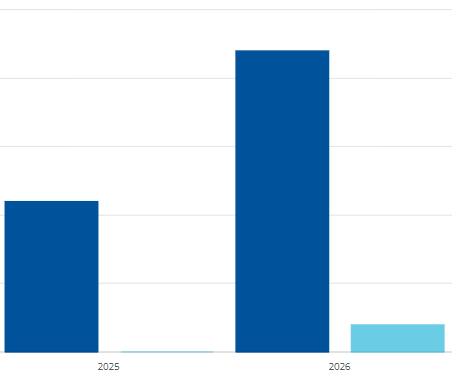
Year-to-Date Sales (2026) vs. Last Year-to-Date Sales (2025). Paperback sales are depicted in dark blue while ebook sales are depicted in light blue. Screenshot from my IngramSpark Dashboard. Special edition sales are not included, nor are in person sales, direct sales, or website sales. This dashboard only counts sales reported from retailers to IngramSpark. Including sales counts from other sources adds an additional 12-ish? copies.
Needless to say, that is awesome. I don’t think there is a better example of why long term indicators are better for gearing the growth of an indie author. For all the struggling and feeling like I’m getting nowhere, this number makes it abundantly clear that I am. I couldn’t be happier. So, thank you, dear readers, as well as my team and the wonderful people who helped me do this. You nerdy weirdos are the best.
That is all I have for this week, though. Check back with me again next week for the next segment of Nerdology 101. Until then, have a nerdy week!
Nerdology 101: Identity & Writing
Nerdology 101 Topic Reveal
Post Fate: 8/21/2026 at 3PM (Next Friday)
Topic: Identity and Writing
This week's Nerdology 101 will be exploring identity and writing. As a mixed person, I can tell you that being mixed is a weird and complex experience in the best of circumstances (but ultimately one I wouldn't trade for the world). This week, though, I want to talk a bit about how that manifests FOR ME as it applies to my authorhood, as well as some other aspects of my identity that I've seen come up in complicated ways throughout my journey as a writer.
The nerds have returned! Welcome back to Nerdology 101. I’m super excited for this weeks topic as it is, of course, one that is very personal to me. This week, I’ll be sharing with you my own experiences regarding identity and writing. Strap in because this is going to be a long post.
Why this topic?
Writing forces you to sit with the truth of who you are in some of the most unexpected ways. Even in the most fictioniest of fiction, it holds up a mirror that you can’t shy away from if you want to write something good. So, I chose this topic because right now, I feel like looking into that reflection and sharing it with my audience is a necessary thing to do. This blog is the best way to do that because it’s definitely NOT a topic designed for short-form content.
Why now?
Because when I sat down at my computer to write a blog post, this is the topic I felt drawn to. On the surface, there probably isn’t a profound reason I’m choosing to do it now. Though, on a more profound level, I think the context of my life, position as a writer, and the world in general is likely why the topic was drawing me in.
What are you mixed with?
In this instance, I am CHOOSING to share specifics because I feel that it’s relevant. Please remember, though, that in general, you aren’t owed answers to this questions or questions like it—and that “what are you?” is NOT an appropriate way to ask the question. If asked in that format, I will almost always say “your worst nightmare” (shout out to Mushu for that one).
Anyway, the simplified answer is Italian and Black. Anything else would be distant and unsubstantial to my identity and experience. I do say it in that order because it’s roughly a 75/25 split.
Being Mixed in General
So, a common issue for mixed people is that you exist outside of societal context. There’s never a clear space for you. In a lot of cases, this triggers a series of back-to-back identity crises that really isn’t healthy on any level. I experienced identity crises like this all throughout my childhood and teenage years. For the most part now, I have sorted that out internally (despite the worlds best efforts to make that impossible), but that doesn’t mean it doesn’t still come up on occassion. It just means I know how to work through the internal chaos it triggers in a way that allows my identity to remain in tact, rather than being called into question by someone else’s lack of education.
Okay, so how does that carry over to your writing?
Well, for starters, the entire angel vs. demon plotline experiments with race. The demons are an obviously oppressed group with dark skin. The angels are group of people with light skin being used as weapons to uphold the oppression of demons. The gods are the ones who misinformed the angels in such a way that made the demons seem bad, thereby turning them into weapons of oppression, because it maintained the power of the gods. There’s a lot of specific context where I ask the reader to question how wrong the demons can really be for reacting to their oppression in ways that are frowned upon by other characters, as well as context where I highlight the fact that the angels being misinformed doesn’t automatically absolve them of harm they perpetuated once they know better, yet I still make it clear that these systems where created and designed by the gods who should ultimately be blamed for it. Now, there’s a lot of obvious real-world metaphor for race in that, but that’s not the only context in which race comes up for me as a writer.
There’s also the community aspect. Most readers at this point have heard the terms Booktok, Bookstagram, and even Booksky for Bluesky users. But, did you know there’s also online Black communities that focus on Black authors and readers—like Black Booktok, Black Bookstagram, and Black Booksky. Let me be abundantly clear about something before I continue: BLACK PEOPLE HAVE EVERY RIGHT TO WANT A SPACE WITHIN THE BOOKISH COMMUNITY SPECIFIC TO THEM. It’s actually out of respect for that space that I don’t use the language, tags, or keywords specific to these communities. My experience will never be equivalent to that of someone with darker skin. I am a light-skinned Mixed woman who could be white passing if she tried and is frequently mistaken for various kinds of Hispanic (I’ve heard Columbian, Mexican, Puerto Rican, everything under the sun.).
Here’s the point, though: There isn’t really a space specific to Mixed people in the book community. Just now, I pulled up IG on my phone and went like I was going to post. When I put in #MixedBooktok and #MixedBookstagram, nothing came up. When I put in #MixedAuthor, there were 272 uses of the hashtag. In contrast, #Booksta has 4,142,080 uses and #BlackBookstagram has 359,954. Now, I do use Booksta and BookTok tags and keywords, but that comes with it’s own challenges. It means that most frequently my books are being introduced to people that don’t specifically connect with the themes I’m writing. The odds of finding my audience are reduced dramatically in that context. What is already a highly saturated space where it’s difficult for an indie author to find their footing becomes an even steeper hill when you’re unable to direct content in a way that connects with the group who would be most invested in seeing a voice like yours thrive.
This isn’t anyone’s fault. My books can certainly be read by anyone of any race and I’m happy to have those readers too. It’s just the way these platforms work. Algorithms run by AI are probably not able to pick up on these nuances and therefore probably can’t send your books to the audience looking for them. Also, because these are short-form content platforms that only push popular content, anything made with the goal of connecting with a sub-audience that isn’t already established ends up being deemed irrelevant.
This sort of erasure is something I often see people hesitant to act on too. It doesn’t come off as malicious to me (most of the time). Rather, it comes from the question “who is this book for?” most of the time. We already have such a hard line in place. There’s been issues where white people who read about mythical creatures and can relate to them have said they can’t relate to Black characters. There’s also Black people who exclusively seek out books by Black authors because they know their community is that authors best chance at thriving—which is fair because Black authors are being pushed out of spaces dominated by white readers regularly. The clear division, though, leaves a limbo where Mixed people exist. Neither group is specifically seeking books by Mixed people. Mixed people usually aren’t even seeking out books by Mixed people because so many of us have been conditioned to feel like we have to “choose a side” often either go one way or the other.
For example, I say, “I’m Italian and Black” and a white person argues with me about how my Black family isn’t even fully Black because my several times great grandmother was Cherokee (we can’t even confirm that in any real way) and someone else generations ago was Irish and blah, blah, blah. Or, I say “I’m Italian and Black” and a Black person starts talking about the 1 percent rule and whether a kid is their mother or fathers race legally and so on—which are valid conversations about the history of race as a construct, how little it’s connected to one’s genetics, and how it’s been legal definition has been so erratic based on what is most convenient for racists at a particular moment—but ultimately does cause some pressure to identify in a certain way when these topics that come up every time a Mixed person mentions that they’re Mixed.
Thus, a lot Mixed people identify more strongly with one aspect of their racial identity than the other and are more likely to seek out books related to the aspect of their identity they identify with because of it. For me, that has always been the Black side because of the fact that I was almost entirely raised with and by my Black family and lived in primarily Black communities where I spent most of my time with Black people. This doesn’t have any impact on my ethnicity, but does greatly impact my racial identity because, as we should all know, race is a social construct that’s comprised of many factors including but not limited to ethnicity, culture, socialization, etc.
All of this is to say, these are things I’ve experienced and topics that have come up for me related to my race as a Mixed author. I’m sharing it based on what I’ve observed and how I percieve the overall bookish space. By sharing these experiences, I hope to create a space where other Mixed people (or literally any other POC) who wants to can share their own. Ultimately, these are all manifestations of a systemically racist society, which infects all spaces within said society, creating issues like this for all people of color. The book space did not create these issues, but they exist nonetheless and I think it’s important that all people of color are able to share the ways racism manifests for them in spaces they occupy.
Other Aspects of my Identity
I make no secret of the fact that intersectionality is a core value to me. For me, that value stems from a place of experience. In my life, I have experienced the crap end of a lot of issues including homophobia, bi+phobia, sexism, issues around mental illness, etc. While race was the primary topic I wanted to talk about today, I did want to add here that these are important issues to discuss as well. I’d like to address them more deeply in the future, but for now I’ll leave you with this:
Through it all, I love being an author more than anything. I adore the bookish community, but I believe there are many ways the community and industry need to grow in order for more diverse voices to thrive within it. Have the uncomfortable conversation. Read books by people who’s voices you don’t often listen to. Engage with content made by people who are different than you are. Support the people who need it. Even if it’s not me, find someone who might not see a clear space where they fit into this community and do something that amplifies their voice.
That’s all for this week’s segment of Nerdology 101. I hope you learned something. Check back again next week for another post. Until then, have a nerdy week!
Nerdology 101: High Stakes and Immortality
Nerdology 101 Topic Reveal
Post date: 8/8/2026 at 3PM EST
Topic: High stakes and Immortality
How do you balance creating high stakes with having immortal characters (such as gods)? If they can't die, how will it ever feel like they're truly in danger? These are questions many fantasy writers have had to reckon with and next week, Nerdology 101 is going to be posting about it. Join me for a glimpse into how it can be made to work.
NERDSSSSS! Welcome back to Nerdology 101. As most of you probably know by now, I’m Maria Levato, indie author, blog writer, anime nerd, and all around weirdo. Recently, I’ve been working on a manuscript titled Harem of the Heavens (HOTH). HOTH deals with gods, naturally, and so I have had to deal a lot with this weeks topic. When writing a fantasy or romantasy, how do you balance immortal characters with high stakes? Are the stakes ever really high if the characters can’t die? The short answer: The stakes are absolutely high. Follow along and find out how it’s done (no, this will not contain spoilers for my unreleased book.). Let’s get into some nerdology!
Research the Pantheons
First and foremost, you’re going to want to research the pantheon your writing about. Immortality doesn’t always mean the same thing to every pantheon. The Greeks were pretty freakin’ immortal, the Norse just had long lifespans, the Egyptians were immortal but in a reincarnation sort of way, and the list goes on. Depending on what you’re writing about, your characters may very well be killable. If they aren’t, you might find established means of disempowerment that you can use.
Add Other Factors
Pose the question of if an eternity of misery or torment is truly any less high stakes then death? For example: A Greek could be immortal all day long, but after they saw what happened to the Titans, they could very well have a fear that certain actions will lead them into a similar situation. If eternal torment in Tartaros is the consequence that replaces death, most readers will probably view that as a worse outcome if you play the card well.
Beyond that specific example, other high stakes factors can be unfavorable marriages and disinfranchisement from the pantheon or family members.
An Uneven Playing Field
Maybe you just don’t? Maybe one character truly doesn’t have as much at stake as another. That’s realistic AND it intensifies things for the character with more at stake. An uneven playing field can lead to passionate arguements where the party with less skin in the game is made to realize how privileged they are when the party with more skin it opens up to them about what’s truly on the line. It’s a moment that can lead to intense character development for both party, the fearful one becoming more vulnerable with this other character and the powerful one becoming more attuned to the needs of others—or at least one other. It’s a nice contrast, when you think about it, to have one character doing this inconcievably terrifying stuff out of boredom and another who’s life is on the line. Use it.
The Life of a Loved One
Is your god in love with a mortal, or a god from another pantheon with a more flexible immortality? Then, there’s another option. If that lover is at risk of dying, the immortal one has enough reason to act. The fear and potential grief they could face would do well at keeping the story high stakes.
No lover? An immortal god who wants to protect their mortal worshipers serves the same purpose. If, for example, your issue is a war, a single god might not be able to protect their entire mortal following alone. That’s another type of love, but it’s equally effective at providing a high stakes motivation for the character.
These are, of course, just a few examples of outs you can use to circumvent immortality. The point is, this is CREATIVE writing. Be creative and your story will be better for it. I hope this post helps you get your juices flowing if this is something that has hemmed you up. Whatever happens, keep writing, keep reading, and keep being the nerd you are. That’s all for this segment of Nerdology 101. Check back again next Friday for another. Until then, have a nerdy week!
Nerdology 101: Experimenting
Nerdology 101 Topic Reveal
Post Date: 5/22/2026 at 3PM EST
Topic: Experimenting
Join me on Nerdology 101 where I'll be talking about a new project I've started as a little genre experiment. Until now, I've always written Romantasy, but in this new project, I'll be working in Contemporary Romance. I'm so excited to tell you all about it. See you there!
Hey, loves. It’s Maria Levato here and we’re back with another segment of Nerdology 101, the blog where we discuss all my nerdy interests from anime to gaming, mythology to history, and yes, of course, my writing. This week I’m going to be telling you all about a project I started (mostly out of boredom since both of my active manuscripts are in editing).
Is it going to be another romantasy?
Nope! It won’t be a romantasy. I know that’s my usual genre, but I was sitting on an idea for a little something different, so I’m experimenting.
What will it be then?
This project will be a short story in the contemporary romance genre. Here’s some of the tropes I’ll be working within:
College Romance
Artist x Business Tycoon
He Falls First & Harder (always)
Strangers to Friends to Lovers
Ohh, Tell me more!
Of course I will, darling. This story will center Kyra Nettle and Osiris Carhart, two freshman at ___ University (unamed because I’m still researching whether or not it’s okay for me to use the name of the university the campus and programs were based off of). They’re both communter students who meet the morning classes start due to a tiny car accident in the parking lot sparked by nervousness about their first day. While exchanging information for the insurance claim, they realize their families are in the midst of negotiating a business deal. Planning to succeed his father as head of the company, Osiris pleads for Kyra not to deliver the news about the accident to her father in a way that might make him look reckless or irresponsible. One thing leads to another and a friendship starts to blossom between them by the end of their first week, all the while their underlying attraction leaves them wondering if friends is all they’ll ever be.
Love it! When can we have it?
I just started writing it last night, so it might be a little while. To give you a clear idea of where we’re at, the file is currently titled “Untitled Short Story Thingy” in my computer. As you can tell, I haven’t decided much. As always, though, you’ll be able to find updates on this and all my other WIPs on the Coming Soon page of this website. I do hope you’ll check it out when it’s released in whatever manner I have not yet decided. Probably not on IngramSpark as I usually do because that wouldn’t really serve my goals for this (which is mostly to see how readers vibe with my writing in this genre). If you’re interested in it, drop a comment to tell me your preference here.
KU
Kobo
Submit to Anthologies or Lit Mags
That’s about all for this week’s segment of Nerdology 101. Drop in again next week for another. Until then, have a nerdy week.
Nerdology 101: My Top 5 Favorite Quotes From “The Fate of Angels and Demons” as the Author Who Wrote It (and why).
My top 5 favorite quotes from The Fate of Angels and Demons as the author who wrote it (and why).
Ever wondered what an authors favorite parts of their own book is, swing by Nerdology 101 next week to find out. You can find it right on my website!
Hi, loves. Welcome back to Nerdology 101. I’m Maria Levato—writer, nerd, bunch of other weird shit. This week, I’m going to tell you what my favorite quotes from my own book are and why I love them so much.
“…children whose ribs are entirely too visible forced into labor by men who wear their greed like a badge of honor…”
I think it’s pretty obvious what group of resource hoarding individuals I had in mind when I wrote this. Let’s not pretend it isn’t. In truth, this quote sticks out to me because it’s relevant. There’s this constant back-and-forth in the bookish community about if books are political (HINT: They are, always.) To that end, here’s another “non-political” quote.
“They have every right to be angry at the centuries of oppression directed at them.”
I know. There’s no possible way this could be relevant to—I don’t know—Black people or any other group of marginalized people, right? I mean, I’m Mixed, but there’s just no way an author’s identity could impact the way they write, right? Hmm… I wonder about that.
“Shut up and let me eat this thick fucking ass, Seshen.”
Oh, come on. It’s just as great line. It encompasses the kink, the spice, the fun, and the pleasure that I love about this book. It’s hot.
“Because I’ll do anything,” He snaps. “I will burn every kingdom and torch every village in this gods-forsaken realm, just to get a moment with you.”
Again, hot. But also… Not to protect her, just to see her for a moment? This is what I love about Michael. He’s understood from the jump that Lilly does not need his protection. The most valuable thing he could give to her as a romantic interest was the consistency and intensity of his love. It was the one thing she didn’t already have and couldn’t attain on her own.
“It feels like being told I’m crazy after I told someone I’m crazy, only to go crazier because they make me feel crazy for it.”
This scene goes to the heart of it all, in a lot of ways. This line in particular is hard to ignore, especially if you’re a woman. There’s a reason gaslighting is such a widespread discussion when it comes to feminism. I think a good amount of us can probably identify with what Lilly is feeling here. We’ve all, at some point, likely questioned our sanity on account of someone who called us “crazy” or “too emotional” or whatever else for simply having emotions they lacked the emotional intelligence to cope with the existence of. It’s all too common an experience and I think it’s what makes Lilly’s character shine so brightly. Her whole thing is that she acts, primarily, based on her emotions. In a way, her character arc revolves around her accepting that it’s okay to lead with heart and fight with mind. It was my answer to this growing thing in fiction where women are only labelled as “badass” if they’re emotionless, calculating, closed-off, etc.
Note:
Obviously, the switch element of this book is one of my favorite elements. The reason I don’t favor spicy lines from moments where Lilly is dominant when it comes to marketing is because it is EXTREMELY difficult to convince the algo’s of the internet to push content that displays obvious depictions of femdom because for some stupid ass reason we (collective, as a society) still seem to have a problem with seeing FLR dynamics in any form of media, even if it’s within the context of a switch dynamic where she’s only the one in charge part of the time. I think it’s ridiculous, but the best way to combat it is to market the book based on what will get pushed so people read it and gain the exposure to women-led power dynamics. Thus, if you’re reading this, you should know much of what I don’t market is equally as great as the rest of this.
Nerdology 101: Why Write?
Swing by Nerdology 101 next Friday to gain a little insight into why I write and why I write what I write! With this being the last Nerdology 101 post before my new book comes out, I wanted to give readers a chance to get to know me a little better.
Hello, nerdy beloveds. Welcome back to Nerdology 101. I'm your host, Maria Levato, and this week you’re going to discover the why behind my writing. Let’s get into some Nerdology!
The Official Bio:
Every author has one, here’s mine. As seen on the homepage of this website, this is my official bio:
“Maria Levato is an author, BIPOC woman, and disabled veteran. She has written three books as an indie author, The Islands of Rune (2023), Journey to Rallem (2025), and The Fate of Angels and Demons (2026). Maria also writes the Nerdology 101 blog on this website.
Outside of her writing, Maria serves the writing community in other ways. She’s the chair of the PRO Advisory Committee for the Romance Writers of America and an ambassador for the Washington, D.C. chapter of The Authors Guild.”
You didn’t come here for that today, though, did you? You want the goodies. So, let’s move right along.
The Fun Bio:
Oh, babes, you’re in for it now.
Who I am and what I do are two very different topics. While my work is a huge part of who I am, there’s so much behind the scenes that doesn’t make it into the bio. If you can’t tell by the name of this blog, I’m a nerd. Niches are my thing. Most nerds, being moderately sane human beings, pick a niche and stick to it. I, however, never have and never will claim to be sane. Thus, I have somewhere in the realm of 5,000 niches I consistently obsess over and another 1,000 or so that come and go with the wind. There are certain core ones that, in my mind, are all interconnected and lead back to a single hobby: Culture. Whether it’s fiction or non-fiction, a national art museum or a ren faire, writing or folding Reese cup wrappers into flowers so I have an excuse to eat a whole bag of minis, deep diving on mythology and history, or passionately raving about current events because I think we should treat people like people, it all comes down to culture for me. I don’t care which culture; I love them all.
Cultures humanize people in a way few other things do. Cultures surrounding race, ethnicity, and nationality are often what we think of when we think about culture, but under each comes a plethora of subcultures that make the experience even richer. Some of the favorite examples in my life now are Black Goth/Alt/Punk/etc. culture (music like Magnolia Park, collectives like Punk Black, events like Blerd Con, etc.), nerdy culture, Irish resistance music (like Chasing Abbey), Indigenous empowerment culture (music like Young Spirit, stores like Eighth Generation, etc.), and even kink/BDSM. Exploring these subcultures has always been what interests me most because it’s such a fun, supportive, and connective way to widen my own perspective. So, there I went, deep into the nerdom where I eventually discovered all of that stuff I love. The books, the anime, the art, the travel, these spaces are where I feel most like myself because so many other people are also free to be themselves in it.
Of course, then I grew up. Life happened; it sucked. Somewhere in there I lost track of who I was. What do we do when we lose something? We retrace our steps. Where had I last seen myself? Why, in the nerdom, of course. After remembering how happy this stuff made me, I was like, “hey, you what sounds like a fun way to cope with life?”
“Writing stories about nerdy shit and sex!” My brain replied.
It wasn’t really what I had in mind, I was thinking something wayyy less demanding, but my brain insisted so that’s what I did and now I love it. Three books later here I am explaining to you how a childhood love of culture resurfaced as the unhinged, smutty coping mechanism I sell to other people who are also fond of unhinged, smutty coping mechanisms. It’s really a full circle kind of thing. I love this life, though. It allows me to be connected to all the awesome things that I love by creating and adding something to the bookish subculture and wider nerdy community.
That’s pretty much the summary of how I became a writer and why I choose to write diverse, creative, outside the box, spicy fantasy books. You should give my newest one, The Fate of Angels and Demons, a read. The special edition can be found HERE and the paperback and ebook formats can be found HERE. Hope to see you back next week for another segment of Nerdology 101. Until then, have a nerdy week!
Nerdology 101: Decision-Making for Characters
You know that big moment you've been building up to for your entire manuscript? The one where the character must finally make that one decision that will define them. Well, I got to that moment in one of my drafts this past week, but when I got there, my character decided to throw a tantrum! RADIO SILENCE!
How did I get her to start cooperating again? How did I coax her into choosing?
Hey there! Welcome back to Nerdology 101, the blog where no nerd is left unsatisfied. I'm your host, Maria Levato. This week, I thought we'd talk about writing the tough decisions.
Every writer comes across a point where their character must make a decision. They have to go down one road or another, but sometimes they refuse to cooperate. I recently had a character that remained indecisive from the beginning of the draft right up until the end of the story.
Of course, it made for an awesome character arc because the build up to this moment has been quite the journey. However, we reached the point where a decision had to be made. Presented with two options that had similarly good outcomes for her, but potentially devastating ones for those she cares for, my FMC finally had to make her decision about which one of them she was going to hurt. Yet, when it came down to the wire, she went radio silent on me.
It didn't surprise me when she went quiet. She's a stubborn character with a bit of a bratty side. I had expected that she might throw a tantrum when she had to make this decision. So, here's how I dealt with it. Let's get into some Nerdology!
My FMC is quite used to having her way. Not because she's spoiled, but because she's powerful. Quite frankly, most of the other characters are terrified of her! When she gets stuck having to choose between two things she wants, she doesn't know how to cope. As the author, it's my job to coax her back out and help her make the decisions without speaking for her (It works best for me when I see the character as fully autonomous. I'm not sure if all writers do this, but I do.).
To do that, I write everything. It all comes out. Every moment up until the statement declaring the decision gets written. All the emotions, all the things they say and do leading up to it, everything gets on the page. Then, I write the first part of the statement. To oversimplify it, "I choose ____." At which point, all the character actually has to do is give you one answer or another. One I get answer A or B, the why flows post decision.
My point: Don't let the characters decision paralysis stall the story.
Let them make the decision on the moment because that's probably what's happening on the page. In most instances, you don't need their decision until very last moment. Give them all that time so they can answer intuitively.
Think of it like going to a restaurant. You know you want something from X place but you don't really know what until you get there and look at the menu. You might even order the same thing you always do, but you'll stare at that menu anyway, and you probably won't actually decide until the waitor/waitress walks up and asks if you're ready to order. It's a realistic and relatable thing for a character to do. Don't you agree?
Thanks for stopping by Nerdology 101. Check back next week for another segment. In the meantime, don't forget to pre-order my upcoming release, The Fate of Angels and Demons. Have a nerdy week!
Nerdology 101: Self vs. Trad Publishing
In this segment of Nerdology 101, Maria Levato discusses why both publishing options are perfectly valid.
Hi! Welcome back to Nerdology 101. I’m Maria Levato, your nerdy sensei who writes about kink play—and a bunch of other random stuff no one asked about.
Lately, I’ve been seeing a lot of discourse around the merits of self vs. trad publishing, so I’m using this week’s post to address that. Let me give you a hint: Both options are perfectly valid.
There are few industries where we judge the legitimacy of a business by who makes the initial investment. I have never heard someone say “Oh, this store is worse than a different store because the owner paid for it themselves instead of getting investors.” Why haven’t I heard that before? Because it would be insane and most people wouldn’t say it. So, why do we do it when it comes to books? Let’s dive into some Nerdology and find out!
Before the Printing Press
Long ago, there was a world without the printing press. A medieval time where books were—Checks notes, then gasps—made by hand!? Oh, the horror. As you may have guessed, they took a lot of time and money to make. The majority of them were made and collected by religious entities and universities. “Getting published”, as we know it today, didn’t really exist. What did exist, though, is the concept of patronage. Wealthy people, like nobles and royals, would find artists and writers they liked and bankroll them. Eventually, after creating some work, some of the artists and writers would start to get commissions from other wealthy people who wanted a work made by that artist or writer. Publishing houses are the post-printing press version of this, so you can call writers who became published this way early trad authors. On the other hand, you could call writers with the wealth to pay to have their writing produced themselves, early self-published authors.
Good Ol’ Gutenberg and the Printing Revolution
In 1454, we see Gutenberg’s printing press get put to commercial use for the first time where he prints a slew of stuff off for the church. Then, suddenly books (or at least those the church approves of) are more widely available. It’s magic. A ton of people were interested in this because it was a quick and easy way to replicate their ideas and distribute them to a wide audience. It was a Printing Revolution, literally, that’s what it was called. It was part of the Renaissance. You can learn a lot about it by viewing this page from Printing R-Evolution that explores it in depth. For our purposes, though, I’m just illustrating how this became the publishing industry. You see, whoever had a printing press could print and distribute anything. So, having one became a powerful way to distribute materials that would make people more likely to agree with your preferred idealogy. That’s a lot of power. It platformed people like Galileo, who was a radical thinker for his time. It also gave us texts that sparked social movements like the rise of Prostestantism, such as bibles written in languages that aren’t Latin, which were considered heresy at the time. Eventually, people realized that printing and distributing books could be lucrative. Enter: The Publishing Industry, entities who printed and distributed books on behalf of the writer.
Literary Agents
Three to four centuries and a lot of books later, literary agents come onto the scene between 1870 and 1930, depending on location. Their job was simple. Connect writers with publishing houses. This is really the start of traditional publishing as we know it today. From there, traditional publishing became more of a standardized process. Query agents (via snail mail, at the time), get an agent, have that agent submit the work to publishers, get published.
The Internet
With the internet came a revitalization of self-publishing. In 2005, Blurb, an online self-publishing platform was founded. In 2009, Amazon started Amazon Publishing. In 2013, IngramSpark came onto the scene. As with anything, some people got mad about it. They started bashing people who took that path because it went against their expectations of what becoming an author should look like. That’s where it started to get stigmatized.
Social Media
With the rise of Booktok/Bookstagram/Booktube/etc. came change. Self-published authors started to gain stronger platforms and their path became less stigmatized. This led us to the debate I’m seeing today about whether self or trad publishing is better. As I said at the start of this blog post, it doesn’t matter. The difference lies in who bears the initial investment, not the quality of the production itself. I’ve read plenty of trad books that I love and plenty that I dislike. The same applies to self-published books. Trad published books sometimes have editing issues, so do self-published books sometimes. Both formats have different pros and cons. Ultimately, the choice on which format is better depends on the writer and the piece they’re publishing. No matter what a writer chooses, they choose it because it is the best route for them and their work. Some writers choose one path at first and a different path later. Some are solidly on one side of the line or the other. So long as everyone respects everyone else’s decisions, there’s nothing wrong with any of it. It’s okay for people to achieve similar goals by different means. To say a trad-published author is a sell out or a self-published author wasn’t good enough to make it is ridiculous. No matter who bears the initial investment, the quality of the writing is what matters at the end of the day. Read books you like, no matter how they were published, and don’t read books you don’t like, no matter how they were published.
Let me know in the comments what your thoughts are! Did you learn something new about the history of publishing?
With that, I bid you all a good weekend. I’ll see you back next Friday at 3P.M. ET for the next segment of Nerdology 101. Until then, have a nerdy week!
Source List (This is a blog, not an academic paper. I’m just dropping the links so people can learn more, not making full citations).
https://guides.library.ubc.ca/historyofthebook/beforeprint
https://independentpublisher.com/article.php?page=1510
https://scarc.library.oregonstate.edu/omeka/exhibits/show/mcdonald/incunabula/gutenberg/
https://www.printingrevolution.eu/7
https://www.transatlantic-cultures.org/es/catalog/agents-litteraires