

Nerdology 101: Patience
Nerdology 101 topic reveal!
Post date: 9/4/2026
Topic: Patience
Heyy, loves. Sorry this is so late. I have an insanely slow recovery time and just now got up the energy necessary to assess the blog post for tomorrow after my trip to FL. So, here's our topic: Patience. You know? That thing authors of any kind need desperately but are always on the verge of running out of. More specifically, I want to talk about all the different circumstances in which patience is necessary as an author. There's some pretty interesting ways that it comes up and I think it'll be a fun topic, so drop by tomorrow to read all about it.
Hey loves, welcome back to Nerdology 101. This week I wanted to chat a little about how patience comes into play for authors of all kinds.
Misconceptions
I frequently see people talk about self-publishing like a short cut, but that is far from the case. Self-publishing is a career decision, but the truth is, it requires just as much patience as trad. It’s not a way to circumvent the query queue or avoid the pain of rejections. It’s just taking a different road. Self-publishers, like myself, have to wait on editing, wait on social media to discover us to make any money, send out applications and wait on answers from bookstores and conventions in order to get spaces that default to trad authors. All of these things take an insane amount of time—and I say that as an author who does hope to go trad one day soon. My reason for switching up doesn’t have to do with thinking either option requires more or less patience, or is anymore valid than the other. It has to do with the fact that I think trying to produce the new series I’m starting without more support would negatively impact my mental health and right now, I can’t afford to hire the level of support I would need without running the risk of hurting the quality of production. Whereas with the series I’ve already established, self-publishing didn’t have any negative impacts because it was just different. Different series come with different needs and visions. Deciding to self-publish something should mean you’ve decided it’s something you’re capable of producing to the quality standards and vision you have for it—not that you’re just too patient to wait on the trad industry to go through it’s process.
Secondly, I’d like to say that contrary to popular belief, self or trad published, agents WANT you to succeed as an author. Of course, there are exception, but I’ve had interaction with enough agents to know that most of them care deeply about authors and that there are even times where they reject a manuscript because they love it and think it deserves someone who can better represent it (more time, more clear vision, etc.). Yup, turns out most of them are just people doing something they love while trying to make sure they do right by all parties involved—including the author and themselves. The process is slow, but that’s because it’s human. For as much as the bookish community loathes AI, one would think we’d appreciate seeing signs of life a little more. I, for one, am glad when a reply takes a bit of time because no matter what the answer is, I feel substantially more confident that a human looked at my work and gave it thorough consideration than if a reply came in a few seconds.
Patience in Trad
Many people seem to forget that publishing is a waiting game. Waiting for a market to swing your way, waiting for an agent to reply to a query, then waiting for them to reply for a full, waiting for editiorial notes, waiting for publishers to answer once you’re on sub, waiting for cover design and blah, blah, blah. You’ll always be waiting for something. It’s highly unlikely that you sign a trad deal and instantly become that publishers first priority. If you do, that’s probably a huge red flag because I have no doubt every other author signed to them had things going on before you got there. If they drop all those people for you, won’t they eventually drop you for the next shiny, new author who comes along? Now, naturally, publishers will always put more into the people they think will bring in the most money, but the simple fact of the matter is that if they think you’ll rake in that much, that’s even more reason for them to slow down. Slow down so you don’t conflict with other big releases, slow down so they can put more time and money into design and marketing, slow down because mishandling the next bestseller could very well stop it from becoming the next bestseller.
Patience in Indie
Here’s the kicker, you can absolutely rush to print as an indie author. No one can tell you no. In fact, the first time around most authors make this mistake. I know I did. In all likelihood, though, the book will flop if you do that. The editing will be poor, the design will be poor, the marketing will be totally skipped over because you wouldn’t have had time to do it. You will almost certainly be doing yourself a disservice.
A self-published book should be going through every single step a trad published one does. You need developmental editing, line editing, copyediting, proofreading, typography, cover design, art design for any character art or map you want inside, file prep, marketing, and so on. If you skip any step, it’s likely to cost you. So, yeah, be patient and do the work. Then, keep being patient because most of the time, you’ll do that 3-5 times with 3-5 books as an indie author before you start gaining traction. The truth is, though, most indie authors will give up long before that happens. They’ll give up in the first year most likely. They’ll realize they’re hermeraging money, cut their losses, and move on. I hate to say it, but self-publishers do kind of have to suffer for their art. I’m sure trad authors do too in ways I’ve yet to discover because I’m not trad yet. There is no easy road in this industry. No fast road either. No matter what you do, you should expect it to take an excrutiating amount of time and energy, quite possibly money too because not every trad deal comes with a marketing budget the size of Saturn. Most people don’t even get Pluto and if you want to make it, you might have to take the difference out of your own pocket.
Post Publishing
Nikki St. Crowe was publishing for 20 years before Never King caught on. She didn’t stop. She kept going. If she hadn’t, she wouldn’t have written the book/series that made her a USA Today Bestselling Author. Tolkien was dead before LOTR caught on. A ton of authors have experienced this. I’ve seen people say that BookTok put an end to stuff like that and it won’t happen anymore, but I assure you it will. There are so many authors on BookTok. Readers are seeing so many book recs all the time and I’m sure it becomes easy for them to tune out the vast majority of them. So, it’s not even just possible, it’s probable that BookTok has scrolled past something that someone some day will stumble upon and next thing you know it’ll be huge. The accessibility of the internet is a double edge sword. Because so many people can reach readers, readers are seeing more things. They’re people and only have so many hours in a day. The more they see, the more selective they have to be about where they spend time and money. So, yes, you do probably have to wait post-publishing. You have to be willing to wait for your success even as you pursue it relentlessly because usually, it takes time.
That’s about it for this weeks segment of Nerdology 101. Hopefully you learned something. See you back next Friday for whatever I’ll be posting then (I’ll make sure I write it Saturday and get the topic reveals back on schedule.). Until then, have yourself a nerdy week!
Nerdology 101: First 150 Days
Nerdology 101 Topic Reveal
Post Date: 8/28/2026 at 3 PM EST
Topic: First 150 Days
Next week will mark 150 days since my newest book, The Fate of Angels and Demons, came out. Friday will actually be 149, but close enough, especially since I'll be at a book signing in Orlando on day 150.
Anyway, I wanted to do a little celebratory post to discuss the landmarks I've hit since release (as well as those I'm still aiming for).
For those who are seeing me for the first time, The Fate of Angels and Demons is a dark romantasy book about a priestess who falls in love with the demon him fated to kill her family. It runs about 388 pages, is super spicy, and explores the complexities of trauma, resentment, and family ties.
The book is available widely. You can find the ebook (.99¢) and paperback ($20) at most retail websites including Bookshop, Amazon, Barnes and Noble, and more. Some libraries might also have it available on Libby and Hoopla. The special edition ($30), however, is a lot more limited as to where it can be bought. To find it, please see my website. Additionally, the paperback is discounted on my website, something I offer for those buying direct because it's a bit cheaper for me since I'm not splitting profits with other places.
You can find all these links and more on my page! I hope you'll check it out and that you'll stop by Nerdology 101 next week to see the post.
Oh my Goddesses! It’s already been 150 days since The Fate of Angels and Demons came out. This is awesome! I’m excited. Honestly, I didn’t even realize how long it had been until I started thinking about this week’s topic. It’s awesome that it falls where it does too since I’ll technically be in Orlando, FL doing a book signing at The New Romantics on the 150th day (I write these posts about a week before they actually release because it helps me make sure I can get them out on schedule. Seems to be working because I haven’t missed a post since this blog started in October of last year.). Anyway, sidebar aside, let’s get into some Nerdology!
What’s so special about 150 days?
A lot! It’s a huge post-release landmark in a lot of ways. 150 days is enough time to accurately measure how a book is doing. Early indicators usually are the most accurate when it comes to indie/self-published works, unlike with trad published books where early sales are some of the highest indicators. This is because of simple math. Most of the big name trad authors that come to your mind when you think of trad publishing are reaching the majority of their audience off the bat, meaning that early indicators are probably gather metrics from most of their established audience. The same doesn’t apply to indies. Even if a book isn’t doing wonderfully out of the gate, for indies, that probably doesn’t cover very much of their target audience because they usually haven’t already found said audience. So, every time they post or run ads, they’re likely being introduced to an entirely new group of people. Thus, long term indicators are probably a much better way to ensure accurate measurement, especially since indie books have a habit of doing a 180 when least expected.
What do the long term indicators say about your book?
Well, I’d say the heartbeat is steady but that it doesn’t necessarily mean we’re out of the woods yet. I see the growth, the slow upticks in engagement (specifically on TT this week), the interest from more and more events and bookstores, and even the slow addition of reviews. The efforts of me and my PA are producing some results, however slowly that might be happening. Here’s a more in-depth summary:
Social Media:
Since April 1st (the release date of The Fate of Angels and Demons) my TikTok metrics have been 14.8k views (375.4% increase), 104 profile views (205.9% increase), 360 likes (291.3% increase), 49 comments (1125% increase), and 89 shares (368.4% increase). Those are pretty huge leaps and bounds, but lets put them in perspective by also going over just the metrics of the last 7 days. 1.5k views (109% increase), 11 profile views (450% increase, also like 1/10th of the total profile views since April), 32 likes (45.5% increase), 3 comments (100% increase, had not the week prior), 7 shares (100% increase, had none the week prior). From this, you can see pretty clearly that the majority of this growth is coming more recently. All in all, I’m up 54 followers on TikTok since April 1st 86.2% increase).
On Instagram, the growth is even slower. It only shows the insights from up to 90 days ago, meaning this is doesn’t go all the way back to April 1st, but in my net followers I see that I’m up by 9 and 71.2% of my views are coming from non-followers, as is 43% of my engagement. The totals are 9419 views, 279 interactions, 452 followers. It’s by no means a boom, but it is a slow, hard earned growth.
Sales:
This is going great. Just this week, I heard from another bookstore in my local area wanting to set up a meeting with me to talk about stocking my book. This one came from a referral. My best friend’s cousin stopped by their store and saw that they work with indies, so she told my best friend and my best friend told me. I reached out; they responded. Yay!
I also had to turn down an event for the first time. It was one I had been waitlisted for. They reached out to me due to some cancellations and asked if I could come, but I had already filled the space with another event on the same date in a different state, so I had to turn it down. This is growth because this year is the first year, and the first book, where I’ve had a pretty full schedule and am able to start working on events for the next year ahead of time. It does also mean more sales.
Of course, most of those haven’t happened yet (next week, Sept, Oct), so I can’t give results quite yet. What I can do, though, is tell you what I have sold—and that, my loves, is more than DOUBLE what I had sold this time last year. The Fate of Angels and Demons has MORE. THAN. DOUBLED. the sales I saw from Journey to Rallem.
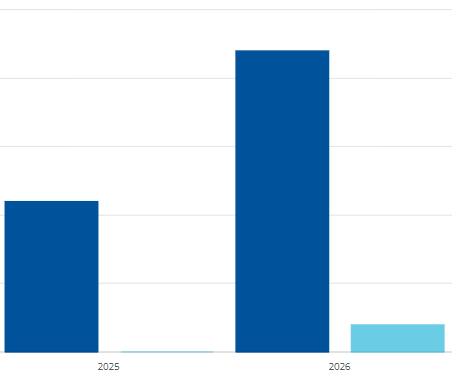
Year-to-Date Sales (2026) vs. Last Year-to-Date Sales (2025). Paperback sales are depicted in dark blue while ebook sales are depicted in light blue. Screenshot from my IngramSpark Dashboard. Special edition sales are not included, nor are in person sales, direct sales, or website sales. This dashboard only counts sales reported from retailers to IngramSpark. Including sales counts from other sources adds an additional 12-ish? copies.
Needless to say, that is awesome. I don’t think there is a better example of why long term indicators are better for gearing the growth of an indie author. For all the struggling and feeling like I’m getting nowhere, this number makes it abundantly clear that I am. I couldn’t be happier. So, thank you, dear readers, as well as my team and the wonderful people who helped me do this. You nerdy weirdos are the best.
That is all I have for this week, though. Check back with me again next week for the next segment of Nerdology 101. Until then, have a nerdy week!
Nerdology 101: Identity & Writing
Nerdology 101 Topic Reveal
Post Fate: 8/21/2026 at 3PM (Next Friday)
Topic: Identity and Writing
This week's Nerdology 101 will be exploring identity and writing. As a mixed person, I can tell you that being mixed is a weird and complex experience in the best of circumstances (but ultimately one I wouldn't trade for the world). This week, though, I want to talk a bit about how that manifests FOR ME as it applies to my authorhood, as well as some other aspects of my identity that I've seen come up in complicated ways throughout my journey as a writer.
The nerds have returned! Welcome back to Nerdology 101. I’m super excited for this weeks topic as it is, of course, one that is very personal to me. This week, I’ll be sharing with you my own experiences regarding identity and writing. Strap in because this is going to be a long post.
Why this topic?
Writing forces you to sit with the truth of who you are in some of the most unexpected ways. Even in the most fictioniest of fiction, it holds up a mirror that you can’t shy away from if you want to write something good. So, I chose this topic because right now, I feel like looking into that reflection and sharing it with my audience is a necessary thing to do. This blog is the best way to do that because it’s definitely NOT a topic designed for short-form content.
Why now?
Because when I sat down at my computer to write a blog post, this is the topic I felt drawn to. On the surface, there probably isn’t a profound reason I’m choosing to do it now. Though, on a more profound level, I think the context of my life, position as a writer, and the world in general is likely why the topic was drawing me in.
What are you mixed with?
In this instance, I am CHOOSING to share specifics because I feel that it’s relevant. Please remember, though, that in general, you aren’t owed answers to this questions or questions like it—and that “what are you?” is NOT an appropriate way to ask the question. If asked in that format, I will almost always say “your worst nightmare” (shout out to Mushu for that one).
Anyway, the simplified answer is Italian and Black. Anything else would be distant and unsubstantial to my identity and experience. I do say it in that order because it’s roughly a 75/25 split.
Being Mixed in General
So, a common issue for mixed people is that you exist outside of societal context. There’s never a clear space for you. In a lot of cases, this triggers a series of back-to-back identity crises that really isn’t healthy on any level. I experienced identity crises like this all throughout my childhood and teenage years. For the most part now, I have sorted that out internally (despite the worlds best efforts to make that impossible), but that doesn’t mean it doesn’t still come up on occassion. It just means I know how to work through the internal chaos it triggers in a way that allows my identity to remain in tact, rather than being called into question by someone else’s lack of education.
Okay, so how does that carry over to your writing?
Well, for starters, the entire angel vs. demon plotline experiments with race. The demons are an obviously oppressed group with dark skin. The angels are group of people with light skin being used as weapons to uphold the oppression of demons. The gods are the ones who misinformed the angels in such a way that made the demons seem bad, thereby turning them into weapons of oppression, because it maintained the power of the gods. There’s a lot of specific context where I ask the reader to question how wrong the demons can really be for reacting to their oppression in ways that are frowned upon by other characters, as well as context where I highlight the fact that the angels being misinformed doesn’t automatically absolve them of harm they perpetuated once they know better, yet I still make it clear that these systems where created and designed by the gods who should ultimately be blamed for it. Now, there’s a lot of obvious real-world metaphor for race in that, but that’s not the only context in which race comes up for me as a writer.
There’s also the community aspect. Most readers at this point have heard the terms Booktok, Bookstagram, and even Booksky for Bluesky users. But, did you know there’s also online Black communities that focus on Black authors and readers—like Black Booktok, Black Bookstagram, and Black Booksky. Let me be abundantly clear about something before I continue: BLACK PEOPLE HAVE EVERY RIGHT TO WANT A SPACE WITHIN THE BOOKISH COMMUNITY SPECIFIC TO THEM. It’s actually out of respect for that space that I don’t use the language, tags, or keywords specific to these communities. My experience will never be equivalent to that of someone with darker skin. I am a light-skinned Mixed woman who could be white passing if she tried and is frequently mistaken for various kinds of Hispanic (I’ve heard Columbian, Mexican, Puerto Rican, everything under the sun.).
Here’s the point, though: There isn’t really a space specific to Mixed people in the book community. Just now, I pulled up IG on my phone and went like I was going to post. When I put in #MixedBooktok and #MixedBookstagram, nothing came up. When I put in #MixedAuthor, there were 272 uses of the hashtag. In contrast, #Booksta has 4,142,080 uses and #BlackBookstagram has 359,954. Now, I do use Booksta and BookTok tags and keywords, but that comes with it’s own challenges. It means that most frequently my books are being introduced to people that don’t specifically connect with the themes I’m writing. The odds of finding my audience are reduced dramatically in that context. What is already a highly saturated space where it’s difficult for an indie author to find their footing becomes an even steeper hill when you’re unable to direct content in a way that connects with the group who would be most invested in seeing a voice like yours thrive.
This isn’t anyone’s fault. My books can certainly be read by anyone of any race and I’m happy to have those readers too. It’s just the way these platforms work. Algorithms run by AI are probably not able to pick up on these nuances and therefore probably can’t send your books to the audience looking for them. Also, because these are short-form content platforms that only push popular content, anything made with the goal of connecting with a sub-audience that isn’t already established ends up being deemed irrelevant.
This sort of erasure is something I often see people hesitant to act on too. It doesn’t come off as malicious to me (most of the time). Rather, it comes from the question “who is this book for?” most of the time. We already have such a hard line in place. There’s been issues where white people who read about mythical creatures and can relate to them have said they can’t relate to Black characters. There’s also Black people who exclusively seek out books by Black authors because they know their community is that authors best chance at thriving—which is fair because Black authors are being pushed out of spaces dominated by white readers regularly. The clear division, though, leaves a limbo where Mixed people exist. Neither group is specifically seeking books by Mixed people. Mixed people usually aren’t even seeking out books by Mixed people because so many of us have been conditioned to feel like we have to “choose a side” often either go one way or the other.
For example, I say, “I’m Italian and Black” and a white person argues with me about how my Black family isn’t even fully Black because my several times great grandmother was Cherokee (we can’t even confirm that in any real way) and someone else generations ago was Irish and blah, blah, blah. Or, I say “I’m Italian and Black” and a Black person starts talking about the 1 percent rule and whether a kid is their mother or fathers race legally and so on—which are valid conversations about the history of race as a construct, how little it’s connected to one’s genetics, and how it’s been legal definition has been so erratic based on what is most convenient for racists at a particular moment—but ultimately does cause some pressure to identify in a certain way when these topics that come up every time a Mixed person mentions that they’re Mixed.
Thus, a lot Mixed people identify more strongly with one aspect of their racial identity than the other and are more likely to seek out books related to the aspect of their identity they identify with because of it. For me, that has always been the Black side because of the fact that I was almost entirely raised with and by my Black family and lived in primarily Black communities where I spent most of my time with Black people. This doesn’t have any impact on my ethnicity, but does greatly impact my racial identity because, as we should all know, race is a social construct that’s comprised of many factors including but not limited to ethnicity, culture, socialization, etc.
All of this is to say, these are things I’ve experienced and topics that have come up for me related to my race as a Mixed author. I’m sharing it based on what I’ve observed and how I percieve the overall bookish space. By sharing these experiences, I hope to create a space where other Mixed people (or literally any other POC) who wants to can share their own. Ultimately, these are all manifestations of a systemically racist society, which infects all spaces within said society, creating issues like this for all people of color. The book space did not create these issues, but they exist nonetheless and I think it’s important that all people of color are able to share the ways racism manifests for them in spaces they occupy.
Other Aspects of my Identity
I make no secret of the fact that intersectionality is a core value to me. For me, that value stems from a place of experience. In my life, I have experienced the crap end of a lot of issues including homophobia, bi+phobia, sexism, issues around mental illness, etc. While race was the primary topic I wanted to talk about today, I did want to add here that these are important issues to discuss as well. I’d like to address them more deeply in the future, but for now I’ll leave you with this:
Through it all, I love being an author more than anything. I adore the bookish community, but I believe there are many ways the community and industry need to grow in order for more diverse voices to thrive within it. Have the uncomfortable conversation. Read books by people who’s voices you don’t often listen to. Engage with content made by people who are different than you are. Support the people who need it. Even if it’s not me, find someone who might not see a clear space where they fit into this community and do something that amplifies their voice.
That’s all for this week’s segment of Nerdology 101. I hope you learned something. Check back again next week for another post. Until then, have a nerdy week!
Nerdology 101: High Stakes and Immortality
Nerdology 101 Topic Reveal
Post date: 8/8/2026 at 3PM EST
Topic: High stakes and Immortality
How do you balance creating high stakes with having immortal characters (such as gods)? If they can't die, how will it ever feel like they're truly in danger? These are questions many fantasy writers have had to reckon with and next week, Nerdology 101 is going to be posting about it. Join me for a glimpse into how it can be made to work.
NERDSSSSS! Welcome back to Nerdology 101. As most of you probably know by now, I’m Maria Levato, indie author, blog writer, anime nerd, and all around weirdo. Recently, I’ve been working on a manuscript titled Harem of the Heavens (HOTH). HOTH deals with gods, naturally, and so I have had to deal a lot with this weeks topic. When writing a fantasy or romantasy, how do you balance immortal characters with high stakes? Are the stakes ever really high if the characters can’t die? The short answer: The stakes are absolutely high. Follow along and find out how it’s done (no, this will not contain spoilers for my unreleased book.). Let’s get into some nerdology!
Research the Pantheons
First and foremost, you’re going to want to research the pantheon your writing about. Immortality doesn’t always mean the same thing to every pantheon. The Greeks were pretty freakin’ immortal, the Norse just had long lifespans, the Egyptians were immortal but in a reincarnation sort of way, and the list goes on. Depending on what you’re writing about, your characters may very well be killable. If they aren’t, you might find established means of disempowerment that you can use.
Add Other Factors
Pose the question of if an eternity of misery or torment is truly any less high stakes then death? For example: A Greek could be immortal all day long, but after they saw what happened to the Titans, they could very well have a fear that certain actions will lead them into a similar situation. If eternal torment in Tartaros is the consequence that replaces death, most readers will probably view that as a worse outcome if you play the card well.
Beyond that specific example, other high stakes factors can be unfavorable marriages and disinfranchisement from the pantheon or family members.
An Uneven Playing Field
Maybe you just don’t? Maybe one character truly doesn’t have as much at stake as another. That’s realistic AND it intensifies things for the character with more at stake. An uneven playing field can lead to passionate arguements where the party with less skin in the game is made to realize how privileged they are when the party with more skin it opens up to them about what’s truly on the line. It’s a moment that can lead to intense character development for both party, the fearful one becoming more vulnerable with this other character and the powerful one becoming more attuned to the needs of others—or at least one other. It’s a nice contrast, when you think about it, to have one character doing this inconcievably terrifying stuff out of boredom and another who’s life is on the line. Use it.
The Life of a Loved One
Is your god in love with a mortal, or a god from another pantheon with a more flexible immortality? Then, there’s another option. If that lover is at risk of dying, the immortal one has enough reason to act. The fear and potential grief they could face would do well at keeping the story high stakes.
No lover? An immortal god who wants to protect their mortal worshipers serves the same purpose. If, for example, your issue is a war, a single god might not be able to protect their entire mortal following alone. That’s another type of love, but it’s equally effective at providing a high stakes motivation for the character.
These are, of course, just a few examples of outs you can use to circumvent immortality. The point is, this is CREATIVE writing. Be creative and your story will be better for it. I hope this post helps you get your juices flowing if this is something that has hemmed you up. Whatever happens, keep writing, keep reading, and keep being the nerd you are. That’s all for this segment of Nerdology 101. Check back again next Friday for another. Until then, have a nerdy week!
Nerdology 101: Experimenting
Nerdology 101 Topic Reveal
Post Date: 5/22/2026 at 3PM EST
Topic: Experimenting
Join me on Nerdology 101 where I'll be talking about a new project I've started as a little genre experiment. Until now, I've always written Romantasy, but in this new project, I'll be working in Contemporary Romance. I'm so excited to tell you all about it. See you there!
Hey, loves. It’s Maria Levato here and we’re back with another segment of Nerdology 101, the blog where we discuss all my nerdy interests from anime to gaming, mythology to history, and yes, of course, my writing. This week I’m going to be telling you all about a project I started (mostly out of boredom since both of my active manuscripts are in editing).
Is it going to be another romantasy?
Nope! It won’t be a romantasy. I know that’s my usual genre, but I was sitting on an idea for a little something different, so I’m experimenting.
What will it be then?
This project will be a short story in the contemporary romance genre. Here’s some of the tropes I’ll be working within:
College Romance
Artist x Business Tycoon
He Falls First & Harder (always)
Strangers to Friends to Lovers
Ohh, Tell me more!
Of course I will, darling. This story will center Kyra Nettle and Osiris Carhart, two freshman at ___ University (unamed because I’m still researching whether or not it’s okay for me to use the name of the university the campus and programs were based off of). They’re both communter students who meet the morning classes start due to a tiny car accident in the parking lot sparked by nervousness about their first day. While exchanging information for the insurance claim, they realize their families are in the midst of negotiating a business deal. Planning to succeed his father as head of the company, Osiris pleads for Kyra not to deliver the news about the accident to her father in a way that might make him look reckless or irresponsible. One thing leads to another and a friendship starts to blossom between them by the end of their first week, all the while their underlying attraction leaves them wondering if friends is all they’ll ever be.
Love it! When can we have it?
I just started writing it last night, so it might be a little while. To give you a clear idea of where we’re at, the file is currently titled “Untitled Short Story Thingy” in my computer. As you can tell, I haven’t decided much. As always, though, you’ll be able to find updates on this and all my other WIPs on the Coming Soon page of this website. I do hope you’ll check it out when it’s released in whatever manner I have not yet decided. Probably not on IngramSpark as I usually do because that wouldn’t really serve my goals for this (which is mostly to see how readers vibe with my writing in this genre). If you’re interested in it, drop a comment to tell me your preference here.
KU
Kobo
Submit to Anthologies or Lit Mags
That’s about all for this week’s segment of Nerdology 101. Drop in again next week for another. Until then, have a nerdy week.
Nerdology 101: My Top 5 Favorite Quotes From “The Fate of Angels and Demons” as the Author Who Wrote It (and why).
My top 5 favorite quotes from The Fate of Angels and Demons as the author who wrote it (and why).
Ever wondered what an authors favorite parts of their own book is, swing by Nerdology 101 next week to find out. You can find it right on my website!
Hi, loves. Welcome back to Nerdology 101. I’m Maria Levato—writer, nerd, bunch of other weird shit. This week, I’m going to tell you what my favorite quotes from my own book are and why I love them so much.
“…children whose ribs are entirely too visible forced into labor by men who wear their greed like a badge of honor…”
I think it’s pretty obvious what group of resource hoarding individuals I had in mind when I wrote this. Let’s not pretend it isn’t. In truth, this quote sticks out to me because it’s relevant. There’s this constant back-and-forth in the bookish community about if books are political (HINT: They are, always.) To that end, here’s another “non-political” quote.
“They have every right to be angry at the centuries of oppression directed at them.”
I know. There’s no possible way this could be relevant to—I don’t know—Black people or any other group of marginalized people, right? I mean, I’m Mixed, but there’s just no way an author’s identity could impact the way they write, right? Hmm… I wonder about that.
“Shut up and let me eat this thick fucking ass, Seshen.”
Oh, come on. It’s just as great line. It encompasses the kink, the spice, the fun, and the pleasure that I love about this book. It’s hot.
“Because I’ll do anything,” He snaps. “I will burn every kingdom and torch every village in this gods-forsaken realm, just to get a moment with you.”
Again, hot. But also… Not to protect her, just to see her for a moment? This is what I love about Michael. He’s understood from the jump that Lilly does not need his protection. The most valuable thing he could give to her as a romantic interest was the consistency and intensity of his love. It was the one thing she didn’t already have and couldn’t attain on her own.
“It feels like being told I’m crazy after I told someone I’m crazy, only to go crazier because they make me feel crazy for it.”
This scene goes to the heart of it all, in a lot of ways. This line in particular is hard to ignore, especially if you’re a woman. There’s a reason gaslighting is such a widespread discussion when it comes to feminism. I think a good amount of us can probably identify with what Lilly is feeling here. We’ve all, at some point, likely questioned our sanity on account of someone who called us “crazy” or “too emotional” or whatever else for simply having emotions they lacked the emotional intelligence to cope with the existence of. It’s all too common an experience and I think it’s what makes Lilly’s character shine so brightly. Her whole thing is that she acts, primarily, based on her emotions. In a way, her character arc revolves around her accepting that it’s okay to lead with heart and fight with mind. It was my answer to this growing thing in fiction where women are only labelled as “badass” if they’re emotionless, calculating, closed-off, etc.
Note:
Obviously, the switch element of this book is one of my favorite elements. The reason I don’t favor spicy lines from moments where Lilly is dominant when it comes to marketing is because it is EXTREMELY difficult to convince the algo’s of the internet to push content that displays obvious depictions of femdom because for some stupid ass reason we (collective, as a society) still seem to have a problem with seeing FLR dynamics in any form of media, even if it’s within the context of a switch dynamic where she’s only the one in charge part of the time. I think it’s ridiculous, but the best way to combat it is to market the book based on what will get pushed so people read it and gain the exposure to women-led power dynamics. Thus, if you’re reading this, you should know much of what I don’t market is equally as great as the rest of this.
Nerdology 101: What’s Next?
Ready to find out what my readers have to look forward to after they read The Fate of Angels and Demons? This week I'm gonna take a bit to talk about my two works in progress. Spoiler free ofc. So, swing by Nerdology 101 next week to find out.
Nerdy people! Welcome back to Nerdology 101. I’m Maria Levato, your hostess that LOVES to do the mostest. Quick briefing: I’m an indie author and this is my blog. I just released my 3rd book, The Fate of Angels and Demons, on April 1st. It’s part of a series of interconnected standalones. You can find the paperback and ebook at a bunch of major retailers, check linktr.ee/marialevato for that. Or go to the store page of this website for the special edition hardcover. This week, I want to talk a bit about works yet to be released so you know what’s coming next.
The Next Book in this Series
The next book in this series is called The Depths of Bloodshed and Purgatory. It will follow Lilly’s younger brother, Callian, as he faces trials all his own and finds love along the way. I’m planning to self-publish this one like I have the other books in the series. It’ll be the forth book in The Islands of Rune Universe and there’s only one more book in it after it, though there’s some spin-offs of it I could write eventually. I’ll actually be finishing the first draft the same day you read this. After that, I’ll give it a thorough once over on my own before I send it to my editor, Robyn. I am planning to do another special edition of this one with BookVault, which will also be available in the store once it’s released. The paperback will, as always, be available at major retailers through IngramSpark. However, I do plan to switch things up with the ebook a little. I’m not a fan of Amazon, the way they treat authors, or their consistently problematic owner. Thus, it’s unlikely I’ll use KU. There are similar platforms, though. Kobo in particular comes to mind. Is that something you’d like to see, readers? If so, just drop me a comment, DM, or whatever so I know that’s the right direction. If not, tell me what your preferred alternative is. I’m likely to go with whatever is best for readers already engaged with my content.
A New Series
For months now, I’ve been hinting that I’m planning to start another series up. The title of that is going to be The Harem of the Heavens (HOTH). I don’t want to go into too much detail about the plot of it yet, but the title should give you some insights on it. This, I plan to query with, though. The draft is currently in developmental editing with the same editor I mentioned before. I’ll polish it out as much as possible and hopefully start querying it in Fall/Winter. I’m still working on my final comp titles, but think Record of Ragnarok x The Bachelorette for this one. Yes, I know neither of those are books, but they are what I was thinking of when I came up with this idea and they paint a VERY clear picture if I do say so myself.
Conclusion
Plenty of more awesome stuff is on the way. While you wait for it, go ahead and give The Fate of Angels and Demons a read. I’ll see you back next week for another segment of Nerdology 101 too. Until then, have a nerdy week!
Nerdology 101: Author Transparency Post
Join indie author Maria Levato this week on Nerdology 101 for this first update on how The Fate of Angels and Demons, her new book, is doing in it’s first few days on the market!
The Fate of Angels and Demons is a dark romantasy book about a priestess who falls in love with the demon king destined to kill her brother and ends up going even more insane than he is. It came out April 1st and as of the posting date of this blog, it will have been out 3 days. This post will give vital insights into the author’s reach, sales numbers, successes, and failures.
It’s highly recommended for:
Readers curious about what’s going on behind the scenes.
Writers who want a transparent look at self-publishing before deciding if it’s the best road for them.
Anyone interested in Maria’s work who wants to know how she’s doing, how she plans to improve, and where she needs the most support!
Intro
Hey readers, writers, and bookish people of all kinds! Welcome back to Nerdology 101. Today is now our 23rd post and the 1st one to happen after my new dark romantasy book, The Fate of Angels and Demons came out. I’m going to take a moment here to just say YAYYYYYYY! I’ve been so excited about this book release for so long. I’m overjoyed to see it on the market finally! Everything about TFOAAD has been emotional for me, from writing and editing, to design, launch, and release. My body, heart, mind, and soul have been poured into this wonderful story and no matter what these insights look like, I have no regrets about that.
Perspective
For point of reference, I’m going into writing this blog post just as blind as you’re going into reading it. Usually, I write my blog posts the Saturday before they post. This time, however, the topic makes that impossible to do. Instead, I’m writing the intro, perspective, and what to expect sections that I don’t need the actual insights for on Saturday and the insights won’t actually be plugged into it until the day of the post so I can provide you with the most up-to-date, vital information about how my new release is actually doing. This post will go up at the normal time, Friday at 3PM EST, just like every other Nerdology post, but I won’t know what it’s going to say until the morning of. I might be getting on here to tell you all that I’m totally flopping, that I’ve managed the ever-elusive miracle of viral success as an indie, or anything in-between, but I’ve already announced my topic on IG and Bluesky (my two largest followings) so there’s no backing out now. I’m not one to back down from a challenge.
What to Expect
In this section, I’ll go over the catagories of the insights I’ll be sharing:
Sales, broken down by edition (ebook not included. I’m unlikely to be able to see ebook sales on the IngramSpark dashboard that soon after release since they take roughly 2-3 weeks to appear in my sales reports).
Engagement, how the posts about the book are doing on IG, Bluesky, and TikTok.
Reviews, reviews are always available on the reviews page of this website, but I’ll talk about how many I have, the books current ratings, and what that might mean for the books long-term success.
Stock, are there any brick-and-mortar stores that have the book or have ordered it to my knowledge?
Events, the amount of interest I have from stores/conventions/etc. (This is the only section I know a little bit about ahead of time, obviously, since it requires me to schedule said events. Be ready for a huge announcement in this section).
Marketing, what’s working for me and what isn’t?
Places where I could use additional support from people who want to help me reach more readers.
Conclusion, an overall assessment of how the book is doing.
* Exact place I stopped writing pre-release.
Sales
Okay! Here we are. It’s Friday morning about 10AM now. So far, 4 special editions have sold at $30 each ($120). I haven’t seen any paperback sales come in on Ingram yet, but that’s not entirely surprising for me. The special edition exists as an alternative for people who want a physical copy and I see why most people would opt for it because it’s freakin’ gorgeous. I do know of two ebook sales even though, as I stated in my explanation of this I can’t seem them quite yet. They came who people who tagged me or showed me their orders. At $6 each, that’s an additional $12 . Thus, I’ve made $132 in sales so far. I’d say that’s pretty good. I paid $150 for my cover, so I’ve almost made that back in just a few days. Of course, there’s still a long way to go before I actually make my money back, but we’re off to a great start, in my opinion.
Engagement
Engagement is up! In part, this is due to the fact that I finally got up the nerve to make some reels with me in them. My reach and engagement have gone up since. I still solidly suck at social media, but again, I think we’re moving in the right direction. In the last 30 days, I’m reach 3.3k views on IG with 224 interactions. On TT I’ve at 2k views and 102 engagements, which is awesome since I just started using the platform a week and a half ago. On Bluesky, it’s hard to say what my views or interactions are since they don’t have analytics insights like IG or TT. I can say that it remains my largest following at 912 followers.
Reviews
I sent out 25 ARCs for this book and 6 reviews have gone up on Goodreads, giving me about a 24% rate there (which is normal for an author in similar positioning to myself, from what I can tell). Of those reviews, 2 have rated the book 5 stars, 2 have rated it 4 stars, 1 has rated it 3 stars, and 1 has rated it 1 star. Overall, that’s a 3.67 rating so far for this book. Across all of my books, though, I have 25 ratings and reviews that average to 4.12 stars. This is one of the areas where I can say I’m definitely still struggling a lot. For those who don’t know, Goodreads doesn’t really recommend a book to people until it has 25 reviews (title specific, not overall for the author). Getting more reviews would go a long way toward increasing my natural reach.
Stock
There are no brick and mortar bookstores I know of that have stocked The Fate of Angels and Demons at this time, though this is something my PA and I have recently turned our attention to.
Events
So far, I have two conventions on the books for this year. One is Smoke and Embers in Thunder Bay, ON this October from the 23rd to 25th. The other has yet to announce my attendance officially yet, so I’ll refrain from doing that so we can announce it at the same time. It is a pretty major con, though, so I’m excited about it.
Marketing
I’ve tested a few strategies so far. IngramSpark’s email promotions, BookBub Ads, IG ads, and free marketing opportunities. Of them, not only is the free stuff free, it works better than any of the paid advestising FOR ME. Instead, the highest impact form of marketing that I’ve seen is actually not coming from me at all. As they say, word-of-mouth is the best type of marketing. Posts from platforms like the Indie Author Collective and Little Lost Bookshoppe & Beyond, as well as from individuals, have done me a great deal of good. You can see a lot of the posts others have made about me and my book here in my media and mentions corner where I’ve collected and embedded the posts I’ve seen.
Support
If you’re a reader looking to support me, here's the key takeaways (in order of importance) of how you can best do that.
Order the book, in any format.
Review the book, whether you loved it or hated it, leave your honest review.
Post about the book online. Even if you don’t have a large following, this acts as a vital form of social proof that tells the alghorithms people are talking about the book.
Conclusion
The Fate of Angels and Demons is doing good for a newly released, self-published novel, but there’s still so much room for improvement. I plan to continue working on things from my end, and I hope, dear reader, that you will continue supporting me from yours. Thank you. Hope to see you back next week for another segment of Nerdology 101. Until then, have a nerdy week!
Nerdology 101: Short Story
This week on Nerdology 101 Maria Levato shares a short story she wrote a while back.
Welcome back, nerds! On this weeks segment of Nerdology 101, I’m sharing a little short story I wrote after a trip to Ireland a few years back. It is definitely minature (5400 words), so it should be a quick read that’ll let you get to know a little bit of my style. This piece is paranormal romance. It was better suited than my usual romantic fantasy style since it was never intended to be anything but a way for me to express my love for Dublin after my trip. Still, I thought it might be cool to share it. Also, I never gave it a title. You’re welcome to suggest any ideas you have in the comments.
Story
Stepping off the plane, I relish in the fact that I’m back on Irish ground. It was an eight-hour flight from JFK. I won't deny that I'm exhausted, but that doesn't inhibit my excitement as I rush to grab my luggage off the carousel. I fidget, impatience overcoming me as I wait for it. Luckily, it's only about fifteen minutes before the suitcases full of clothing, hygienic musts, and magical ingredients arrive. After I have it, I step out. There's a line of taxis waiting to load passengers. The yellow sedans are lined bumper to bumper, each with drivers that patiently await travelers. Many of the engines start when the hoard of arrivals I’m surrounded by emerge from the airport. I get into one and my assistant files in the other side, then addresses the driver. "We're heading here."
The driver looks at the written address Shi hands him on a notepad. He must know the place because he starts driving without plugging it into the GPS. As we drive, I stare out the windows at the luscious greenery and beautiful buildings in Dublin. It isn't long before we arrive. When I enter the hotel, there's a bit of apprehension. I wanted to keep most of my money for activities, so I opted to book the cheapest hotel in the area. I hoped that wasn't a mistake.
As the concierge greets me, I look around the lobby, then head over. It doesn't seem too bad at all. I check in and head to my room. It's small, but clean and comfortable. Shi and I will be fine in here. While Shi unpacks, I focus on clearing my mind. I take a long, deep breath. Inhale, one... two... three... Exhale, one... two... three... My intentions become clear to me as the racing thoughts of the day-to-day fade until they're far, far away. My desire is the foremost thought in my stilled mind. Now, I know what materials I need. Wandering around the hotel room, I search for the supplies I need. First, to the bathroom. I collect some fresh water into my silver chalice marked with ancient Egyptian hieroglyphs I had inscribed onto the metal. To purify it, I light a match, then toss it inside. I know from experience how effective fire is as a purifier. This isn't the only ingredient I need though. I wander until I spot a cabinet to the left of the hotel’s microwave sitting on the small kitchenette counter. Shi rolls his eyes. "I just put that away, Kita."
I hum. "And now I need it."
He scoffs, but I can hear the smile behind it without even looking his way. I collect rosemary, a protective herb that only allows positive forces into my life. Next, some thyme. It complements the rosemary well since it’s great for spiritual healing and also acts as a secondary safeguard. Of course, I can't forget the cinnamon either.
Finally, I’m done. I add all the selected materials to my chalice and set it on a makeshift altar. I light the candles on the sides of it, then align the two candles and make a triangle from them and the chalice. I choose a rose quartz from my crystal collection and set it meticulously in the center of the triangle.
Having set the altar, I take a few more of those long, deep breaths before chanting a ritualistic blessing over it. "O', I beseech thee, heed my call. Make my will into fate, accept the offering I make on this day."
With that, my altar is set for the day.
After showering, Shi, and I head straight out, ready to explore and get some food. He found this small restaurant about a block away. It was on the same side of the Liffey our hotel was. PHX Bistro was its name. This is our first date. I've known him for years, but this feels different. It's not like I'm just going to hang out with Shi, my childhood friend and present-day assistant. Suddenly, he's a man and I'm a woman. We don't know each other in that sense. Of course, that isn't to say that I don't want to get to know him in this new way. It's exciting. It's just that I wish it were easier. His asking me out seemed so random. It happened on the plane as we crossed the Atlantic. It's as if he just got tired of searching one day and decided to settle for me. He was usually so non-committal, prioritizing attraction and hook-ups. None of the others resembled me in personality or appearance. I can't help but wonder if I'm just the easiest option to pursue now that he's randomly decided he wants to settle down.
I sit down across from him at the candle-lit table, observing the atmosphere of the restaurant. It's not too busy inside, but not too quiet either. The place he chose is nice enough; intimate and romantic. I particularly like the red decor. Red is my favorite color. He smiles. "Hey, Ki. You look great."
My heart flutters a bit, but I make sure the only thing he sees is an eye roll. The waitress asks for my drink order before I can reply. After looking over their comprehensive selection, I settle on a wine. After she walks away, I mutter. “Flirt.”
A mischievous smirk graces his face. Has he always been this beautiful? That jawline is so sharp it could pierce vibranium, if it were real. "That I am, but at least you know that I'll only be flirting with you from here on out."
"I hope so. I'd hate to think that you're just using me as a placeholder until someone more ideal comes along."
His face distorts until nothing but disgust is visible. "I would never. Don't you know you are the ideal."
"I am not."
He laughs so hard it blows out one of the candles as he takes my hand. The soft scent of the vanilla smoke fills the air between us. "You are everything to me, Kita."
I could hear the sincerity in his tone. This was Shi, the man. In that moment, I finally knew that this wasn't a game to him. He wanted me, and damn, did that make me want him.
The waitress returns before I can lose myself in the moment too much. We order food too. Then, a dessert. That was amazing. Everything was amazing. I make a note to habitually recommend it to anyone I know who may visit the area. After that, Shi takes me to the Museum of Literature in Ireland, the place I was most excited to go as we were planning. I was in absolute awe as we made my way there. The architecture is so grand and old. I missed Ireland so much. There's a unique energy here. Everyone is friendly and seems happy. It's a city, but not like back in New York. Here, nature and city life find this balance unlike anything I've ever seen.
When we make it to the museum, my fondness for Dublin further intensifies. I fall in love with it all over again as I wander through the exhibits aimlessly, being sure to carefully observe every amazing piece. From the Gaelic Language Movement and the fight for freedom of speech, to the first copy of the first edition of James Joyce's Ulysses, it is all amazing. Still, there was one piece even more inspiring. Looking up at the ceiling you find pages filled with endless red markings, edited manuscripts from great authors whose names will be remembered for centuries more. I think to myself, "My story isn't bad. It's just unedited."
It's the sentiment I think the piece is meant to give off.
After a while, we return to the hotel and relax some. For all the fun of the day, we were here on witch business and tomorrow wouldn’t be as pleasurable. We rest well in separate, queen beds. Some part of me wonders if some day we will be booking single King rooms instead of Double Queens. It’s a nice thought to dream of while I rest, at least.
The next morning, Shi and I get down to business. Our business involves the Onyx Witch, known for her dark magic and dictatorial rule in her territory. She oppresses quite the number of witches, and our job is to find out what her ultimate goals are and see if we can’t protect those she targets.
We head to Dublin Castle first. To most, this is a gorgeous tourist attraction that commemorates the inspirational history of Ireland. However, those of us with the ancient magic of the Celts coursing through our veins know that there is much more to this palace than meets the eye. As we tour the beauty, we pass a guarded hall, prohibited to most visitors. The guard is one of the Onyx Witch’s own though. He verifies my identity via my magic signature and allows me enterance so I can have an audience with her. He prohibits Shi from entering though. He offers the excuse that lower-ranking magic wielders shouldn’t be allowed on this sacred ground I’m about to enter, but I see it for what it is. The Onyx Witch is up to something, and she wants us separated. I have no choice but to allow her to think she is trapping me though. I give Shi a nod and he settles. “I’ll wait for you here, Kita.”
I nod before heading off down the hall. When I get to the entry way to the Onyx Lair, I open it magically and cross over. I find the Onyx Witch sat upon her throne of ash and bones waiting for me. She wears a black cloth that is barely long enough to be called a dress. At least she bothered to cross her legs. She looks to me, “Kita, what brings you to my domain?”
“I’ve come to demand that you cease your oppression of the Herbal Witches in your territory at once, by order of the Interdisciplinary Council of Witches.”
A scowl forms on her face. “I will do no such thing. Since you’re here though, won’t you do me a favor and die for me?”
She attacks with a force so great it could break the barriers and bring down the palace in the non-magic realm. It would kill many and destroy a vital piece of Irish history. I can’t allow that to happen. I reinforce the barriers with my own magic right away, but I can’t protect myself and hold them at the same time. The energy expenditure leaves me all but defenseless. Shi, being keen enough to sense the magic from across realms, acts from the other side. I may outrank him, but he knows that Onyx is much stronger than even I. Getting a sense for the situation, he takes over holding the barriers to give me half a chance to escape with my life. When I feel the weight lift some, I know it. He’s come through for me. I don’t waste a moment before I launch the best counter spell I can muster with such little time and energy. It doesn’t do much, but it does give me a moment to teleport myself back to Shi.
The Onyx Witches rage increases though, causing the barriers to fracture even further. It’s too much for Shi to hold. It’ll kill him. I grab hold of them with my magic again. It takes everything I have to push her back, but I manage, albeit temporarily. That seal I cast won’t hold her for long and I’ve drained myself too much. Without a doubt, I’ll have a case of magic deficiency, which will likely kill me in no time.
Shi and I retreat back to the hotel, and he wards it the best he can. He tends to me enough to extend my time about twenty-four hours, giving us one day to come up with a solution.
I rise from my hotel bed as pain pumps through my body with an intensity I have never experienced before. Oh, how I long to get my hands on that grimoire. It may be the only way. As I walk out the door again, Shi follows, trembling at my side. “But Kita,” he must have realized by now what I’m thinking, “the grimoire of the Jade Witch is said to hold unspeakable power. It’s too dangerous!”
“It’s too dangerous not to!” I hadn’t meant to snap at him, but we both know what would happen to me if I don’t get it. “That grimoire is my only chance at survival, and without me, what’s to keep the Onyx Witch from killing the rest of the Herb Witches. I only have a day left before the disease takes me.”
He sighs. “Yes, twenty-four hours sounds about right. It was a large spell to cast singlehandedly, most witches would have already died of magic deficiency. I’m amazed that you even have the energy to search for the grimoire.”
I walk alongside him, feeling my body already weakening. “That’s true. I may not, but it’s the only way, Shi.”
He seems absorbed in his thoughts as he fails to respond. My attention falls to the details of our surroundings to distract myself as we walk, heading for the teleportation point at the top of Arthur’s Seat. The endless daisies remind me so much of my younger years, training with my covenant in these very fields. Who would have guessed that I’d grow to be the strongest of us, especially given how horrible I was at practical magic? The memories are bright ones, albeit slightly embarrassing. The sound of our laughter can still be heard with each whistle of the winds. This is my home. Without the grimoire, I will fall, and it will burn. I must try.
“There may be another way, Kita.” Shi starts, interrupting my peace. “The Diamond Witch, what if we went to her. She creates antidotes for Magic Deficiency Disease.”
I think a moment. Shi isn’t entirely wrong, but there’s no guarantee that the Diamond Witch is actually capable of making a sufficient antidote for MDD this severe. Healing is more of a side gig for her than a specialty, whereas I know for a fact that the Jade Witches grimoire has a solution because my predecessor told me about it. “No, Shi. If we do that, we risk being told no. We could just lose time by taking that detour. The grimoire is our best bet.”
He nods, accepting my decision as we approach the teleportation point. Immediately, he summons the space-time portal. It looks quite like a blackhole and can be intimidating for inexperienced witches, so I’m not surprised when he winces at the sight of it. We hop through the portal to the abandoned Jade temple. ‘
This temple is in Cairo, Egypt, where the Jade Witch once lived. She fell many centuries ago, but her work still echoes throughout the world. It is probable that she was the most skilled witch to ever live. Her temple reflects that too, even after all this time that it’s been abandoned, it remains spotless. Her menial cleaning spells must have been powerful enough to survive without her constantly feeding them. It’s amazing. Who knows what else her grimoire may hold. If we manage to find it, it may even tell me how to defeat the Onyx Witch myself. If I recall, Onyx was around back then too. She was one of Jades enemies, as she is mine now. I’m sure whatever magic of Jades still exists here will bless me and help me find the answers I need. After all, if I can stop Onyx, Jade may finally be able to rest in peace.
Shi and I search the temple, top to bottom. Yet, in all the tomes and information, the Grimoire of Jade is nowhere to be seen. We don’t give up though. Instead, we search and search, over and over, until eventually, Shi spots something promising.
“Kita, look!” His exclamatory tone reflects the hope he must be feeling. My eyes dart his way, and I see it, a distorted wall. It’s a magic one. Only the most skilled of witches would have noticed it. I’m proud that he had grown enough to see it. I approach the wall, observing it for a few moments.
“You’ll have to do it, Shi. I can’t. I might kill myself faster if I expend much more magic.”
He removes the magic, and we enter into a library filled to the brim with grimoires. Every last one of them were hers. Finding the one we needed in the twelve hours we have remaining would be challenging, to say the least.
We both start scanning the grimoires. Shi moves through them faster than I because he can use magic to help him, whereas I can’t right now. As the hours pass, we both grow nervous that we won’t find what we need on time. All the while, I grow weaker and weaker until I’m not even able to help.
With only one hour left on the clock and myself barely conscious, Shi calls out. “Kita! Kita! I found it.”
He starts to prepare the spell right away. I fight my weakening body to stay conscious just in case he has to as me anything. He does, a few times, and with just thirty minutes left, he’s ready. Shi heals me using its spell and once again, I can fight the Onyx Witch.
Shi
She stands before me and I’ve never been so happy to see her. Her long, kinky curls flow like a waterfall.
“Kita…” I sound so scared, like I’m the one who was dying. “You’re alive.”
The emotional rollercoaster that is her presence; it tears me to shreds. Yet, that quick-witted mind is somehow oblivious; or perhaps its insidious, using her feigned ignorance to make me delirious. It's like Dionysus intoxicated me with the wine called her soul. Every touch is an unwelcome rush of unbridled lust. I can't live without her; she's a must.
“Yeah, Shi.” She takes my hand. “I’m alive, you did great. Thank you.”
To describe her is to steal the air from my own lungs, a heart attack and a stroke rolled into one. Every emotion is a more difficult one. So complex that I can't even deny that she's one. She's poetry and literature. She's every beautiful thought that I've ever sought. I'd try to resist her, but it would be for naught. Heavens, how does she make me so distraught?
Kita
Out of nowhere, Shi kisses me. I have no idea what was going through his mind, but I’m glad it was. He saved my life, but more than that, the way he looks at me is just so intense. How could I not fall for him?
My lips intertwine with his as I kiss him back. It means everything to me. I don’t know how it escaped my notice for so long that he and I belonged together, but right now, it’s abundantly clear as he takes me into his arms and holds me against his chest.
We stay like that for quite some time before he finally lets go. “So, now what?” He asks me that as if I have any idea.
I think a while, then look up at him. “We keep reading. Now that the pressure is off, we read through these grimoires until we find something that will help us stop Onyx. No idea is too out of the box. Theorize about how every single one of these spells could be used against her until we find something that works.”
For three days and three nights, we did exactly that. It took some work, but in time, we found something. It was a risky spell that could just as easily backfire and kill us, but it was our best chance. Jade called it Sever. The spell is exactly as the name implies. Through the power of twelve witches, a full coven, the spell would sever the tie between the target and their magic. However, Jade noted that if the twelve weren’t strong enough, that the spell could decide to sever them from their own magic instead. That’s the thing about spells, there is always some risk. This one was especially unique though. Not many spells required this much risk. Where the hell would we find twelve witches willing to risk losing their magic? Or ten at least, considering that Shi and I would cast with them.
“We should make a list of twenty witches we think might. Ten that are ideal and another ten that are possible alternates to the ideal.”
Shi nods, but I continue before he says anything. “Furthermore, if at least five of the ideal ten don’t consent, we can’t risk it. The plan will be dead in the water, and we’ll have to find another way. We can’t risk our power if we are likely to fail because then we can’t fight her either. So, we need to choose wisely.”
Shi agrees. “Okay, well… Want to start with the New York convent? We know them best.”
I shake my head. “And every last one of them is lower ranked than you. That would be pointless. They won't have the amount of power we need. We should start with the Dublin Herb Witches. They are her targets, so they are the most likely to want to take this risk.”
Shi and I get to work, throwing out everything we know about the witches in the Dublin Herbal Sect. We narrow it down to four possibilities. First, the Head Witch of the Hedge Witches. She’s especially talented and had a history of taking huge risks anyway. The only issue is that this might be asking too much. She’s the only reason her people aren’t already obliterated. She’s their best defense. Asking her to do this would be asking her to risk abandoning them and I’m not sure it’s ethically okay to even put her in this position.
The second option wasn’t ethically bad, but it was less ideal. This witch was young and while her talent is immense, her lack of experience could be dangerous in these circumstances. Given that Shi was casting too, I worried that having two inexperienced people casting with us on talent alone wouldn’t go over well at all. Besides, it would do little to convince other experienced witches to go along with us.
The third was better. Experienced. but even younger than the second. He had been casting since a young age, thus experience was there, as was talent, but at only thirteen, we would be asking a child to carry the burden and risks adults should be taking and that doesn’t set right with me at all. It’s even more unethical than asking the Head Witch. In my mind, I knew it’s not a road I could ever bring myself to take.
Finally, the fourth. He was about our age, less experienced, but not inexperienced. He presented no ethical dilemma either.
Shi sighs. “I say the Head Witch as first choice and the fourth guy as back up. She is more ideal magically and frankly, that’s what we ought to be making choices based on.”
As much as I hate to admit it, he’s right. “Okay. Put it down.”
We repeat this process several more times with witches from Japan, Nigeria, Venezuela, Italy, and Bahrain before completing our lists of ideals and alternatives. Geographically, it was all very scattered, so we split up. Shi would work from Egypt out to the east, and I would work from here out to the west. Then, we’d meet back in Dublin to gather the last witch.
It takes about a week for us to gather them all. We were able to maintain communication throughout it though. Granted, it was all very businesslike and left me missing just being able to talk to him for enjoyment. Besides, we still haven’t had the chance to define our new relationship dynamic and that bothered me more than I’d ever admit out loud. Ultimately, we managed six of our ideal, which I didn’t think was too bad. I decided to focus on that success during the long flight back to Ireland rather than my anxiety about Shi and me.
Upon our arrival, we all gathered at the Herb Witches hideout in Wicklow, a beach town to the south of Dublin. There, we presented her and our alternative with our idea. “Well, it is bold. You’re right to believe it’s our best shot.” She sighs. “Your point about possibly abandoning my people is well taken, but if this plan has a higher chance of success with me taking part, I must. Besides, I primed my people for my downfall long ago. They know what to do if I fall.”
With that, we had our full team. We took some time to get to know each other’s abilities better knowing that it would help with breaking down and assigning the many components of the spell we will need to prepare. First, Shi and I explained that we are caster-types from New York and would do best focused on the part of the spell that required us to break down casting dynamics and plans.
Naturally, the Head Witch of the Hedge Witches was the best choice for herb and plant gathering since it’s her specialty. So, we let her focus on that task. Especially given that I haven’t even heard of most of the plants and herbs listed in Jades grimoire.
Then, there was the summoning-type witch from Japan. He would be responsible for figuring out the safest way to summon the Onyx Witch into the center of the casting circle to cast the spell. With him, we paired a barrier-type witch from Italy. She’s the daughter of the witch who cast the wards around the Vatican, so I have no doubt that she can figure out how to keep Onyx from attacking us while we cast.
A spirit-type witch from Nigeria focused on figuring out how to contain the magic energy in this realm alongside a second barrier-type from Venezuela who would help her pin it so it the massive amount of magic energy didn’t leave our immediate surroundings and her people. They would work closely with the previous team as well.
Finally, the witch from Bahrain who specialized in dark magic would act as a consultant to let the rest of us know how things may differ when dealing with Onyx who also uses dark magic, except much less responsibly. With her, was her assistant, which she never worked without. They reminded me of Shi and I a lot, but with much less annoying romantic and sexual tension interfering.
Nearly a month passed before preparations were fully completed. All the while, we bore witness to the suffering of the Irish Herbal Witches. It broke each and every one of our hearts to see how our delay had harmed them, costing so many their lives, but we knew we couldn’t be hasty with a spell like this one. We would have but one shot at this, and if we failed, many more would die as a result.
With the date of casting set, we had a few days while we waited for the new moon. Many assume more powerful spells all require a full moon, but no real witch thinks that way. It all depended on what the purpose of the spell was and for this one in particular, a new moon was perfect since what we wanted was a new beginning for the Herb Witches of Ireland.
We took the time to rest and prepare ourselves mentally for what was to come. While we did, I thought it best to talk to Shi. If this went bad, I didn’t want to leave any unfinished business. Besides, he deserves to know how I feel one way or another.
Together, we go on a brief walk for the privacy. Although, I used fresh air as a thinly veiled excuse to create said privacy, I’m sure he, and everyone in our vicinity, knew better. Once we were alone, I spoke. “Shi, there’s something we should discuss.”
“No. Don’t, please. If you say it now, it’ll feel like a goodbye. I don’t want it to be a goodbye, Kita.”
“But Shi…”
He stops me. “But nothing, Kita. You may be my teacher, but I simply can’t listen to you here, gorgeous.” He turns and kisses my forehead. “If things go bad, die knowing I knew what you wanted to say and that I will find you in the next life so we can say it there.”
Unable to argue, I relent. “Fine. As long as you know.”
“I do.” He paused, “And you know too, right?”
I can’t help but smile. “Yeah, Shi, I know.”
Soon after, we return to the hideout. We ate with the group in the closest thing to a feast the Hedge Witches could offer in this hideout, then partied until midnight before passing out and resting well before the next night came ushering in our potential doom with it.
The next night, around ten at night, we began the casting. Each of us trying our best to do our part. First, the summoning, followed by the various barriers. Each of which were successful. This was our shot. The herb witch lit the fire and began burning the herbs she gathered. Meanwhile, the dark witch and her assistant began to cast their half of the spell. Shi and I would do the second half when they were done.
About fifteen minutes passed before that time came. Shi and I stepped up and started casting. We knew it was working when Onyx, yelling irately, began to thrash against the barriers the others were helping to hold in place. She was getting scared.
Our half of the casting took about another fifteen minutes and then it was done. The Onyx Witch, powerless, fell to the ground. Several of us tested to make sure it wasn’t a ploy before lowering the barriers and calling the Council to take her into custody.
They arrived within minutes and carried her off with little congratulations. Jerks. Nevertheless, those of us who helps cast gather is a group hug. The Head Witch cried as she realized her people were free again. Once more, they could enjoy the lush Irish greenery and live as their ancestors did. It was for that reason; I knew her tears were of joy and relief.
After everyone passed around hugs and celebratory words, we went and gathered the herbal witches and escorted them and the Head Witch back to Dublin Castle where they joyously reclaimed their territory. We all stayed the remainder of the night, exhausted from the casting, but the next day, everyone went their separate ways. We would remain close friends, but it was time for us all to return to our own peoples.
As for Shi and me, we decided not to return to New York. Instead, we petitioned the Council to let us reopen Jades temple in Egypt citing the need for her knowledge and magic if anything like this happened again. They agreed, though not without slapping us with a list of bounds and expectations. It wasn’t like we wanted anything like what Onyx did. Our temple was for the good of all witches, so it didn't bother us much to have to play by their rules.
One month after opening it, I named Shi’s training completed and certified him to teach others. With that, he enlisted others to train in our temple’s ways. We were doing so well that by the end of the second month, we had nearly one-hundred member witches.
Then, one night, he and I had dinner to celebrate. To commemorate our first date, we teleported to Dublin and went back to PHX. There, he finally told me he loved me, but he made it worth the wait by doing it on one knee while offering me a ring. Of course, I said yes. We could hardly wait to get married, but there was so much tradition to focus on that it took our temple nearly a year to prepare.
Impatiently, we waited, and soon enough we were married. Our closest allies, the Herb Witches of Ireland, were perhaps as happy as we were during the wedding. Not that Shi and I could look away from each other long enough to celebrate with them.
End.
There it is! If you enjoyed this piece, I highly recommend checking out some of my books. I have so much more space when writing novels to play with story elements I just don’t in a short story. To get you started, check out The Fate of Angels and Demons! For the special edition hardcover, visit my STORE. For the paperback and ebook, you can find it at just about any major retailer. I’ve accumulated some of the links to those HERE to make it easy. I hope to see you back for next weeks segment of Nerdology 101. Until then, have a nerdy week!
Nerdology 101: The Fate of Angels and Demons
Join me on the Nerdology 101 blog on Friday, 2/6, for the newest segment. I'll be doing a [spoiler free] deep dive about my upcoming release, The Fate of Angels and Demons. Find out what the book is about, what inspired it, how spicy it is, what goes into planning the release, and more!
Hey there, Booksluts. Thanks for dropping by! For those who are new here, this is Nerdology 101, my blog. Here, I discuss all the nerdy happenings. My name is Maria Levato. I’m an indie author, anime-lover, self-certified kinklord, mythology obsessor, and more. This week, I wanted to talk a bit about my upcoming release, The Fate of Angels and Demons.
This post is spoiler free!
The Fate of Angels and Demons is a 94,000 word (388 page) romantasy featuring [the spicier] elements of a dark romance. The book comes out on April 1st, 2026.
Here’s the official blurb:
Lilly, a priestess sent to prevent a prophecy that foretold the death of her brother (angel), the heir to Oceanica's throne, from unfolding falls in love with the demon king that is said to be her brother’s killer—and goes even more insane than he is.
Michael, the demon king of Tendu, has long resented the royal family of Oceanica due to the part they played in his father’s downfall—little does he know, his obsession with this priestess might lead to his own.
The book will be available in 3 formats. Paperback and ebook, available at most major retail stores through the Ingram catalog, and a special edition hardcover that will only be available via direct purchase. Retail stores and libraries may purchase it via the direct wholesale ordering form at a discount if they are ordering 20+ copies, and it will be available for individual purchases on this website at launch.
The special edition will include the following:
Sprayed edges,
2 pieces of character art, 1 NSFW and 1 SFW,
A ribbon page marker,
Head and Tail bands,
Bonus content.
For readers who just can’t wait to get their hands on a copy, though, I am currently accepting applications for e-ARCs. E-ARCs, for those who may not be aware, are advanced reader copies, a number of distributed copies of a book sent to readers prior to release in the hopes that they might review the book and help build buzz. My ARCs are distributed through BookFunnel as a PDF. The minimum requirements are that the reader must be at least 18 years old (in the U.S., if outside of the U.S., whatever the age of majority is in your country), I must also be able to confirm that you’re human (no bots), and finally, the reader must agree not to re-sell, share, or distribute their ARC. To apply for an ARC, fill out THIS form.
Now, time for the fun part!
What is the spice level in The Fate of Angels and Demons?
This book is on fire. It features 7-ish sex scenes, all of which include some form of kink. The love interests develop a switch dynamic (For the vanilla folk: Sometimes he’s dominant; sometimes she is. It’s about a 50/50 split). My favorite spicy scene is the one that got made into the NSFW piece of character art for the special edition. It’s based on a scene in chapter 5. Needless to say, this book is INTENDED FOR AN ADULT AUDIENCE. Even among adults, its content may be triggering to some readers. I do strongly advise that readers review the trigger list thoroughly prior to starting the books (provided on the ARC sign up form, in the front of the book, and in numerous other locations).
What inspired me to write The Fate of Angels and Demons?
Well, to start, Lilly’s character has been around in my writing for a while. If you’re new to my writing, I write The Islands of Rune universe so it can be read as a series or as standalones. The books are connected, but you don’t have to read them all in order to understand the latest release. In part, I do this because my craft tends to improve drastically from one book to the next (as with anything, even if you’re good, there’s always still room for improvement). I always want new readers to be able to start off reading my best work. So, I actually encourage people to always start with what’s newest.
As for this book specifically, Lilly was always intended to get her own book. I knew it from the moment I introduced her. Her character development, some of the things she’s been through, thinks, and feels, are all deeply personal to me in one way or another. In my writing, I tend to use the enthralling fantasy plots and intense romances to make palpable the more serious topics I address (as do most authors, at least the ones I read). Underneath the fun of the story is a lot of important commentary regarding what life after trauma actually looks like and why its okay if you never go back to “normal” (gag, I hate that stupid word), along with other topics surrounding racism, bigotry, forced labor, poverty, and more. This book came out of me when it did for a reason. With the state of the world being what it is, art and literature are more important than ever. It’s no secret that reading helps people develop a stronger sense of empathy and increases literacy, so I write to make sure people can accomplish those goals in a fun and accessible way. Lilly is the perfect character to help me accomplish that because she has such a unique perspective that allows for both a brutal rage and a kind heart.
Also, though, I love priestess characters.
What sorts of things are you doing to help boost yourself coming up to the release?
So, so many things. Of course, there’s the social media aspect. I hired a PA to help me with content creation. Her name is Jazmine (@jazzys_books & @apenandapromise on IG). She’s been great. Having her helping me out has done wonders in terms of freeing me up so I can A) focus on writing other books, B) focus on contacting bookstores (both previously partnered and new to me), libraries, planning events, and contacting book bloggers/influencers to seek partnerships, and C) managing and distributing ARCs, running ads, and connecting with readers directly. With all of that going on, I’m sure you can see how sparing myself that 3ish hours/week on making posts is actually so helpful (plus I literally suck at coming up with stuff to post. I’m still at that stage in being an author where I freeze up any time I’m asked what my book is about or am expected to speak out loud.) (If you happen to be a more popular author reading my blog, please let me know if and when that will go away? LMAO.)
Anyway, as things happen, you can hear all about them on any of my socials. Here’s my Instagram, my Bluesky, my Threads, and on the home page of this website, you’ll also find a form to sign up for my email list (I won’t spam, I promise).
That’s all for this week! I hope you’ll drop in again next week for another segment of Nerdology 101. Until then, have a nerdy week!
Nerdology 101: The “Smut” Convo
Nerdology 101 Topic Reveal
Post date: 1/9/2026 @ 3PM
Topic: The "Smut" Convo
What was once a friendly joke has begun to take on a different connotation. Let's talk about why we shouldn't give the word up or soften the language we use to talk about books with adult content. Drop by my blog next week for my thoughts.
This blog post is not recommended for anyone under the age of 18. If you’re a minor, please check with a parent or guardian before proceeding.
We’reeee backkkk! Welcome to Nerdology 101. I’m your host, Maria Levato. This week we’re going to talk about the word smut. I’m not going to waste any time getting into it because this is already going to be a rant. So, let’s get into some Nerdology!
If you read this blog, my books, or my social media content, it’s probably no suprise to you that I love smutty books. I love reading them, writing for them, and today I love advocating for them because by now we’ve all seen the shift start to happen.
I’m going to say this loud and fucking clear: There’s nothing wrong with sex. Sex is normal. It’s healthy. It’s enjoyable. Therefore, there is nothing unclean, shameful, embarrassing, or wrong about reading smut. It’s a book. The fact that sex happens in a book doesn’t reflect whatsoever on its literary value or relavance. In fact, it adds value in the sense that it highlights ideas that push forward social movements such as sex positivity, feminism, and LGBTQIA+ rights—all of which I stand by firmly.
The word smut, in this context, is one the bookish community used to refer to these books when BookTok, Bookstagram, and other bookish social media tags started becoming more popular. It was used primarily as an inside joke that brought joy to the community. Anyone who has actually read these books is unlikely to see them as simply being pornography. Recently, however, we’ve started to see a rise in people who are using the word smut to diminish the books, the people who read them, and the people who write them. As such, the language has started to change. I’ve seen more and more people beginning to avoid the word smut altogether. In leiu of it, they’re leaning towards softer, less direct options like spice—which has been used for a while, but not in the way that it’s happening now where it’s being used to avoid stigmatization. With that being the case, many have begun to debate which words should and should not be used. In this post, I’m going to give my thoughts on why we shouldn’t let go of the word smut or otherwise soften our language.
What message are we sending?
When we communicate, word choice matters. That’s why an author will some times spend hours searching for that perfect word. When I stop and ask myself what message we are sending with our word choices regarding sexual content in books, here’s what comes to my mind (I cannot speak for everyone. I’m giving my perspective and that’s all.):
“I read smutty books.” - I confidently read sexual material with the critical engagement necessary to understand that books containing it often offer great stories, diverse voices, powerful social commentary, and that the act of reading it is a form of empowerment that affirms for me that my pleasure, autonomy, and needs matter both in and outside of the bed.
“I read spicy books.” - This does NOT automatically imply that the person speaking doesn’t feel the same way as the one who says they read smut. It does however require more thought. In the bookish community, I’ve never seen anyone use a smut scale because of the implications behind the word, but spice scales are frequently used. The translations of these scales often vary widely. For one reader, Fourth Wing may be the spiciest book they’ve ever read. For another reader, it could be a one or a two on a scale of one to five. I think that matters because it means using the word spice allows a massive amount of interpretation that can lead to some misunderstandings. So, by using the word, you’re allowing the other person to judge your meaning based on their scale. Because of this broadness, the message you’re sending with your word choice is less clear. I can’t tell based on the sentence alone if this person is quietly capitulating to purity culture or if they are loudly and intentionally rebelling against it in their own way. Thus, I have to assume someone who loudly and intentionally perpetuates purity culture would be pleased by this because it leaves room for them to twist things in a way that may or may not align with the intention of the person saying it. I can see people using this type of soft language to make it seem like “Oh, so this is something you know you should be ashamed of” even though that argument is easily dismantled by anyone with a critical thinking skills. The danger of it, though, is that not everyone has critical thinking skills. Moreover, the crazies would rather not think critically if what’s being said inflates their false sense of superiority and makes them look justified in their oppression.
Infantilization
We’re fucking adults. It is insane to me that a bunch of adults cannot speak about sexual content in a direct way. The softening of the language is reminiscent of arguing on a playground about who has cooties. This probably has a lot to do with censorship on social media platforms as well, but it has a real impact. This soft language and avoidance reaffirms stereotypes (particularly when it comes to women). It allows people to imply shame, lack of assertiveness, indecisiveness, innocence and corruption in accordance with whatever arbitrary standard they so choose, and other harmful ideas that make it sound like we’re unable to think and act of our own free will. Men talk about sex amoungst themselves. The fact that its considered problematic for women to do the same in regards to books often written with women in mind is a symptom of misogyny and the infantilization that comes with it.
Content
Changing the language we use to discuss content could result in a change the content itself. I love these smutty books and a lot of you do too. So, let’s talk about how erasure of the word smut could lead to erasure of the content. Censorship is a tricky thing. It usually doesn’t start by saying “this type of language is banned”. Outright attacks on words like that are more likely to meet resistance. Convincing people to self-censor is a much easier thing to do, especially on social media platforms because it rewards self-censorship with reach, which leads to engagement, and to sales that a lot of bookish accounts might be depending on for their income. While I acknowledge how difficult it might be for people to cope with this loss of income, I’d argue that the benefit outweighs the cost. If we will self-censor on social media, we’ll eventually self-censor in other ways when that push for it expands. Bookstores and readers may eventually start to move away from carrying smut, which will push publishers away from publishing it, then agents away from representing it, and in the end push writers away from writing it. Even self-published authors have to consider the market and what will sell, it could even result in less smut being available from us too. The issue is bigger than one word. If we allow that word to be erased, we invite them to push for more.
The impact of it could substantially setback conversations around sex positivity and feminism as I’ve addressed, but it could also setback conversations around LGBTQIA+ rights. I know recently there’s been a lot of conversation around straight women writing MM, but that’s the point—There’s conversation. Representation leads to conversation. Conversation leads to increased understanding of the communities perspective. Increased understanding leads to better representation. I read a fair amount of LGBTQIA+ books written by LGBTQIA+ authors, but I never would have found most of them if I hadn’t been reading smutty MM written by straight women that were already popularized. While I do agree that books by LGBTQIA+ authors should be the priority in LGBTQIA+ genres AND that staight people who write LGBTQIA+ stories need to do better, I think the point stands that without popular smut, I would know less LGBTQIA+ authors and that these conversations about what good representation and allyship look like wouldn’t be happening.
With all of that being said, I will continue to use the word smut because I think the benefits of it are worth protecting. That’s my two cents on this discourse and I hope it helps readers and writers alike think more about the language we’re using and decide for themselves what language they want to use.
Let me know in the comments what your thoughts are! See you back next week for the next segment of Nerdology 101. Until then, have a nerdy week!
Nerdology 101: Thoth
Welcome to Nerdology 101 by Maria Levato! Join us for this weeks topic: Thoth (Egyptian God of Wisdom, Writing, Science, and the Moon). We’ll get into a fun mix of mythological and cultural information about him, while also exploring a bit about my relationship with the diety as a writer who may or may not indulge in a bit witchy fun.
Hey, hey! You, you! It’s time for some Nerdology! No way, no way. You can’t be too excited!
[Clears throat] … Please excuse my outburst. I had to do it at least once and thought this would be a good week because [Insert drum roll] it’s my 10th post! Over the past 10 weeks of hosting and writing this blog, it has become the most visited page on my website. So, thank you all so much for sticking with me. It’s actually a huge help and is definitely boosting my visibility, so I appreciate it.
If you've been here for a while, you already know me. But if this is your first time visit, I’m Maria—the crazy, quirky kinklord of an indie author who runs this blog. I'm happy to have you all here and for that reason, this weeks post will be a bit special. I’ll be doing a bit of a deep dive on my favorite deity: Thoth. Most of you have probably heard the name before, but for those who haven’t, Thoth is the Egyptian God of wisdom, writing, science, the moon—pretty much everything a nerd could ask for, right? I thought so too. Let’s get into some Nerdology!
Thoth (originally called Djehuty in Egyptian) was an awesome god. I listed a few of the areas where he’s noted above, but there’s more. How Thoth came into existence is a bit debated. According to some sources, he was born from Ra’s lips asexually. Others say that the god literally created himself. What is clear, in any source, is that Thoth was revered and that Egyptian mythology placed him as a central figure. A lot of gods depended on him in some way or another. He had a hand in judging souls as they moved to the afterlife. He advised Seshat, Osiris, Horus, and other gods. Perhaps most importantly, though, is the fact that this god knew everything. Period. Every scrap of knowledge there was to know, he knew it. Now, I like to learn, but that’s a lot of stuff to know.
One of my favorite things about Thoth is that he’s so intersectional. Thoth is equally associated with science and math as he is with art and philosophy, literature—even mediation. He did it all. It’s nice to think of it that way. In the modern age, it always kind of feels like there’s this huge divide between the humanities/liberal arts/art and STEM where it’s constantly a choice between one or the other. Either we invest in STEM or we invest in the arts? If we prioritize science, non-STEM subjects become “useless degrees”? It’s all very black and white, one or the other. We seem to have forgotten the word “and”. Thoth, to me, serves as this sort of ancient reminder to place equal importance on all of it because they’re all important aspects of intelligence. It would probably seem crazy to such a god to place more weight on one form of knowledge than another.
Thoth was so important to the Egyptian pantheon that he was one of its first gods. We can trace him back to the 25th century BCE. Roughly, that places our earliest accounts of Thoth’s worship within a few centuries of the Akkadian rule of Mesopotamia, making this god pretty freakin’ old. Of course, that’s not to say Thoth doesn’t still have his following today. Many self-identifying witches seek his guidance. Here, you can see one such practitioner talk about their experiences with the deity, and here, we see that later pantheons recognized that their own god, Hermes, was an iteration of Thoth in their own culture. The Romans also had their own iteration of him in Mercury too, hence the planets astrological associations with communication, curiosity, and versitility. It’s the “messenger” of the astrological world.
As a writer and a lover of knowledge myself, I’ve always taken a great interest in Thoth. He’s one of the few deities I can identify with. Of all the tales various religions tell, not many of them register with what I’d see as god-like. Thoth makes a lot of sense to me as a god, though. Knowing things that mortals, and even other deities, are unaware of. Being a sort of vessel for knowledge, literature, and art sounds like something a god would do to me.
I’ve been known to embrace witchy concepts, although its worth noting that I wouldn’t call myself a witch (I just have a deep respect for them and think they could be closer to “right” about spirituality than most humans). For me, I view religion of any kind through an academic and/or culturally curious lens. But, I do hold certain ritualistic things that I do not necessarily because I believe a deity is on the other end of them, but because the practice is something that helps me psychologically. So, yes, you could say that on several occassions, I have connected with the idea of Thoth during those practices—if not the deity himself, then with the ideas the archetype embodies that I identify with on a deep enough level to consider it spiritual. These moments fuel the curiosity that comes to life when I write… or travel… or watch something that brings up a question… or just about anything because I tend to get curious often. I consider that, in and of itself, a form of honor to Thoth and deities like him, who, whether they exist or don’t, inspire humanity to pursue the creativity and knowledge they stand for. As intangible and unprovable as the concept of a god is, there’s no denying that the impact mythology has had on us as a species it. Ultimately, unlike many gods, I see the idea of Thoth and his iterations as one that has a net positive impact on the world and that’s not something I would say about many deities, modern or ancient. That’s why he’s my favorite deity and one I consider myself connected to.
That’s about it for this weeks Nerdology 101 post. I’ll see you back next week for the next segment of Nerdology 101! If you want to know what the topic will be, I post weekly topic reveals on Saturdays across my socials! (Meta: @malevato6 , Bluesky: @marialevato.com ). Until then, have a nerdy week!
Source List:
https://www.ebsco.com/research-starters/religion-and-philosophy/thoth-deity
https://egyptianmuseum.org/deities-thoth
https://www.metmuseum.org/essays/the-akkadian-period-ca-2350-2150-b-c
https://www.metmuseum.org/art/collection/search/700048
Nerdology 101: Diversity in the Nerdom
Nerdology 101 writer Maria Levato addresses topics surrounding diversity in the the Nerdy community.
Hello and welcome back to Nerdology 101, the blog where, at least for this week, I say things that should be obvious because the Nazi’s among us don’t seem to get the point that they are the only ones that aren’t welcome here. This week we’re talking about diversity in the nerdy world. So, let’s dive right in.
The nerdy community wouldn’t exist without diversity. Let me say it louder for the people in the back: THE NERDY COMMUNITY WOULDN’T EXIST WITHOUT DIVERSITY.
Being a nerd is a concept that began its evolution some time between 1930 and 1980, according to Merriam-Webster. While the etymology of the word isn’t extremely clear, we do know that it has taken on a few different meanings since its creation. It’s been used to call people socially inept, intelligent, socially inept with intelligence, and more. Today, we mostly use it to describe those who are enthusiastic and knowledgable about a niche topic such as gaming, books, anime, etc. This is important to remember because the concept of nerd we know today didn’t even start to form until the 90’s. Millenials fueled and witnessed the shift ourselves when we woke up at 5AM every day to watch Inuyasha on Adult Swim and popularized series Divergent, Hunger Games, Dune, and Lord of the Rings. Thus, nerd culture is still relatively new to society.
Part of the reason nerd culture took off with such ferocity is because it reached the disinfranchised. Do you know how rare it was to see a Black person in a TV fantasy series in 2006? How about a Black person who wasn’t depicted in a racist way or who only showed up once for five seconds only to never be seen again? Bleach did it, though. Most popular is the character Yoruichi, who we all know and love, they also had quite a few others who were well written with brown skin. The same goes for Naruto—though there were flaws in the way they did it—characters like Karui and Darui are met a need American media was completely ignoring at the time. This type of representation attracted diverse communities that drove the success of anime. In these statistics released by Crunchyroll in 2024, we see that the amount of Black anime fans has been rising drastically with each generation with only 9% of Boomer anime fans being Black, 13% of Gen X, 19% of Millenials, 23% of anime watchers in Gen Z. That’s almost a quarter of anime fans in Gen Z that are Black. If you include other ethnic minority groups, 48% of anime fans in Gen Z are not White. Beyond ethnicity, over 1/3 of the total anime watching community across generations is women with the highest two generations (Millenials and Gen Z) both being over 40% and 32% of across generations identifying as LGBTQIA+ in some way. These are massive portions of anime’s fanbase. Without that diversity, the style would take massive hits likely resulting in worse animation, storytelling, etc. More than that, though, it’s insane to call yourself a nerd if you hate such a large portion of the community you’re identifying with.
Aside from anime, we also have substantial diversity in the bookish community, gaming community, and every other aspect of nerdom. Just recently, a Mixed race author who I look up to, Amber V. Nicole, topped the USA Today and NYT Bestseller lists with her new release, The Wrath of the Fallen in the Gods and Monsters series. Julian Winters made the Marie Claire “25 Best Romance Books of 2025” list with his book I Think They Love You. Tracy Deonn, Analeigh Sbrana, Harley Laroux, and the list goes on—diverse authors are thriving with the support of diverse readers. We would lose a ton of great writing without the diversity that is getting attacked by so many.
In information released by Women in Games, 53% of gamers are men and 46% are women with the remaining 1% being non-binary or putting “I prefer not to say”. 38% of gamers are an ethnicity other than white. Thus, this extends to gaming as well. Every corner of the wider nerdom is filled with diversity. So, why is it that the bigoted ideas that harm so many within the community still thrive? The only answer I can come to is silence. So many are afraid to speak up when something is wrong for fear that no one will stand with them and that they’ll only isolate themselves further. In a video posted by Tony Weaver Jr. following the death of a Black cosplayer named Ash, he calls for us not just to be more inclusive towards Black people in the nerdom, but also for us to be more exclusive towards those who making the sort of bigoted comments that led to Ash’s death to begin with. This sort of hatred has no place in our community and I agree with what Tony is saying here. We need to drive the hatred out by making it harder for it to exist in the first place. Our community will be better for it, just as it has been better for the increased diversity throughout the generations.
That’s all I have for you this week. Drop in next Friday at 3PM ET for our next segment of Nerdology 101. Until then, have a nerdy week!
Nerdology 101: Interview w/ Eliwood S. Gheist from The Hook and Quill Press
Nerdology 101 by Maria Levato features an interview with Eliwood from Hook and Quill Press.
Hey, hey! What’s up, nerds? I’m Maria Levato, self-proclaimed nerdologist and indie author, back once again to bring you another segment of Nerdology 101. Today, we have a very special segment featuring Eliwood S. Gheist (she/they) from The Hook and Quill Press, making this our very first interview. Before we dive in, I want to take a moment to thank her for joining me. It’s so exciting for me to have my first interview and I hope you all enjoy it.
Now, let gooo!
Maria: “What is your role at Hook and Quill?”
Eliwood: “I am the CEO, and primarily that means signing paperwork and running the social media accounts. We started this company as a co-op, and every member has put in an incredible amount of time and work to get us here.”
Maria: “Tell me about the formation of Hook and Quill? Your website mentions that it was born of a writing support group, what did the evolution from that to being an indie press look like?”
Eliwood: “Many of us met on Bluesky, particularly through the WIPSnips promptgame. Being all writers of similar mindsets, we tried making a Discord where we could support each other through the trials of all phases of writing; brainstorming, drafting, editing, querying. Our focus has always been on uplifting each other and encouragement, and I think that naturally helped us all start to feel more confident in ourselves and the future. We commiserated about the difficulties of getting published, and talked through the merits of tradpub versus selfpub. One of the main struggles of self publishing is having to handle every aspect alone; proofreading, book design, marketing. The joke became “what if we started our own publishing company?” And gradually, it just stopped being a joke, and became a hypothetical: “What would it actually take for us to be able to do that?””
Maria: “When producing books, what does the process look like internally? Does Hook and Quill function more like trad or self-publishing, or is the approach new altogether?”
Eliwood: “We are in the process of producing our first book, and while we have planned out the process as much as we could, there’s still more to learn with every step. The first step is to assign roles to members who volunteer for them; things like proofreading and formatting the manuscript. We develop a social media promotion campaign, and schedule goalposts for release. After proofreading and edits, we make sure we have cover art and formatting ready. We arrange an interview with the author in our newsletter, as well as potentially on our sister podcast, From Tree to Book Writing Group. And then we think about distribution! We try to go wide, and make sure we are available on as many platforms as possible. We are reliant on the selfpub model at this point, as we don’t really have any funding or ability to order large volumes of books (or any place to store them or any way to distribute), so we’re doing everything using as much as we can by ourselves, and rely on things like Print-on-Demand and word of mouth to get where we want to be.”
Maria: “How many member authors do you have and what have they written?”
Eliwood: “There are six authors, and our happy helper Kelsey Ann. Of the writers, there’s Lizzie Blackwood, Samantha Breaux, myself, T.D. Gonzalez, Emily Klotz, and Kara Moon. There’s more details about what each author is writing and has written on our website (https://hookandquillpress.com/writers/). If you enjoy fantasy, science fiction, horror, romance, queer love, or any kind of story that focuses on character and humor and heart, we’ve definitely got some great books coming out for you!”
Maria: “Are there any new works from members coming out soon?”
Eliwood: “We are releasing our first book Bludeye Beach on January 1st, 2026, and preorders have just opened up! Join Edie Grayson as she navigates family drama and romance, all while trying to figure out the eerie mystery at the heart of idyllic coastal town of Bludeye Beach.
“We’ve got a few other titles in line to be released throughout the year; keep an eye on Emily Klotz, Lizzie Blackwood, and Samantha Breaux! In addition, we’re going to be releasing quarterly Zines to feature shorter pieces from our writers, if you’re interested in a smaller sampling. These will be available for individual sale, and made available to any of our supporters on Patreon and Ko-Fi.”
Maria: “Are books written by members available widely? Where can readers find them?”
Eliwood: “We are planning a wide release, and would like to make our books available to as many people as we possibly can. The best place for more details will be our website and the HookandQuillPress Bluesky account. We also highly encourage people to request a copy through their local library when they are available. Part of our company mission is to support the writing community, and writers would not be where we are without libraries!”
Maria: “Is Hook and Quill currently accepting submissions? If not, do they have plans to accept new members in the future?”
Eliwood: “At this time, we are not accepting outside submissions or new members, primarily because there’s a lot that we’re still figuring out. But who knows what the future holds!”
Maria: “How can readers keep up with the happenings of the press?”
Eliwood: “We have a monthly newsletter that gets posted to our website, Patreon, and Ko-Fi; hookandquillpress.com, and HookandQuillPress everywhere else. If you track us down on one of our socials, I hope you’ll stop to say hi!”
Maria: “What are some of Hook and Quill’s goals for 2026?”
Eliwood: “We want to share the work from our writers with the world, but we also want to uphold our company goals; uplift the writing community and support indie artists.”
Maria: “Is there anything else about Hook and Quill or its members readers or writers may want to know?”
Eliwood: “We are so grateful to be doing this work, and we thank you all for the support we’ve been shown. Check out Bludeye Beach, releasing January 1st, 2026! Preorder your copy now!”
That concludes our interview with Hook and Quill. To support the press, be sure to buy their books, leave reviews, and engage with their content. For more content like this, engage with mine. I’ll see you back next week for the next segment of Nerdology 101. Until then, have a nerdy week!
Relevant Links:
https://www.instagram.com/hookandquillpress/
bsky.app/profile/hookandquillpress.com
https://www.patreon.com/cw/hookandquillpress?utm_source=search&vanity=hookandquillpress
Nerdology 101: Self vs. Trad Publishing
In this segment of Nerdology 101, Maria Levato discusses why both publishing options are perfectly valid.
Hi! Welcome back to Nerdology 101. I’m Maria Levato, your nerdy sensei who writes about kink play—and a bunch of other random stuff no one asked about.
Lately, I’ve been seeing a lot of discourse around the merits of self vs. trad publishing, so I’m using this week’s post to address that. Let me give you a hint: Both options are perfectly valid.
There are few industries where we judge the legitimacy of a business by who makes the initial investment. I have never heard someone say “Oh, this store is worse than a different store because the owner paid for it themselves instead of getting investors.” Why haven’t I heard that before? Because it would be insane and most people wouldn’t say it. So, why do we do it when it comes to books? Let’s dive into some Nerdology and find out!
Before the Printing Press
Long ago, there was a world without the printing press. A medieval time where books were—Checks notes, then gasps—made by hand!? Oh, the horror. As you may have guessed, they took a lot of time and money to make. The majority of them were made and collected by religious entities and universities. “Getting published”, as we know it today, didn’t really exist. What did exist, though, is the concept of patronage. Wealthy people, like nobles and royals, would find artists and writers they liked and bankroll them. Eventually, after creating some work, some of the artists and writers would start to get commissions from other wealthy people who wanted a work made by that artist or writer. Publishing houses are the post-printing press version of this, so you can call writers who became published this way early trad authors. On the other hand, you could call writers with the wealth to pay to have their writing produced themselves, early self-published authors.
Good Ol’ Gutenberg and the Printing Revolution
In 1454, we see Gutenberg’s printing press get put to commercial use for the first time where he prints a slew of stuff off for the church. Then, suddenly books (or at least those the church approves of) are more widely available. It’s magic. A ton of people were interested in this because it was a quick and easy way to replicate their ideas and distribute them to a wide audience. It was a Printing Revolution, literally, that’s what it was called. It was part of the Renaissance. You can learn a lot about it by viewing this page from Printing R-Evolution that explores it in depth. For our purposes, though, I’m just illustrating how this became the publishing industry. You see, whoever had a printing press could print and distribute anything. So, having one became a powerful way to distribute materials that would make people more likely to agree with your preferred idealogy. That’s a lot of power. It platformed people like Galileo, who was a radical thinker for his time. It also gave us texts that sparked social movements like the rise of Prostestantism, such as bibles written in languages that aren’t Latin, which were considered heresy at the time. Eventually, people realized that printing and distributing books could be lucrative. Enter: The Publishing Industry, entities who printed and distributed books on behalf of the writer.
Literary Agents
Three to four centuries and a lot of books later, literary agents come onto the scene between 1870 and 1930, depending on location. Their job was simple. Connect writers with publishing houses. This is really the start of traditional publishing as we know it today. From there, traditional publishing became more of a standardized process. Query agents (via snail mail, at the time), get an agent, have that agent submit the work to publishers, get published.
The Internet
With the internet came a revitalization of self-publishing. In 2005, Blurb, an online self-publishing platform was founded. In 2009, Amazon started Amazon Publishing. In 2013, IngramSpark came onto the scene. As with anything, some people got mad about it. They started bashing people who took that path because it went against their expectations of what becoming an author should look like. That’s where it started to get stigmatized.
Social Media
With the rise of Booktok/Bookstagram/Booktube/etc. came change. Self-published authors started to gain stronger platforms and their path became less stigmatized. This led us to the debate I’m seeing today about whether self or trad publishing is better. As I said at the start of this blog post, it doesn’t matter. The difference lies in who bears the initial investment, not the quality of the production itself. I’ve read plenty of trad books that I love and plenty that I dislike. The same applies to self-published books. Trad published books sometimes have editing issues, so do self-published books sometimes. Both formats have different pros and cons. Ultimately, the choice on which format is better depends on the writer and the piece they’re publishing. No matter what a writer chooses, they choose it because it is the best route for them and their work. Some writers choose one path at first and a different path later. Some are solidly on one side of the line or the other. So long as everyone respects everyone else’s decisions, there’s nothing wrong with any of it. It’s okay for people to achieve similar goals by different means. To say a trad-published author is a sell out or a self-published author wasn’t good enough to make it is ridiculous. No matter who bears the initial investment, the quality of the writing is what matters at the end of the day. Read books you like, no matter how they were published, and don’t read books you don’t like, no matter how they were published.
Let me know in the comments what your thoughts are! Did you learn something new about the history of publishing?
With that, I bid you all a good weekend. I’ll see you back next Friday at 3P.M. ET for the next segment of Nerdology 101. Until then, have a nerdy week!
Source List (This is a blog, not an academic paper. I’m just dropping the links so people can learn more, not making full citations).
https://guides.library.ubc.ca/historyofthebook/beforeprint
https://independentpublisher.com/article.php?page=1510
https://scarc.library.oregonstate.edu/omeka/exhibits/show/mcdonald/incunabula/gutenberg/
https://www.printingrevolution.eu/7
https://www.transatlantic-cultures.org/es/catalog/agents-litteraires
Nerdology 101: Record of Ragnarok
In this segment of Nerdology 101, Maria Levato talks about her thoughts on the return of Record of Ragnarok as we lead up to it’s new season that will release on 12/10/2025.
***Light Spoiler Alert***
Hey, hey! Welcome back to Nerdology 101—the blog where we’re currently freakin TF out because it’s almost time for the new season of Record of Ragnarok! My name is Maria Levato and I’m your nerdy professor here to whip you into shape and keep you up-to-date on all the nerdy happenings. Now, be a good boy/girl, sit down, and enjoy the ride.
ROR quickly made my list of favs back in 2021 when it made it’s anime release (haven’t read the manga at all). Being outside of my normal tastes, I was hesitant to start it back then because I’m normally a romance lover, even other none romance anime that I watch usually feature some romantic elements. ROR, though, is quite different from that. It’s bloody and brutal to the core, but the characters are hot AF and I read dark romance anyway, so why not?
Now, in S3 we’re getting a bad ass line-up. In an article by Fandom Wire, it was revealed that we should expect to see Hades v. Qin Shi Huang, Beelzebub v. Nikola Tesla, and Apollo v. King Leonidas. Out of these, I’m personally looking forward to Hades the most (I’m team gods all the way). ROR has a way of making its most beautiful characters the most ruthless too and I think that means we’re in for a wild fight here. I mean, it’s Hades. It’d be hard to make his character anything less than the absolute wonder that he’s always been. I actually had to look up his opponent, though. I’m not well-versed in Chinese history, but he’s the first emperor of China and founded the Qin dynasty. He also coined the term Emperor in China. You can learn more about him here, if you’re interested, but he built the Great Wall and established the Terracotta Warriors—making him a substantial figure in Chinese history and a human figure who can actually match the legend that is Hades in terms of influence over the respective culture.
The other fights won’t be anything to sneeze at either, though. I think Beelzebub v. Nikola Tesla is an interesting match up. If it weren’t for my personal bias toward Hades, this would be the most interesting match up this season. I feel like this is the most unpredictable of the fights. I can’t even begin to imagine how it goes down. It’ll be great to see what direction they take it in.
As for the last match, Apollo is an interesting choice on the gods front. In Greek mythology, he has a ton of domains, though he’s best known for music and healing, but the one I think the creators might be thinking of is one that’s not so commonly discussed. Apollo is also a god of plagues and disease, as you can see here. I’m almost imagining him showing up in the arena looking all sweet and innocent then using some sort of dark plague magic. It'd be cool to see him depicted that way since other depictions of him usually don’t highlight that aspect of him. I hope they do this.
What are your thoughts and expectations for the season? Do you imagine Apollo’s fight the way I did? Is there one you’re most excited for? Let me know in the comments and I’ll see you back next Friday at 3PM ET for the next segment of Nerdology 101.

Nerdology 101: Working with a Character Designer as an Indie Author
Maria Levato discusses her experiences working with character designers as an indie author.
Hello, and welcome back to Nerdology 101, the blog where I explore all things nerdy and you read it because you’re a good little nerd just like me. That’s right. Good nerd, you keep reading this blog like the little cutie you are. LOL. #PraiseKink - Nerdy Edition. I’m your weekly blogger, Maria Levato, a proud fellow nerd and indie author. Let’s get started!
This week, we’ll be talking about character design! I chose this topic because I’ve been seeing a lot of discourse around it—particularly from other indie authors who keep getting ghosted by people they hire. It’s no good, so I figured I’d do a deep dive and talk about my experieces with it. Hopefully, this helps someone weed out the AI slop and false artists to find that ever-elusive perfect match. At the end, I’ll also name a few character artists I know to be legit.
What are your experiences working with character artists?
I’ve worked with two of them. The first was in 2023. I hired this one off of Fivver. He did great work, designing art for my whole original cast in The Islands of Rune universe. The price was affordable at $75/piece for 6 characters, full body, single pose, no backgrounds. I loved the pieces and it was a great time. Unfortunately, though, we eventually went our separate ways. It’s worth noting, though, that AI wasn’t as much of an issue on the platform a few years ago as it is now. I cannot speak to what searching would be like on there today. If you have worked with someone on Fivver or a similar platform recently, please share that experience in the comments to elaborate on this. However, for the time being, I will say that my experience hiring someone off of the platform was positive and that, if nothing has changed that makes it more complicated, I would recommend using it.
The second time I worked with a character artist is right now. A few weeks ago, I put a call out on Threads asking artists to drop their work in the comments. As you can imagine, a mass of them flocked to the post and I was left with the task of sorting through it all. It was a wild ride, but a good idea. It boosted my engagement and profile signifcantly while also offering an opportunity to people that allowed them to display their work. There were a ton of great submissions, but ultimately, I found my artist. As of now, I’ve commission two pieces from them (one NSFW and one SFW). These two are slightly more expensive than the original two, but this time I also wanted full, exclusive rights to the work and for the pieces to reflect scenes from the book they’re associated with—meaning there we’re backgrounds and more than one character in the images which makes it more complex. Given that, the additional cost makes plenty of sense and is still great for what I’m getting. I paid 50% of the price upfront via PayPal—this is where it goes wrong for a lot of authors—but I wasn’t ghosted! Ever since, I’ve recieved a few updates per week from the designer—which is a huge help in making sure they aren’t using AI—and communication has been consistent. This is mostly the experience we’re going to be talking about for the rest of this post because there’s a lot to learn. We’ll discuss: How I made sure I wouldn’t get ghosted, how I checked for AI on the original post, and a few other key topics that may help someone hiring a character designer for the first time—especially if, like me, they’re still learning how to spot the less obvious AI.
Does follower count matter?
Sometimes, but it’s not an end all be all way of making a judgement about whether you’re dealing with a bot or not. While this can indicate that the profile is bot-run, I’d call it a yellow flag because there are a lot of other things that this could mean. For example, since Meta and TikTok favor white, western, eurocentric content, sometimes someone who doesn’t speak perfect English or has a style that doesn’t fit into that narrow box can struggle to gain a following. Also, there’s new people. Maybe the artist just opened their commissions for the first time or just started pursuing it as an income stream. There’s also the possibility that they’ve been doing this for a while, but haven’t found quite the right combination of hashtags that work for them. Social media is hard. Trust me, I will struggle with it because I’m video shy (I start stuttering and get anxious every time I try to record one). For someone who doesn’t post reels, growing a following is a slow process. So, make sure that you aren’t knocking a perfectly valid artist because of something that isn’t necessarily indicitive of their humanity or talent.
2. Okay, then how do I find the bots?
That’s a layered process. First, give instruction. Tell people to drop their work in the comments. Those who DM you anyway are either bots or people who don’t listen well. You don’t want either because even if they are real, an artist needs to be able to follow the specifications provided in the commission. It’s the same reason those of us who are pusuing trad publishing have to follow the guidelines provided by lit agents/agencies when querying. So, this step will weed out some of the bots, but also some of the people who exhibit signs that they might not be suited for your commission. Next, watch language. One thing I continuously saw that registered as a red flag for me is this one phrase that came up in multiple submissions: “I look forward to your positive reply.” It’s not all that often that I hear a human say something like that, so to see it in multiple subs put me off. Most of people understand that’s manipulative and shifts unfair pressure onto the commissioner to hire. It’s especially weird for an artist to say because it makes the assumption that they’re getting a commission over every other interested party and most true artists respect the work of other artists. Thus, I see that as either a bot or a narcissist, so again, it’ll weed out more bots and people with undesirable traits that might make them hard to work with. Once you narrow it down, DM 3-5 artists. TALK TO THEM. Ask questions. Discuss rates. Talk about the commission. Anything. It won’t take too long for you to notice if the conversation feels manufactured, as if you’re speaking to a bot. This functions as a vibe check and a bot check.
3. And what about the people who are actually people, but are using AI?
Spotting AI is becoming increasingly difficult as the technology continues to invade creative industries, but there are still things you can do to spot it. Lines are a big one. Humans have distinguishable lines around their drawings. Think of a coloring book. Each object in the photo has a clear outline even after its colored in. If we removed that, the picture wouldn’t look quite right to us. AI usually doesn’t have these lines. That’s one way you can spot it. Of course, there’s ways slop generators get around that too. It’s easy to do, especially if they do AI-assisted art. This is where AI checkers come in. There’s more than a few sites that offer this service free. My advice: Use more than one. Some are good at catching certain things, others excel at catching other things. It’s always good to have more than one source. Another helpful tip is that AI is no good at mimicing extremely unique styles. What it generates typically fits into a more generic version of what its prompted to create. If an artist has a style you don’t see all the time, they probably didn’t use AI to make it.
4. That’s good to know, but now, how do I protect myself from people who are just out to scam me?
As with everything, written agreements are the best way to protect yourself. I used Jotform to create mine. Set it so the form is private and only those you send invites via email can access it. Add signature fields and a recaptcha—and if you’re really suspicious, add a second check in the way of a “Select all that apply” question to be extra sure the bots don't get in. Define your terms clearly. Define what the total payment is, what the deposit is, when it will be paid, and when other payments will be made based on your discussion with the artist. Make sure you state clearly that the artist must work within the specifications, not use AI in any capacity, not be affiliated with anything that would have affected your decision to hire them, etc. Make sure it’s clear that violation of terms will void the contract, that they’ll owe you a refund, that any legal recourse available will be pursued, etc. You should also address rights to the work in there. There’s levels to them. For most authors, you either want commercial use or full, exclusive use. Commercial is fine for most authors and will allow you to sell, but it leaves the artist the right to reuse designs made for your characters as long as they aren’t selling them. This isn’t an issue most of the time, one rarely interferes with the other, but in my case, I particularly wanted the designs to be synomous with my book. That comes with an upcharge and most artists don’t default to it. I was lucky to be in the position to pay it when I hired this time. Don’t stress too much if you aren’t, just be sure you know what your liscence includes.
Name your obligations as well. Write it all out. Then, even if you get ghosted, the payment platform will be inclined to reimburst you—or your bank will via a dispute if the platform refuses. Most payment platforms will do it without this, but on the off chance you run into an issue, this is good to have because it acts as evidence that you are owed the refund. The character artist I ended up hiring had no issue signing the agreement and I doubt many legitimate ones would, so long as the agreement is fair and reflects both sides because then, it protects them too. This is a perfect final line of defense. By this point, you’ve weeded out bots, jerks, and most problematic people. The artist you’ve chosen is a vibe match and you get along. You can see yourself working with them and you’re confident in them. This agreement is just there because sometimes even the best of us can make an error in judgement and something slips past us. It never hurts to have something in place just in case. The right artist won’t be insulted by this. If they are, most of the time that’s a them problem. Unless they provide some type of legitimate complaint or are suggesting a reasonable ammendment, don’t fall for the “Oh, you should just trust me.” Real artists are well aware of the struggles indies face when it comes to this and are glad to see that more of us are learning to protect ourselves.
5. I finally have my character artist. Now what?
Congratulations! You made it to the part of the process that’s actually enjoyable. Now, you get started. If you haven’t already sent it to help the artist quote you accurately (some will want you to, others have standard rates), send the artist a document addressing the specifications for your project(s). Go into full detail about what your characters look like, what size you need the images to be, if you want them in scene and if so, what that scene looks like, reference photos, etc. For reference on how much information you should include, my document was 6 pages long for 2 characters, 2 scenes, and there were still holes I had to find reference photos for after the fact because I hadn’t thought of it (positioning for the NSFW scene. Lol. We spent a whole morning exchanging hentai pics to get it right). After that, if you defined a communication frequency with your artist agreement, which I did, you should hear from them with about that frequency unless they have questions. They should send you progress updates so you can see the work as it progresses, reassuring you that its not AI, but also giving you the opportunity to give additional feedback and let them know your thoughts along the way. Feel free to ask questions. Unless you draw too, it’s normal to have things you don’t know or need to ask in order to make sure the art is coming out as you want it to. Enjoy the process, it’s rewarding and is a huge part of bringing your imagination to life. Hopefully, if all goes well, you can return to this artist for future projects and continue to work together.
6. Artists I Feel Comfortable Recommending?
This is the one I’m working with now. As you can tell, I’m enjoying working with them and have zero complaints.
https://www.instagram.com/sincerrio/
This artists was one of my top choices. While I didn’t end up hiring her, she does amazing work and has worked with plenty of other authors, including some very prolific ones.
https://www.instagram.com/whet.paint/
This artist was also one of my top choices. Again, he wasn’t my final, but his work is still awesome and works he’s done for other authors are included in his portfolio.
https://www.instagram.com/officialichigo7/
So far as I know, all of these artists are accepting commissions at this time.
I hope you enjoyed this weeks Nerdology 101 segment. Make sure you let me know in the comments. Share your experiences, ask more questions, recommend topics for future posts, etc. I’ll see you back next Friday at 3PM ET for the next one. As always, have a nerdy week!

Nerdology 101: Don’t Just Say the Weird Thing, Ask the Weird Questions.
A Blog on All Things Nerdy
Hiya! Welcome to my new blog, Nerdology 101, where we explore all things nerdy. I’m Maria. My professional bio can be found on the homepage, but here, I’ll give you the fun version.
I’m a playful, goofy person who’s weird neither starts nor ends at her public persona. I embrace all the quirks so please be prepared to bring your weirdest to my comment section. My nerdy qualifications involve a plethora of books, anime, and historical/mythological/scientific/philosophical rabbit holes and it’s a list longer than any textbook you’ve ever seen. Here’s a few basics, though. Favorite authors: Amber V. Nicole, Harley Laroux, Xiran Jay Zhao, H.D. Carlton, etc. Favorite animes: Fairy Tail (guild mark tattooed on thigh), Inuyasha, Yu-Gi-Oh, Pokemon, Record of Ragnarok, Bleach, Naruto, and My Happy Marriage. Philosophy, history, and mythology are all kind of one big hobby for me. I’m fascinated with culture and the way humans think/function, so I research all three. I’ve focused on cultures from around the world at different points, but Japanese, Egyptian, and Greek, and Norse are the ones I’m best versed in.
Now that you know a bit about me, let’s get into some NERDOLOGYYYYY! (please read that in hype voice with alarms sounding in the background).
This week's topic is: Ask the weird thing. With the trend on social media telling us to “say the weird thing,” I want to encourage people to ask the weird questions. Weird questions tend to lead to weird information and any good nerd knows that knowing weird stuff is our area of expertise. My most recent weird question involved a scene I was writing where, for reasons most likely attributed to creative sadomasochism and a need to track power scaling, I decided I needed to know the answer to a hypothetical math/science question with little to no basis in reality. So, you know what I did? I asked. Amazingly enough, I got an answer from a scientist willing to indulge hallucinations affiliated with my profession and I now know how many joules a random tsunami crashing out of the sky would generate. The information is otherwise useless to me outside of the context of what my brain tells me I need to know in order to write the scene, but what’s more nerdy than otherwise useless information?
As another example, I'll bring up someone I admire—someone who built her entire career off of asking the weird thing—Dr. Esmé Louise James (@esme.louisee on IG). She’s a sex historian who wrote a book titled Kinky History. As you may have guessed, sex history isn’t a major offered at most colleges (or any, to my knowledge). But she always asked the weird thing and ended up crafting a field perfectly suited to her niche interest. This led her to a career she’s passionate about and a slew of interesting information that few have taken the time to learn. Thanks to that career, she's been able to cultivate similar interests in sex history in other people and find a following of people who love her work almost as much as she does. To me, Dr. James is a nerdy shero deserving of every bit of success she’s built.
Asking the weird thing is the key to nerdiness. The way we become absorbed in our interests—allowing them to consume our soul—makes us who we are as people. For that reason, I encourage everyone to be open-minded and to ask the questions that seem strange, or even socially unacceptable. So, who are your nerdy sheroes/heroes? Do you have any weird questions you want to ask, or have asked and want to share? Let me know in the comments and make sure you come back next Friday at 3P.M. for the next segment of Nerdology 101. Have a nerdy week!
This post was made with the permission of Dr. James’s manager, Ben Grand, at Stage Addiction. If you’re interested in Dr. James or her work, please see her website.